

In 1894, astronomer and eclipse chaser Mabel Loomis Todd described the Moon’s approaching shadow as a vast, palpable presence that seemed to overwhelm the world. More than a century later, accounts of totality remain remarkably similar: people describe falling silent, losing their sense of time, and sometimes crying without expecting to.
On August 12, 2026, a total solar eclipse will sweep across Iceland and northern Spain. It is not going to be the longest totality ever recorded, not even close. Maximum duration at the point of greatest eclipse, which sits in the ocean about 45 kilometers west of Látrabjarg, Iceland, is 2 minutes and 18 seconds. For much of Spain it will be under 90 seconds. By the brutal mathematics of eclipse-chasing, that’s actually fairly short.
None of that matters. Nobody who was there will say it felt short.
Understanding the August 2026 Total Solar Eclipse Path
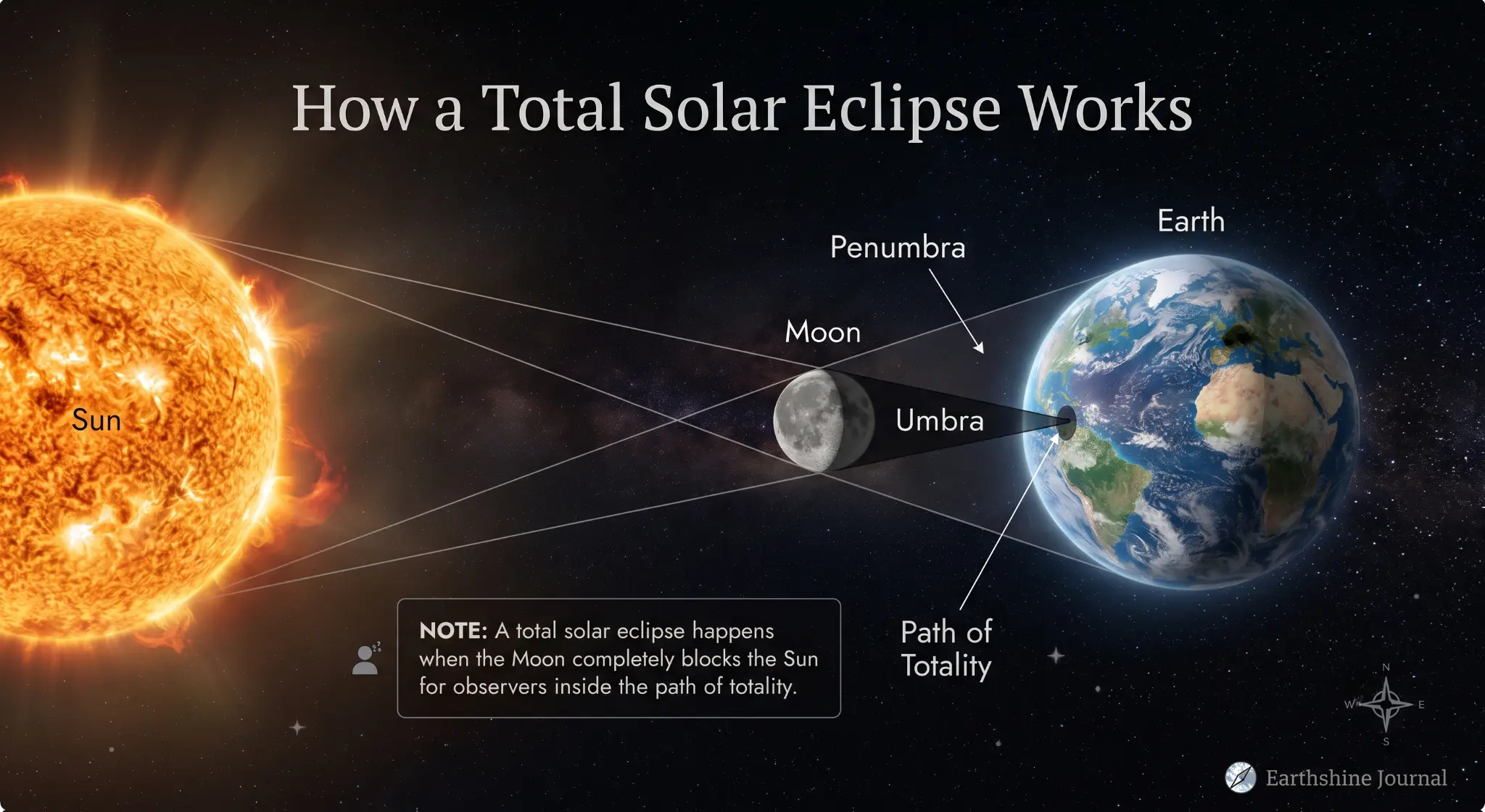
A total solar eclipse works because of one of the more improbable coincidences in the solar system. The Sun is roughly 400 times wider than the Moon. It is also, give or take, 400 times farther away. Those two facts cancel each other out so neatly that from Earth’s surface the two disks look almost identical in apparent size. Not exactly, the match isn’t perfect, and it varies slightly depending on where the Moon sits in its elliptical orbit, but close enough that when the Moon slides in front of the Sun, it covers the solar disk almost precisely.
For this August eclipse, the Moon will pass its closest orbital point to Earth (called perigee) about 2.2 days before the eclipse date. That means it is running slightly large in the sky, with an apparent disk fractionally bigger than the Sun’s, which is why totality is possible at all. If the Moon were at its farthest orbital point instead, it would look slightly smaller than the Sun and leave a bright ring visible around the edges. That’s called an annular eclipse. Close, but completely different experience. No corona. No stars appearing. No crying.
Once alignment is achieved, the Moon’s shadow, ‘the umbra’, the deepest part, hits Earth’s surface and races across it at roughly 3,400 km/h. That’s about 2,110 mph. It starts at sunrise in the Taymyr Peninsula of Siberian Russia, arcs over the top of the world, crosses eastern Greenland, touches down on western Iceland, skips across the open Atlantic, and arrives in the early evening over Galicia on Spain’s northwestern coast. It ends at sunset near Mallorca in the Mediterranean.
This results in just under two minutes of darkness in Iceland, and less than 90 seconds for most places across Spain. By the strict mathematical metrics of eclipse-chasing, that is incredibly brief. But none of that matters. Nobody who actually stands within the sweep of the umbra will ever tell you it felt short.
The reason people react the way they do, encompassing the crying, the silence, and the strange feeling of dislocation, is not fully agreed upon, honestly. Part of it is probably the sheer physical weirdness of the light changing in a way the brain has no reference for. Not like dusk, not like a storm rolling in. Something else entirely. Temperatures drop noticeably. Animals go quiet or behave the way they do at dusk. And then there is the corona, the Sun’s outer atmosphere that is ordinarily invisible because the solar surface is too bright, which suddenly blazes into view as a structured halo of pale white light. It doesn’t look like a photograph of the corona. Photographs flatten it. In person it has depth, texture, threads that reach outward into the dark.
Two minutes of that. Less, for most places in Spain. And then it’s over.
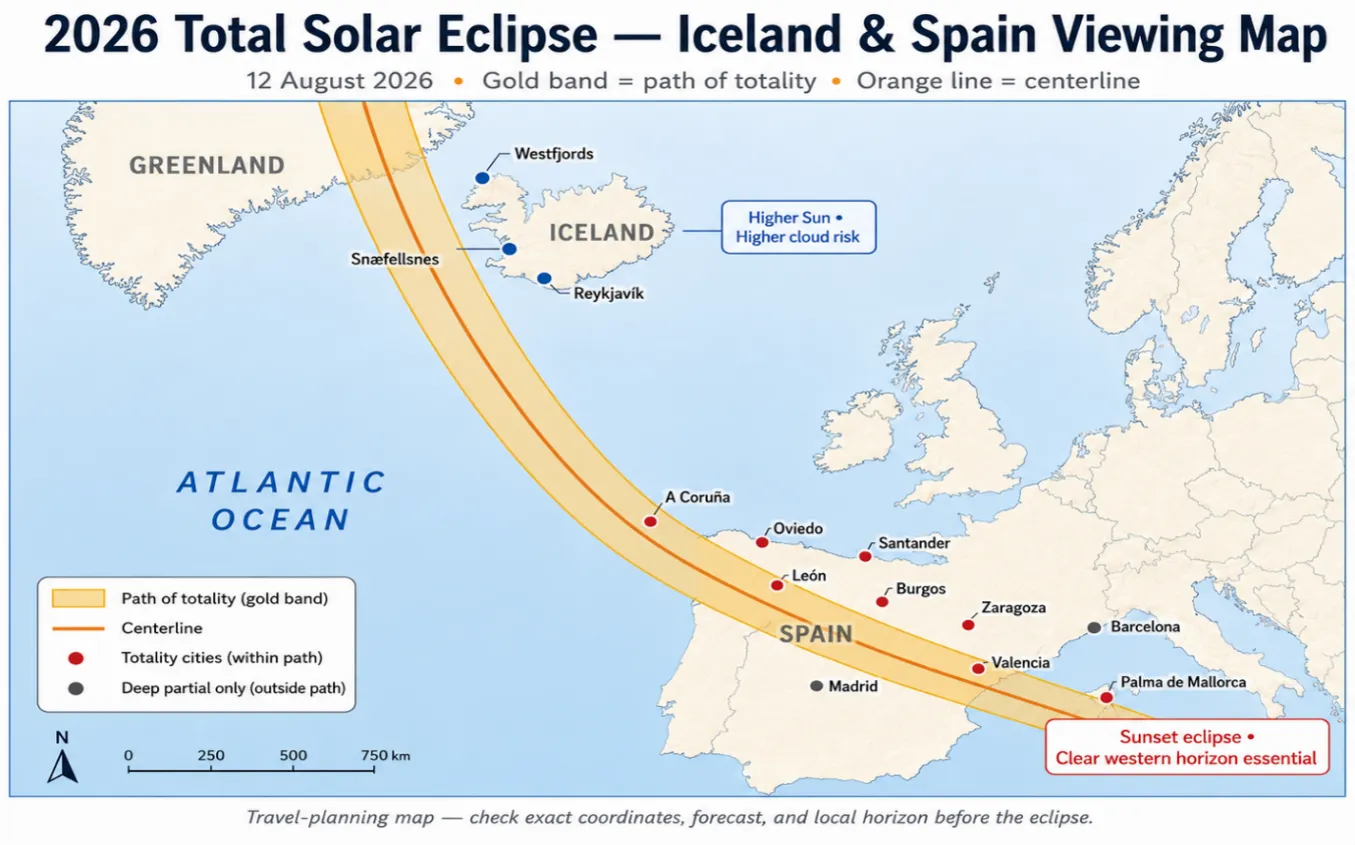
For high-precision scientific coordinates, check NASA’s official eclipse map.
When Was the Last Total Solar Eclipse in Europe?
A number worth sitting with:
The last total solar eclipse visible from mainland Europe was in August 1999. Before that, 1961. For Iceland specifically, this is the first total eclipse since June 30, 1954 — and the only one the island will see in the entire 21st century. Next one for Iceland: 2196. Spain’s last total eclipse was in 1905. These aren’t scheduling conflicts you can work around.
Bonus Astronomy Event: The 2026 Perseid Meteor Shower Peak
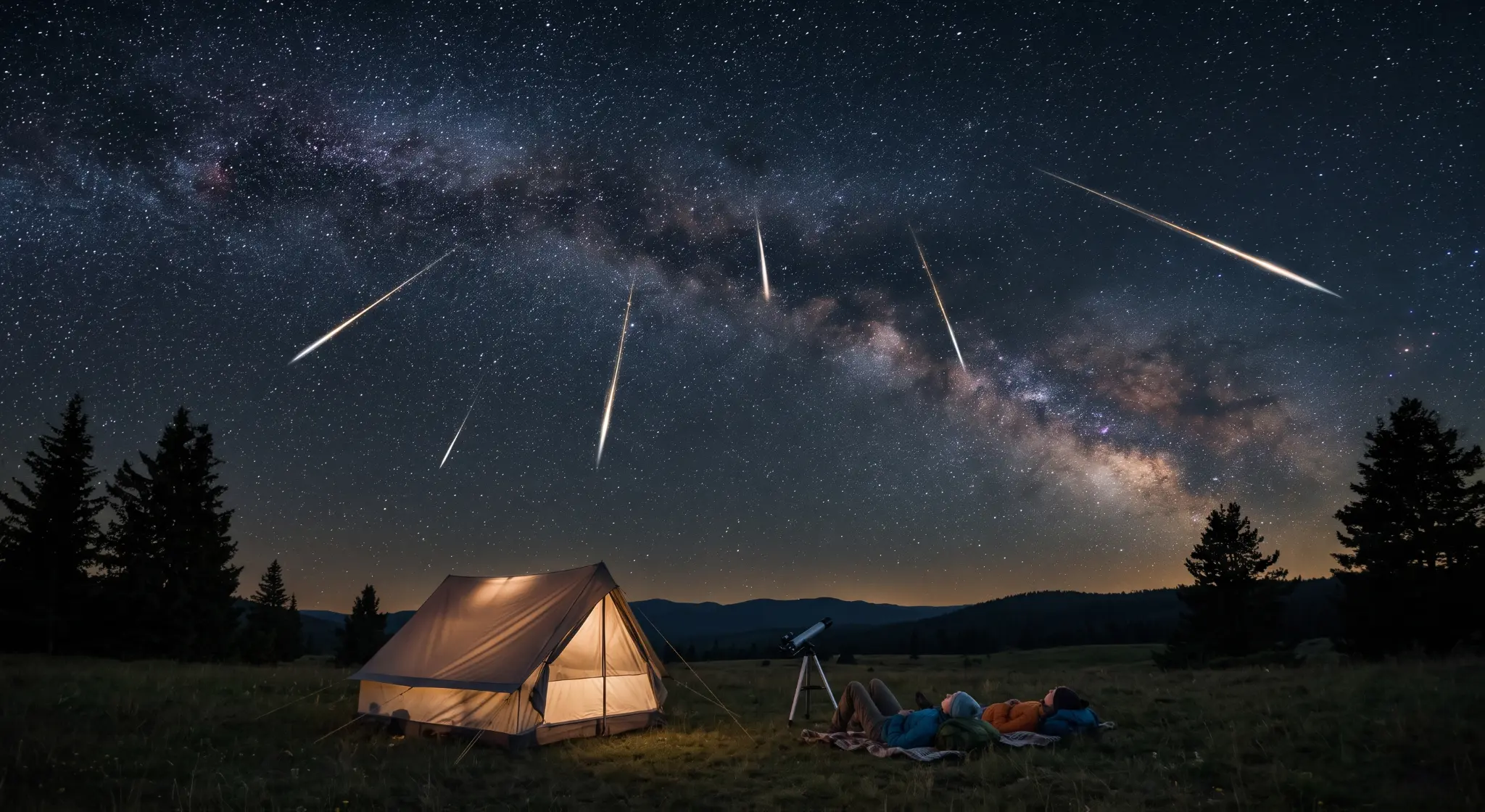
There is something extraordinary happening the night of the eclipse that doesn’t get mentioned often enough. August 12 falls right at the peak of the annual Perseid meteor shower. The Perseids are reliable — Earth passes through the debris trail of Comet 109P/Swift-Tuttle every year around mid-August, and rates of 50 to 100 meteors per hour are normal under dark skies at peak. The eclipse itself means a massive gathering of people in dark-sky territory, already looking up, on one of the best meteor nights of the year. That’s a coincidence worth planning around.
Best Places to View the 2026 Solar Eclipse: Iceland vs. Spain
Most people chasing this eclipse will choose between two countries. Greenland is technically in the path, as the shadow crosses eastern Greenland, but reaching the right part of Greenland involves a multi-leg journey that puts you close to polar research outposts, not hotels. So: Iceland or Spain.
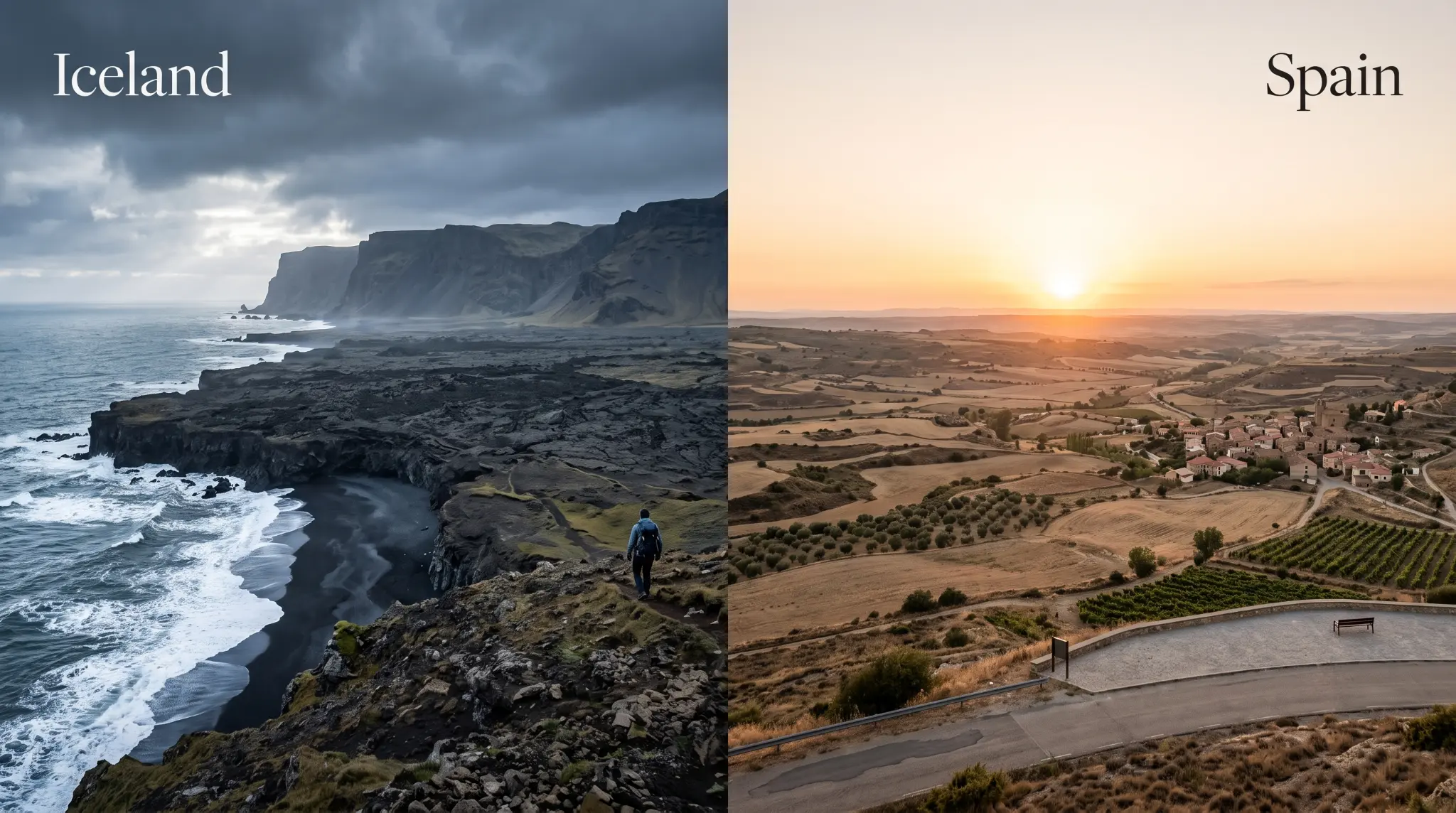
For most independent travelers, the decision comes down to Iceland or Spain. Neither is automatically the better choice: Iceland offers a higher Sun and extraordinary scenery, while inland Spain generally provides better historical weather prospects. The comparison below shows the practical trade-offs.
Iceland vs. Spain Comparison Table
| Comparison | Iceland | Northern Spain |
|---|---|---|
| Weather prospects | Higher historical cloud risk; flexibility is essential | Generally better inland, especially away from the Atlantic coast |
| Totality duration | About 1 minute in Reykjavík and close to 2 minutes in some centerline locations | Varies by location; some central areas receive around 1 minute 40 seconds or more |
| Sun position | Higher above the horizon, reducing the risk of terrain obstruction | Very low in the western sky; a completely open horizon is essential |
| Scenery | Volcanic landscapes, glaciers, lava fields and Atlantic cliffs | Coastlines, vineyards, plateaus, historic cities and semi-arid landscapes |
| Travel flexibility | A rental car or mobile tour is strongly recommended | Easier road access and more possible bases, though heavy traffic is likely |
| Best suited to | Travelers prioritizing dramatic scenery and adventure | Travelers prioritizing clearer-sky probability and easier logistics |
Which Destination Should You Choose?
Choose inland Spain if your main priority is improving your statistical chance of a clear view and retaining access to multiple possible observing locations by road.
Choose Iceland if the surrounding landscape is a central part of the experience and you are willing to accept greater weather uncertainty, rent a vehicle or join a mobile tour, and adjust your location shortly before the eclipse.
Whichever country you choose, do not select a site using totality duration alone. A slightly shorter eclipse beneath a clear sky is more valuable than a longer eclipse hidden behind clouds.
Once you have chosen your target country, executing a successful viewing strategy requires knowing exactly where the shadow lands and how the local geography behaves. Let’s look at the specific routes, timings, and environmental conditions for both destinations.
Western Iceland Totality: Path, Timing, and Weather Strategy
The Moon’s umbra makes its first landfall in Iceland at Straumnes Lighthouse in the Westfjords at 5:43 PM local time, then sweeps south across the Snæfellsnes peninsula, through Reykjavík, and off the Reykjanes volcanic ridge into the sea. In Reykjavík the partial phases start around 4:47 PM, with totality arriving at about 5:48 PM and lasting nearly two minutes near the centerline.
What Iceland offers is genuinely unmatched as a backdrop. Black lava fields. Glaciers visible on the horizon. The same volcanic ridge that’s been erupting intermittently for the past few years sits right in the eclipse path — there’s something almost theatrical about watching the sky go dark over a landscape that’s still actively being made.
The problem is clouds. This is not a minor concern. Iceland sits in the path of the North Atlantic’s primary storm system, and according to Eclipsophile’s 2026 eclipse climatology data, average cloud cover across the island in August runs between 70 and 80 percent. Even on days that start clear, convective cloud can build along peninsula ridgelines by afternoon. The leeward sides of the Westfjords and Snæfellsnes tend to open up when the wind is right, but that requires luck and flexibility in equal measure.
The strategy most eclipse veterans recommend for Iceland: stay mobile. Book somewhere near the path, get a car, watch the forecast obsessively in the 48 hours before, and be willing to drive an hour or two for a gap in the cloud. That is genuinely doable. Iceland’s eclipse path is narrow but accessible, and the island isn’t that big. What it isn’t is relaxing.
Northern Spain Sunset Eclipse: Path, Times, and Duration
Spain gets the eclipse at sunset. The shadow enters over Galicia around 8:26 PM local time and sweeps eastward across the northern half of the country, reaching the Balearic Islands around 8:32 PM. Depending on where you stand, the Sun will be somewhere between 2 and 12 degrees above the western horizon when totality hits. That’s low. Low enough that a single medium-sized building, hill, or line of trees in the wrong direction can block the view entirely. Site selection matters more here than it does for any high-altitude eclipse.
2026 Eclipse Path: Which Spanish Cities are in Totality?
The path crosses a long list of cities: A Coruña, Oviedo, Santander, León, Burgos, Vitoria-Gasteiz, Logroño, Zaragoza, Castellón, Valencia, Palma de Mallorca. Madrid misses it. Barcelona misses it. Both sit just south of the totality band and will get a very deep partial eclipse, the sky will dim significantly, but no corona, no totality, no stars.
Totality durations vary a lot depending on where in the path you are. The longest stretches in Spain sit near the centreline around Oviedo, Palencia, and Burgos — roughly 1 minute 45 seconds to 1 minute 49 seconds. Zaragoza, further along the path, gets about 1 minute 25 seconds. Valencia about one minute. Mallorca around 1 minute 36 seconds, with the Sun barely 2.5 degrees above the sea.
Weather Strategy: Where are the clearest skies in Spain?
Weather is the real deciding factor for where in Spain to position oneself. The northern Atlantic coast, including Bilbao, Santander, A Coruña, and the whole Asturias–Cantabria stretch, carries a cloud risk of around 60% in August. Beautiful scenery but an unreliable sky. Cross the Cantabrian Mountains and things change sharply. The Castilian plateau, where Burgos and Palencia sit, offers over 80% clear-sky probability in August. Zaragoza and the Ebro Valley are consistently cited as the single best weather bet on the entire Spanish path, with cloud probability below 30% and historical data showing clear conditions on 18 of the last 21 August 12ths. The trade-off is a slightly lower Sun altitude and shorter totality. Whether that trade is worth it depends on how much you trust a weather forecast four weeks out.
Most Scenic Eclipse Viewing and Photography Spots
For something more scenic than the Ebro Valley’s flat plains, the Bardenas Reales in Navarra, a semi-arid badlands landscape that looks almost Martian, sits close to the centreline with similarly good weather odds and a vast flat horizon. La Rioja’s vineyards are also in the path. The Albufera Natural Park south of Valencia, a flat lagoon reserve, offers an open western view over water. Mallorca’s west coast, if you find a raised viewpoint with nothing blocking the horizon toward the sea, will produce an image that probably doesn’t need a filter.
What to Expect During Totality: A First-Timer’s Guide
This part is for people who haven’t watched a total solar eclipse before, because the first-timers usually say nobody warned them what to expect.
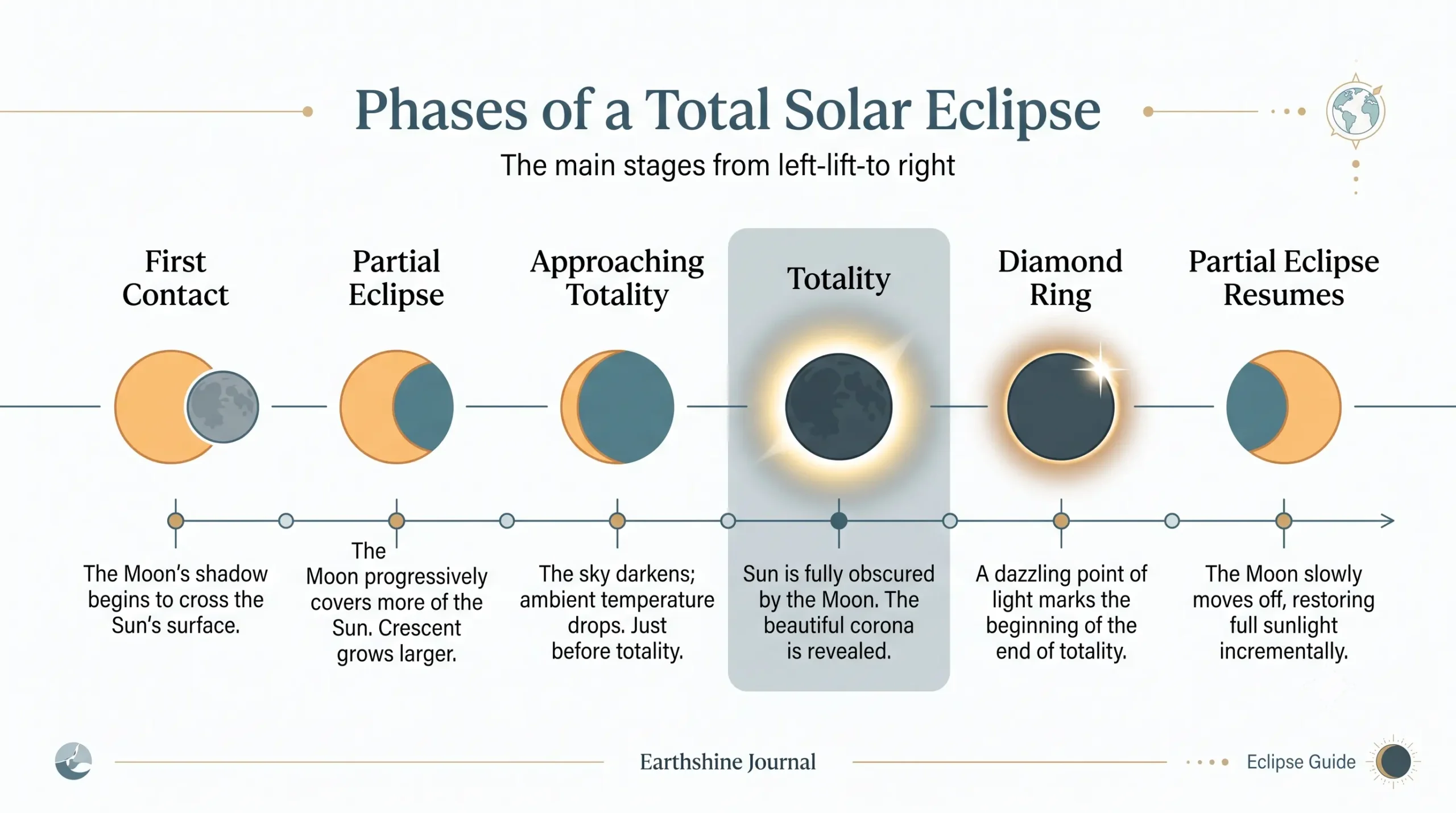
An hour or so before totality, give or take depending on your position in the path, the Moon begins crossing the Sun’s disk. Without eclipse glasses you wouldn’t notice at first. The light changes subtly, softening rather than dimming, and the brain adjusts for it the same way it adjusts to clouds passing overhead. Birds sometimes head toward roosts early. Insects quiet down. Dogs get uncertain.
The ten minutes before totality are different. The air cools. Shadow bands, which are rippling interference patterns caused by atmospheric refraction, may appear on pale flat surfaces. The horizon in every direction takes on a reddish glow, a 360-degree sunset that has nothing to do with where the Sun actually is. And the light, the light turns a color that really doesn’t have a name. Photographers describe it as silver. That’s not quite right. It’s more like the light has had something removed from it.
Then totality. The corona appears, the Sun’s outer atmosphere, normally washed out by daylight, visible now as pale structured threads extending outward into the dark sky. During this eclipse Venus will be clear in the southwest. Mercury and Jupiter should appear to the west. Depending on how dark the totality runs, Arcturus, Vega, and Capella may emerge. The temperature drop is noticeable, in the range of 5 to 10 degrees Celsius in some locations, though this varies.
Then it ends. Quickly. The diamond ring effect, which is a single point of solar light blazing through a lunar valley as the Moon begins to slide away, is the signal. The corona vanishes. The sky returns. And the crowd, wherever you are, makes a sound.
2026 Solar Eclipse Travel and Safety Checklist
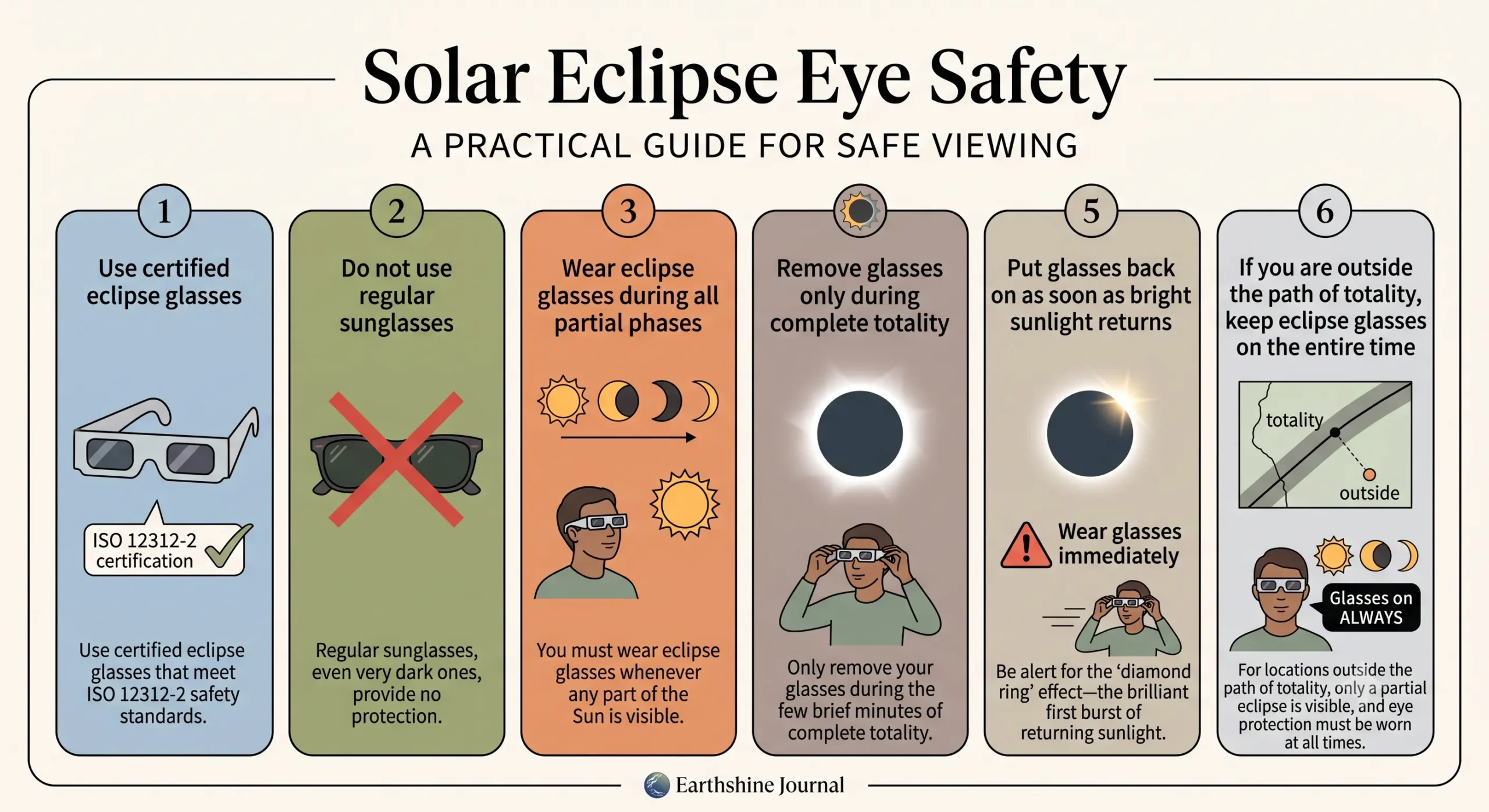
Eclipse glasses. ISO 12312-2 certified. Not regular sunglasses, those are not safe for looking at the Sun during the partial phases, regardless of how dark they are. Bring more than you need. You will give some away and feel good about it.
Get to your spot early. The eclipse falls on a Wednesday in August, peak summer season, in some of the most tourist-dense parts of Europe. The path cuts through Mallorca, Valencia, and the Basque coast, not exactly off the beaten track. Roads will be at capacity. If you’ve picked a specific viewpoint, especially an elevated one with a clear western horizon — assume other people have picked it too and arrive accordingly.
Book accommodation with free cancellation where possible, especially if you’re going to Iceland or the northern Spanish coast. The weather variable is real and the willingness to reposition, even just 60 or 90 kilometers, can be the difference between totality and a gray sky. A rental car isn’t optional for Iceland. For Spain it’s strongly recommended.
One last thing and it’s the one eclipse chasers say most consistently: don’t spend totality looking through a camera. Use the partial phases for photography. During totality, watch it. The corona does not look the way it looks in photographs. No image, not even a very good one, replicates the three-dimensionality or the sense of scale. The camera can wait two minutes. You cannot undo the experience of having stared at your screen while the sky went dark around you.
The Date Is Set
August 12, 2026. The shadow enters Iceland at 5:43 PM local time and leaves Spain’s coast sometime after 8:32 PM. It does not pause, does not extend itself for latecomers, does not offer a second pass. The Moon’s orbital mechanics are not negotiable.
Iceland’s last total eclipse was 1954. The next one, for anyone currently alive, won’t come in their lifetime. Spain hasn’t seen one since 1905. Those facts were always true. They just feel different now that the date is six weeks away.
Pick a side. Book the car or prep your off-grid setup. Find somewhere with a flat horizon to the west and nothing blocking it. Arrive early enough to stop worrying about logistics.
The rest will take care of itself.
Frequently Asked Questions About the 2026 Total Solar Eclipse
The eclipse will occur close to sunset in Spain. Depending on the location, the Sun may be only a few degrees above the western horizon during totality.
A hill, building, mountain ridge or line of trees could therefore block the eclipse completely. Travelers should inspect their site in advance and choose an unobstructed view toward the west or west-northwest.
Yes. The eclipse falls exactly during the peak of the Perseids. Because the eclipse coincides with a New Moon, the sky will be perfectly dark, offering excellent conditions to view meteors later that night.
You must wear certified solar glasses during all partial phases when any sliver of the bright Sun is visible. You can safely remove them only during the brief minutes of complete totality when the Sun is entirely covered.
As soon as the bright solar surface begins to reappear, eye protection must be put back on immediately. Anyone observing from outside the path of totality must keep proper solar-viewing protection on throughout the entire eclipse.
Yes, but you must use a certified solar filter over your camera lens during all partial phases to avoid permanent sensor damage. Remove the filter only during the brief window of totality, but consider keeping photography simple so you can experience it live.
Plan to arrive several hours early. The eclipse takes place during peak August summer tourism on major routes like Mallorca and the Basque coast, meaning roads and scenic overlooks will hit maximum capacity quickly.
Yes, much of Europe and parts of North America and Africa will see a partial solar eclipse. However, a partial eclipse is fundamentally different from totality. Only observers inside the path of totality will see the solar corona, the fully darkened Sun and the most dramatic changes in the surrounding sky.