

Two black holes in orbit around each other lose energy, spiral inward, and eventually merge into a single larger black hole. That much is simple. What happens when black holes collide gets strange in the accounting.
On 14 September 2015, detectors in Louisiana and Washington State recorded the final moments of two black holes of roughly 36 and 29 solar masses. The black hole they became weighed about 62 solar masses, not 65. The missing three solar masses did not go anywhere in the ordinary sense. It was converted into gravitational waves and radiated away as ripples in the shape of spacetime itself.
For a fraction of a second, the power flowing out of that collision was more than ten times the combined light output of every star in every galaxy in the observable universe. It produced no light at all.
When black holes collide, what is actually colliding?
Two black holes do not collide in the way two rocks do, because there is nothing solid to make contact.
A black hole is a region where gravity is strong enough that nothing, including light, can escape. Its boundary is the event horizon, which is not a surface but a location: the point beyond which every possible path leads inward. There is no material there to crash.
When two of them orbit closely, general relativity says the orbit itself radiates energy as gravitational waves. Losing energy means the orbit tightens, which makes them orbit faster, which radiates energy faster. The process runs away. Over millions of years the inspiral is imperceptible, and in the final second the two objects sweep around each other dozens of times before their horizons merge into one.
What emerges is a single black hole that briefly wobbles, like a struck bell, before settling into a smooth stable shape. That final wobble is called the ringdown, and it is visible in the data.
Three Suns’ worth of mass became pure spacetime ripple
The energy released is the part worth slowing down for, because it is hard to place on any familiar scale.
In the 2015 event, catalogued as GW150914, about 3.0 solar masses were radiated as gravitational waves, roughly 5.4 × 10^47 joules. That is mass converted directly into energy, the relationship Einstein wrote down in 1905, applied at a scale nothing else in the universe reaches.
The peak power matters more than the total. LIGO’s estimate is that in the final moments the collision radiated more than ten times the power of all the light from all the stars and galaxies in the observable universe, combined.
And none of it was light. All of that energy went into distorting the geometry of space, spreading outward at the speed of light. It passed through the Earth in a fraction of a second, briefly changing the distance between everything, including you, by an amount far too small to notice.
What a gravitational wave physically does
A gravitational wave stretches space in one direction while squeezing it in the perpendicular direction, and then reverses, over and over.
Picture a circle of floating dots. As the wave passes through the page, the circle is pulled into an ellipse taller than it is wide, then back through a circle, then into an ellipse wider than it is tall. That oscillation is the wave. It is not something moving through space. It is a change in the distances that define space.
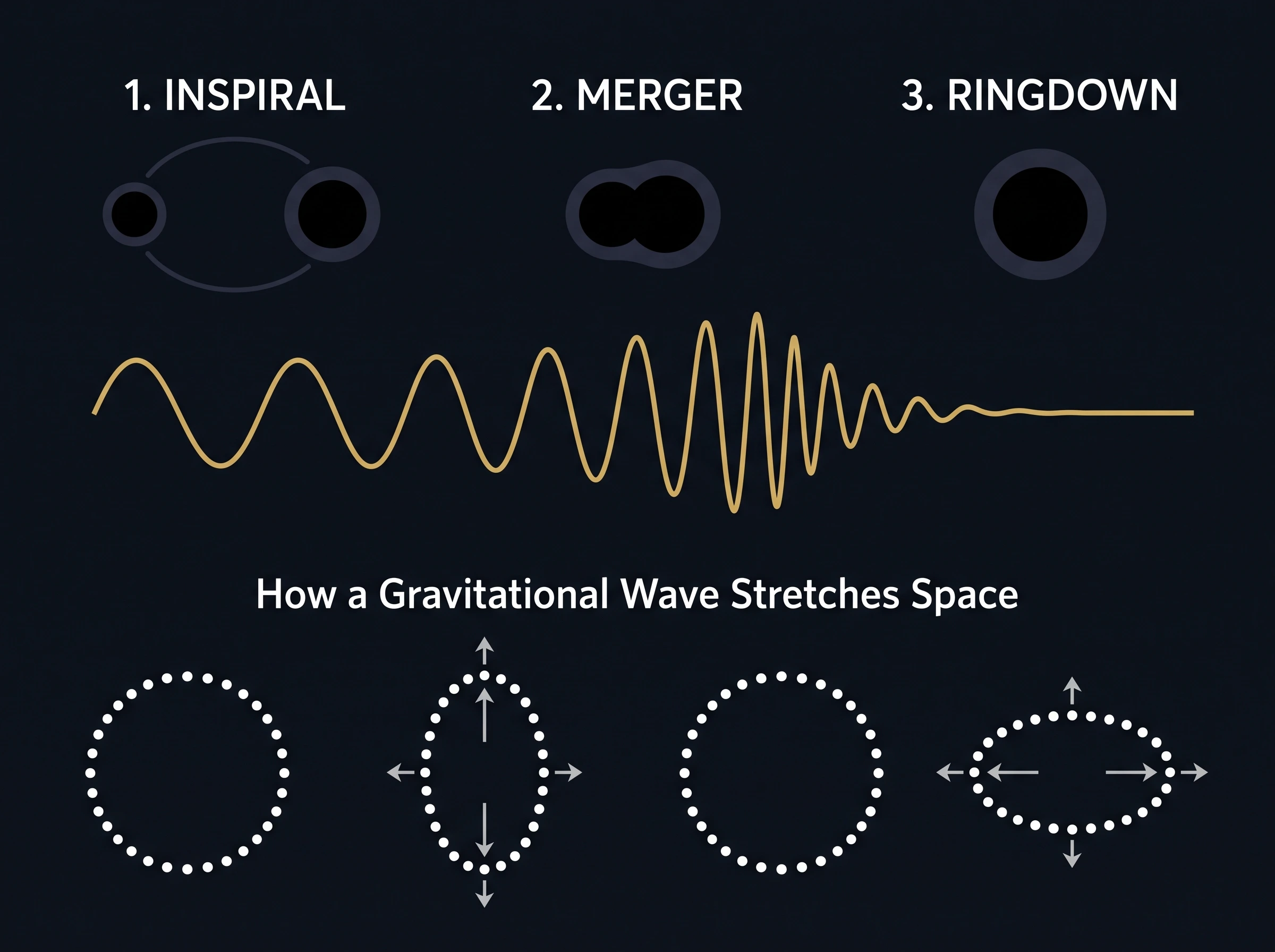
As two black holes spiral together and merge, the resulting gravitational wave rhythmically stretches space in one direction while compressing it in the perpendicular direction.You have probably met the bowling ball on a trampoline analogy, and it is worth being honest about what it does and does not show. It illustrates one real idea well: mass curves the geometry around it, and other objects follow that curvature. What it cannot show is a gravitational wave, and it has a circular flaw that is easy to miss. The bowling ball only makes a dent because Earth’s gravity is pulling it down into the rubber. The picture explains gravity by assuming gravity.
For waves, the stretching circle of dots is the better picture, because it shows the thing that actually happens: distance itself changing, rhythmically, in two perpendicular directions at once.
How you measure a change smaller than a proton
The detection problem is the reason it took a century between Einstein’s prediction and the first measurement.
LIGO is two enormous L-shaped interferometers, one at Hanford in Washington State and one at Livingston in Louisiana, each with two arms 4 kilometres long. A laser beam is split, sent down both arms, bounced back by mirrors at the ends, and recombined. If both arms are exactly the same length the recombined beams cancel out and the detector sees darkness.
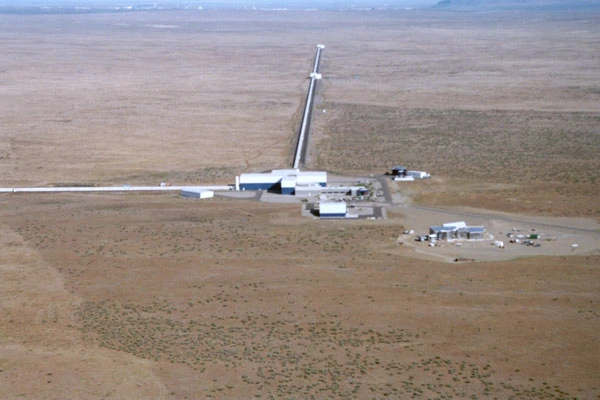
A passing gravitational wave lengthens one arm and shortens the other. The beams no longer cancel perfectly, and light appears where there should be none.
The scale of that change is the difficult part. LIGO is built to detect a strain of about one part in 10^21. Over a 4 kilometre arm that is a length change of roughly 10^-18 metres, about a thousand times smaller than the width of a single proton.
The comparison LIGO uses is the clearest one available: it is like measuring the distance to the nearest star, 4.2 light years away, and detecting a change the width of a human hair.
This is also why there are two detectors far apart. A truck, a quarry blast or a minor earthquake will shake one site. A genuine gravitational wave sweeps past at the speed of light and appears at both, separated by the light travel time between them. In the 2015 detection, the Livingston instrument registered the signal about 7 milliseconds before Hanford, which is consistent with a wave crossing the continent at light speed and also gives a rough idea of the direction it came from.
The count is no longer 90
If you have read that LIGO has detected around 90 mergers, that figure is several years out of date, and the current picture is a different kind of science.
The first three observing runs, between 2015 and 2020, produced about 90 confident detections in total. That number appears in a great deal of published material and it is the one most people know.
The fourth observing run changed the scale. The GWTC-4.0 catalogue, released in August 2025, covers only the first segment of that run, from 24 May 2023 to 16 January 2024. That segment alone yielded 128 candidate compact binary mergers identified with a probability of astrophysical origin of at least 0.5, of which 86 met the stricter threshold of a false alarm rate below one per year.
One partial run more than matched everything found in the previous decade. The full fourth run finished in November 2025, and the remaining segments are still being analysed, so the total will rise again.
That shift matters for what the field can do. A handful of detections is a discovery. Hundreds is a population, and a population can be used to ask statistical questions: how black holes of different masses are distributed, how often they pair up, how they form in the first place.
The one that came with light
Not every detection is two black holes, and the exception opened an entirely new way of observing.
On 17 August 2017, LIGO and Virgo recorded GW170817, produced by two merging neutron stars rather than black holes. Neutron stars have surfaces and material, so unlike a black hole merger, this one was expected to be visible.
About 1.7 seconds after the merger, the Fermi space telescope detected a short gamma-ray burst from the same part of the sky. Telescopes worldwide turned to look and found a fading optical and infrared source in the galaxy NGC 4993, roughly 40 megaparsecs away.
What they were watching was a kilonova: a glow powered by the radioactive decay of newly created heavy elements. The merger had synthesised elements through rapid neutron capture, the process that produces gold, platinum and much of the rest of the periodic table beyond iron.
That single event confirmed that neutron star mergers are a major source of the heaviest elements in the universe. The gold in a wedding ring was very probably made in a collision like that one.
It also established multi-messenger astronomy: the same event observed through gravitational waves, gamma rays and visible light at once. Each carries information the others do not.
| Event | Date | What merged | Why it mattered |
|---|---|---|---|
| GW150914 | 14 Sep 2015 | Two black holes, ~36 and ~29 solar masses | First direct detection of gravitational waves |
| GW170817 | 17 Aug 2017 | Two neutron stars | First event seen in both gravitational waves and light |
| GWTC-4.0 | Aug 2025 | 128 candidates from one run segment | Detection became routine enough for population studies |
What all of this has actually taught us
The results have been less about confirming Einstein than about finding objects nobody expected.
General relativity passed, which was the headline in 2016 but was also the expected outcome. The waves arrived with the predicted shape, the inspiral and ringdown matched the models, and they travelled at the speed of light.
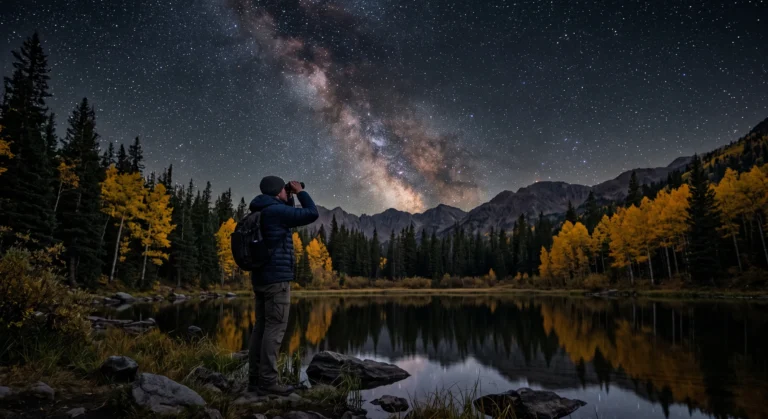
The surprises were in the black holes themselves. Before 2015, the stellar-mass black holes known from X-ray observations inside our own galaxy—the same Milky Way band you can photograph from a dark campsite—were typically around ten solar masses. The very first detection involved objects of 36 and 29, heavier than the models comfortably allowed, and heavier examples have followed. How stars produce black holes that large, and how those black holes find each other and pair up, is now an open and active question.
There is also a limit worth stating plainly. Gravitational wave astronomy sees a specific and violent class of event: compact objects merging. It is deaf to almost everything else in the universe. What it provides is not a better telescope but a different sense, and for a century it was one we did not have.
Written from published LIGO, Virgo and KAGRA collaboration material on what happens when black holes collide, including the GW150914 detection papers, the GWTC-4.0 catalogue released in August 2025 and the multi-messenger observations of GW170817. Detection totals reflect published catalogues as of 28 September 2026 and will increase as the remaining fourth observing run data is analysed.