

You do not need a telescope for any of this, and you do not need to learn eighty-eight constellations. For the autumn constellations in the northern hemisphere you need one shape, and everything else hangs off it.
That shape is the Great Square of Pegasus, four stars in a large, obvious rectangle in the eastern sky on autumn evenings. Find it once and you can reach the Andromeda Galaxy, the nearest large galaxy to our own, using nothing but your eyes and a sequence of short hops.
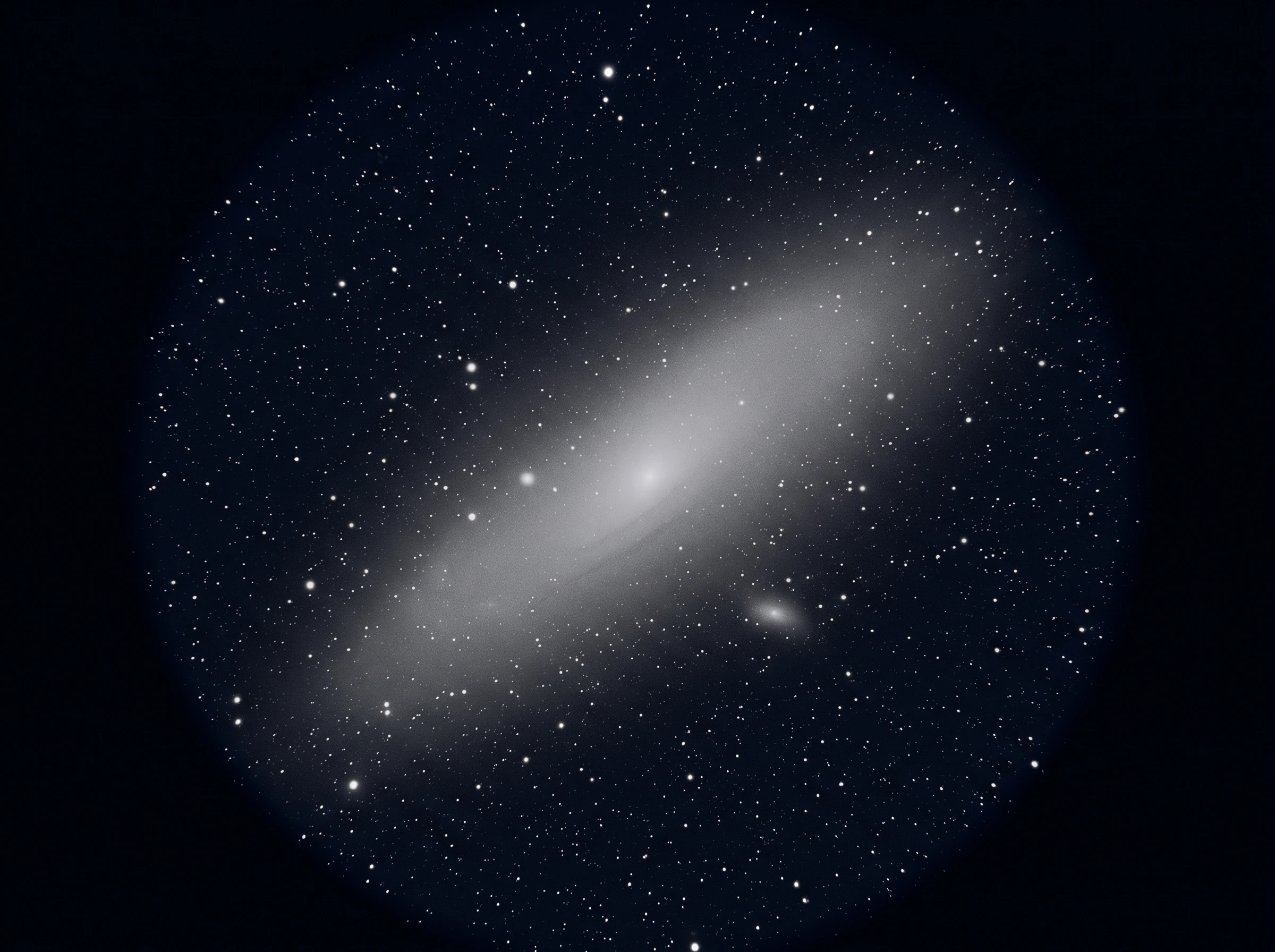
One thing worth knowing before you start, because it is the single most common reason beginners fail to find Andromeda: it is not a dot. It is a faint elongated smudge roughly three to four times the width of the full Moon. People scan the sky looking for a small fuzzy star and pass straight over something much larger and dimmer than they expect.
This guide is written for mid-northern latitudes, roughly the United States, Europe and northern Asia. If you are in the southern hemisphere these objects sit low or below your horizon and the advice does not transfer.
Start with the Great Square of Pegasus
The Great Square is the anchor for the whole autumn sky, and it is genuinely easy once you know what you are looking for.
Look east in the early evening during September and October, or high in the south later in the season. You are looking for four moderately bright stars forming a large square, tilted so it often reads as a baseball diamond standing on one corner. It is big. Held at arm’s length, the square is wider than your outstretched hand.
There are no bright stars inside it, which is part of what makes it recognisable. It is a conspicuous empty box.
Three of its corners are stars in Pegasus: Markab, Scheat and Algenib. The fourth, the northeastern corner, is Alpheratz, and Alpheratz is not in Pegasus at all. It belongs to the neighbouring constellation Andromeda. That is not a piece of trivia to file away. It is the doorway you will walk through in a moment, because Andromeda begins at that corner.
Cassiopeia is the W that tells you where north is
If you are ever lost in the autumn sky, Cassiopeia is the pattern to find first.
It is five bright stars in a clear W shape, or an M depending on the time of night, sitting in the northern sky. From mid-northern latitudes it is circumpolar, meaning it never sets. It is up every clear night of the year, just rotating around the pole.
The quickest route is from the Big Dipper. Find the two stars at the end of the Dipper’s bowl, follow the line they make to Polaris, the North Star, and keep going the same distance again on the far side. You land on Cassiopeia. The Dipper and Cassiopeia sit on opposite sides of Polaris, which is why when one is high the other is low.
Cassiopeia is useful for more than orientation. It sits in a dense part of the Milky Way, so even ordinary binoculars pointed anywhere near it will show far more stars than your eyes alone.
The star hop to the Andromeda Galaxy
This is the part worth getting right, because it is the most distant object a human being can see without equipment.
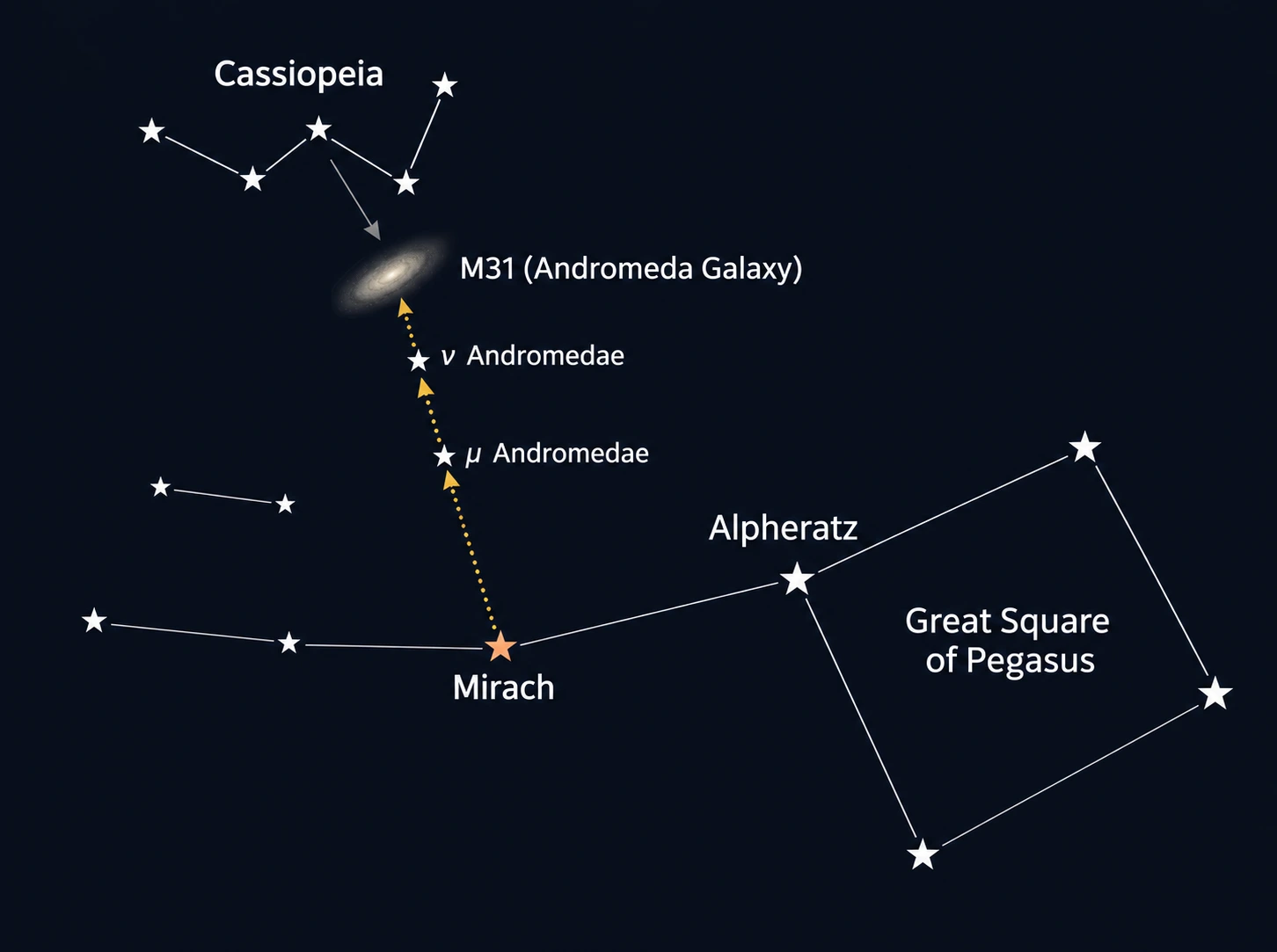
The route runs from the corner of the Great Square through two stars and out into empty-looking sky. Do it in this order:
- Find Alpheratz, the northeastern corner of the Great Square, the one nearest Cassiopeia. (EarthSky’s star hop follows the same route.)
- Spot the two streamers. From Alpheratz, two curving lines of stars trail away from the Square. These are the constellation Andromeda. Ignore the upper streamer and work along the lower one.
- Count two stars along to Mirach, a noticeably orange star.
- Go one star up from Mirach, at roughly a right angle away from the Square, to a fainter star called Mu Andromedae.
- Continue the same distance again. Extend the line from Mirach through Mu Andromedae, and travel the same distance past Mu as you travelled from Mirach to Mu. You are now on the galaxy.
If your sky is dark, you should see a faint oval glow. If you are not sure whether you are seeing it, look slightly to one side of where you think it is. The centre of your eye is poor in low light, and the technique of looking slightly off-target, called averted vision, makes faint objects appear noticeably brighter. Practised observers use it constantly.
Binoculars make this much easier and are worth using even if you eventually see it unaided. Through them the oval shape becomes obvious.
Why Andromeda is harder than its magnitude suggests
This trips up almost every beginner, and it is not your eyesight or your equipment.
The Andromeda Galaxy is listed at magnitude 3.4. That sounds bright: plenty of stars you can see easily from a suburban street are fainter than that. So why is the galaxy so difficult?
Because a magnitude is a total. For a star, all that light arrives from a single point, and a point source of magnitude 3.4 is easy. For the galaxy, that same total is spread across a patch of sky three to four times the width of the full Moon. Per unit area, it is very dim. The quantity that matters for an extended object is surface brightness, and Andromeda’s is low.
This has two practical consequences.
- The first is that darkness matters far more than magnification. Under a genuinely dark sky the galaxy is straightforward. From a city, roughly Bortle class 7 or worse, it is not visible to the naked eye at all and shows in binoculars only as a weak smudge, because the sky background is brighter than the object.
- The second is that moonlight ruins it. A bright Moon raises the sky background exactly the way light pollution does. Plan around the Moon: the week either side of new moon is what you want, and a full Moon will hide the galaxy even from a dark site.
The light you are looking at left that galaxy about 2.5 million years ago, which is worth a moment when you do find it.
If you are new to observing away from city lights, our beginner’s guide to stargazing and dark-sky camping explains how to find dark skies and get oriented after sunset.
Perseus, and a star you can watch change in one evening
Perseus is below and east of Cassiopeia, and it contains the best beginner project in the autumn sky.
The constellation itself is a scattered shape rather than a neat figure, easiest to find by following the W of Cassiopeia away from Polaris. Its brightest star is Mirfak.
The interesting one is Algol, and it is unusual because it visibly changes.
Algol is an eclipsing binary. Two stars orbit each other, and from our line of sight one passes in front of the other on every circuit, blocking part of its light. When that happens, Algol fades from magnitude 2.1, close to Polaris in brightness, down to magnitude 3.4, and then recovers. The fade takes a few hours and the whole cycle repeats every 2.87 days, with clock-like precision.
You can watch this happen in a single evening with no equipment at all. Compare Algol against nearby stars at the start of the night and again a few hours later, and the change is obvious. Predicted minima are published by astronomy magazines and apps, so you can pick an evening when one falls at a convenient hour.
It is a genuinely unusual experience, watching a star dim while you stand there. The name carries the history: Algol comes from the Arabic ra’s al-ghūl, the head of the demon, and the association with something unreliable or malevolent appears in several cultures. Nobody knew why it winked until the eighteenth century, but people had clearly noticed.
The other target in Perseus is the Double Cluster, two open star clusters sitting side by side, NGC 869 and NGC 884. They lie roughly halfway between Mirfak and Cassiopeia, appear to the naked eye from a dark site as a hazy patch in the Milky Way, and in binoculars resolve into two dense heaps of stars in the same field of view. They are around 7,100 and 7,400 light years away.
When to look for the autumn constellations
All of these are available across the whole autumn, but each is best placed at a different point in the evening.
| Target | Best months | Where to look, mid-evening |
|---|---|---|
| Great Square of Pegasus | September to November | East in September, high south by November |
| Cassiopeia | All year, highest in autumn | High in the north, overhead late autumn |
| Andromeda Galaxy | September to December | Near overhead in late autumn, which is when it is best |
| Perseus and Algol | October to January | Rising in the northeast, climbing through the night |
| Double Cluster | September to January | Between Cassiopeia and Perseus |
Late autumn is the sweet spot for Andromeda specifically. When an object is overhead you are looking through the least atmosphere, and that matters most for faint, diffuse things.
The practical part nobody mentions
Four things make more difference than anything you could buy.
| Give your eyes 20 minutes. Dark adaptation is a real physiological process and it is not instant. Most people glance up for two minutes, decide they cannot see anything, and go inside. Sit outside and wait. |
| Protect it. One look at a phone screen resets much of that adaptation. If you need light, use a red light, or at minimum turn the screen brightness to its lowest setting. |
| Check the Moon before you choose a night. A clear night with a bright Moon is worse for faint objects than a slightly hazy night with no Moon. |
| Use binoculars if you have any. Ordinary 7×50 or 10×50 binoculars, including ones bought for birdwatching, will show the Andromeda Galaxy, resolve the Double Cluster and transform Cassiopeia. For this particular set of targets they outperform a small telescope, because a wide field of view suits large faint objects better than high magnification does. |
Start with the Great Square tonight. Once that shape is fixed in your head, the rest of the autumn sky is a series of short walks from a landmark you already know.
Written from published observational references and star-hopping guides for the autumn constellations, including EarthSky, BBC Sky at Night Magazine and Sky & Telescope, together with standard catalogue data for the objects described. Positions are given for mid-northern latitudes and vary with your location and the time of night.