

At the bottom of the Mariana Trench the water pushes with about 110 megapascals of force, roughly 1,100 times the pressure at the surface. Animals live there anyway.
The usual explanation is that they have evolved to resist being crushed. That is not really what is happening. A snailfish at 8,000 meters is not holding pressure out. It has almost nothing inside it that pressure can squeeze, so the force passes straight through. The genuine problem is much smaller and much stranger: at those pressures, the molecules that run a living cell stop holding their shape.
That distinction explains nearly everything about how deep-sea creatures survive, including something the depths are rarely credited with having, which is a hard ceiling. There is a depth below which no fish has ever been found, and the reason is the same chemical trick that lets them get that deep in the first place.
Pressure does not crush deep-sea animals, because there is nothing to crush
Crushing needs something compressible, and most of a fish is not.
Water is very nearly incompressible. Squeeze it with the weight of eight kilometers of ocean and it gives up only a few percent of its volume. An animal made mostly of water, with no gas-filled spaces inside it, is in the same position. The pressure outside equals the pressure inside, and nothing collapses.
This is why deep-sea fish generally have no swim bladder, the gas-filled organ shallow fish use to control buoyancy. A gas pocket is compressible, so at depth it is a liability. Remove it and the crushing problem largely disappears.
It also explains something people find backwards. Animals hauled up quickly from the deep often arrive damaged, and it is the trip up that does it, not the depth. Nothing is crushed on the way down.
How deep-sea creatures survive comes down to proteins, not armour
What pressure actually attacks is shape, at the scale of single molecules.
Proteins do their jobs by folding into specific three-dimensional forms. Enzymes have to fit their targets, cell membranes have to stay fluid enough to function. High hydrostatic pressure pushes those structures toward more compact arrangements, and a protein forced out of its working shape stops working. The cell does not get crushed. It stops running.
So the adaptation that matters is chemical rather than structural. Deep-sea animals accumulate small molecules called organic osmolytes that stabilize proteins and counteract the effect of pressure. The most important one is trimethylamine N-oxide, usually shortened to TMAO.
TMAO is the same compound that gives fish its characteristic smell. In deep-sea species it is present at far higher concentrations, and the concentration rises steadily with depth. Work on amphipods sampled from shore down to the hadal zone found TMAO increasing more than any other osmolyte measured. Hadal snailfish from the Yap Trench carry much more TMAO in their muscle than shallow-water fish, and their genome contains multiple copies of the gene for the enzyme that produces it.
The molecule that lets fish live deep also stops them going deeper
This is the part that gets left out, and it is the most interesting thing about the hadal zone.
Almost no fish has ever been found below about 8,200 meters. With the rare exception of a solitary juvenile snailfish recently filmed at 8,336 meters, the deepest confirmed records stop there. Pseudoliparis swirei, the Mariana snailfish, has been recorded between roughly 6,198 and 8,078 meters. Notoliparis kermadecensis in the Kermadec Trench runs to about 7,669 meters. Below that band, trawls and landers bring up invertebrates and no vertebrates.
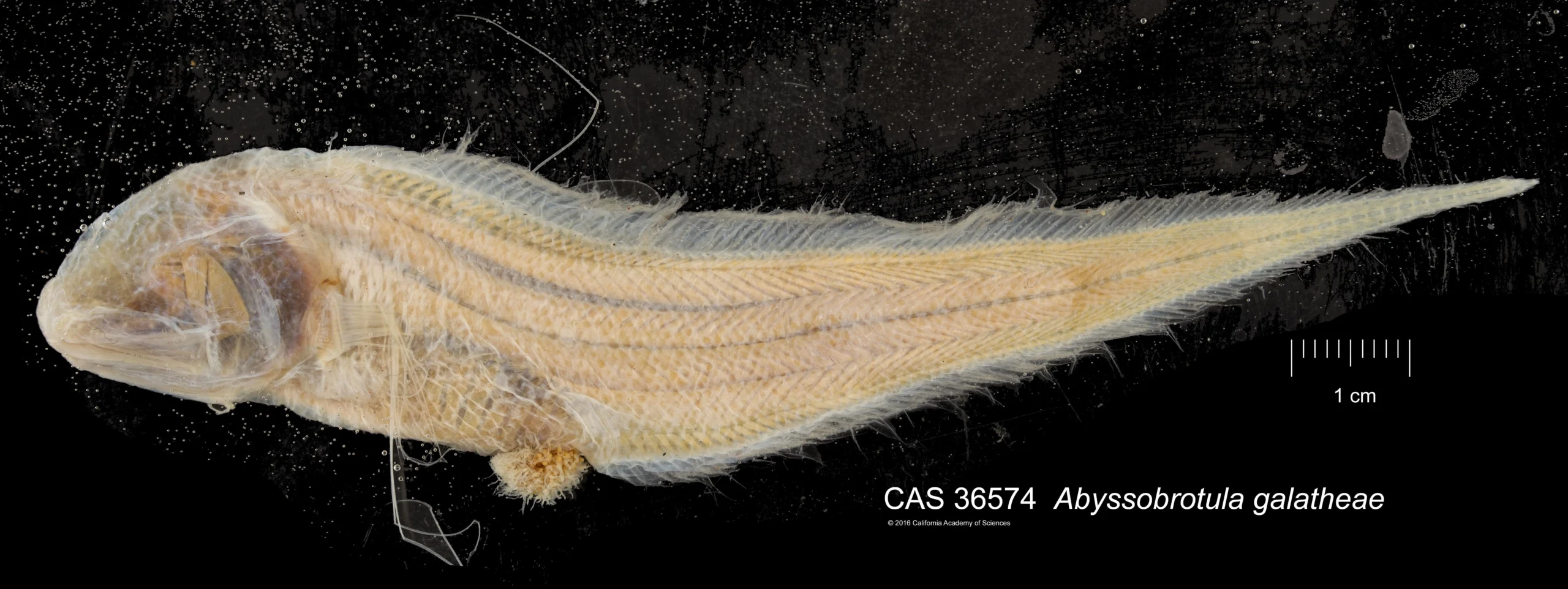
The leading explanation is that the fish are trapped by their own solution. TMAO is an osmolyte, which means it affects the balance of dissolved substances between the animal and the seawater around it. Pile in enough TMAO to stabilize proteins at 8,000 meters and the fish’s internal fluid approaches the same concentration as seawater. Go deeper and it would need more TMAO than that balance allows. The chemistry that makes 8,000 meters survivable is what makes 9,000 meters impossible.
That is a real physiological limit on vertebrates, in the ocean, discovered by noticing an absence. Recent genomic work suggests the full picture is broader than TMAO alone, involving gene regulation, metabolism and behavior, so treat the 8,200 meter figure as a well-supported boundary with an explanation that is still being refined.
Trenches themselves go far deeper. The Mariana Trench bottoms out near 10,900 meters. Those last three kilometers belong to invertebrates and microbes.
💡 Bottom Line: Deep-sea fish rely on TMAO to stop extreme pressure from destroying their proteins, but they cannot chemically accumulate enough of it to survive deeper than roughly 8,300 meters.
Where the pressure actually sits, zone by zone
Pressure rises by roughly one atmosphere for every 10 meters of depth, which makes the numbers easy to place.
| Zone | Depth | Approximate pressure | What is down there |
|---|---|---|---|
| Sunlight (epipelagic) | 0 to 200 m | 1 to 21 atm | Photosynthesis, most familiar fish |
| Twilight (mesopelagic) | 200 to 1,000 m | 21 to 101 atm | Some light, no photosynthesis, huge biomass |
| Midnight (bathypelagic) | 1,000 to 4,000 m | 101 to 401 atm | No sunlight at all, anglerfish, gulper eels |
| Abyssal (abyssopelagic) | 4,000 to 6,000 m | 401 to 601 atm | Seafloor across most of the ocean |
| Hadal | 6,000 m and below | 601 atm and up | Trenches only; snailfish to about 8,300 m |
The zone names are standard, and the light boundaries are approximate rather than sharp. Below roughly 1,000 meters no sunlight remains, and every photon an animal sees is made by something alive.
Glowing is not a deep-sea specialty, which is the opposite of what most accounts say
The best data on how common bioluminescence is produced a genuinely surprising result about depth.
Séverine Martini and Steve Haddock of the Monterey Bay Aquarium Research Institute published the first large quantitative survey in Scientific Reports in 2017. They went through 17 years of remotely operated vehicle video from Monterey Bay, more than 350,000 individual observations across 240 dives, from the surface down to about 4,000 meters, and scored each animal for whether its group is known to produce light.
The headline figure is that about three-quarters of all the animals observed were bioluminescent. Broken down by category, the numbers look like this:
- Fish and cephalopods (squid/octopus): Roughly 50 percent glowing
- Cnidarians (jellyfish and siphonophores): 97 to 99.7 percent glowing
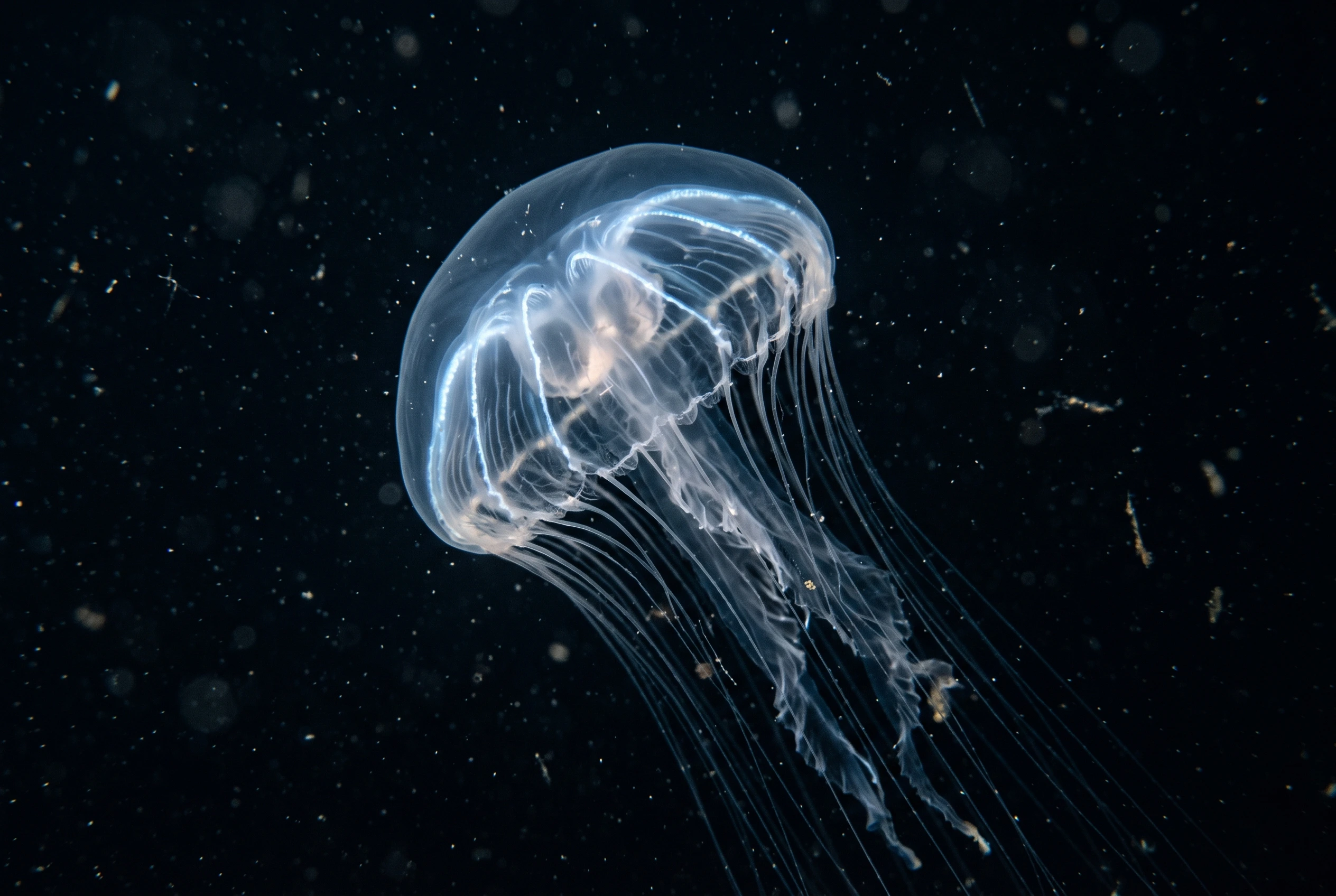
Here is the finding that matters. The proportion of glowing to non-glowing animals stayed roughly constant from the surface all the way to 4,000 meters. The absolute number of glowing animals falls with depth, but only because there are fewer animals of any kind down there.
That undercuts the standard story. If light production were an adaptation to darkness, the fraction of glowing animals should climb as sunlight disappears. It does not. Bioluminescence looks less like a deep-sea trick and more like an ordinary feature of ocean life that is simply easier to notice where there is no competing light.
Two caveats worth attaching. This is one region, Monterey Bay, and the scoring is by taxonomic group rather than by testing each individual animal. It is the best quantitative estimate available, not a global census.
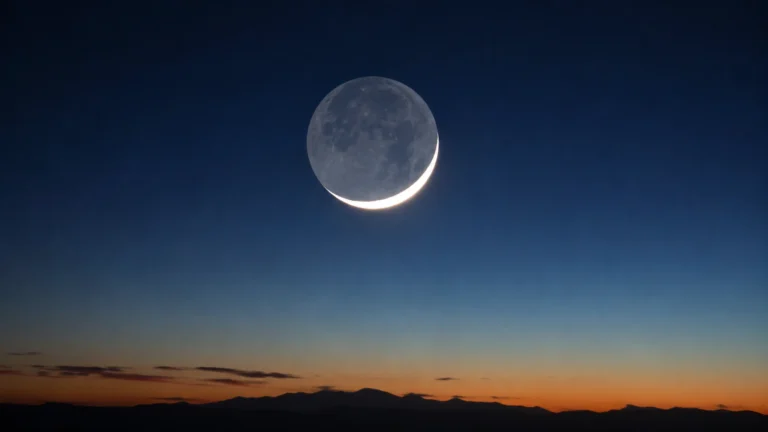
If you are fascinated by how light operates in complete darkness, you might also enjoy our guide to What Is Earthshine? The Mysterious Glow on the Moon’s Night Side.
The light itself is a chemical reaction, not a glow
Bioluminescence is a controlled chemical reaction that releases energy as light rather than heat.
The general form is simple. A molecule called luciferin is oxidized, an enzyme called luciferase drives the reaction, and the product emits a photon. “Luciferin” and “luciferase” are category names rather than single compounds, and different groups of animals use chemically different versions, which is one sign the ability evolved many separate times.
The result is sometimes called cold light because almost none of the energy is lost as heat. A deep-sea animal cannot afford a lamp that also warms it up and advertises it in infrared.
What the light is for varies. Counterillumination is the most elegant: an animal lights its underside to match the faint glow filtering from above, erasing its silhouette from anything looking up at it. Others use light to lure prey, as anglerfish do with a bacteria-filled organ on a modified fin spine, or to startle a predator, or to signal to their own species.
The deepest food webs never involve the sun
Some deep-sea communities are not living on leftovers from the surface at all.
Most of the deep ocean does eat sunlight indirectly, through marine snow, the slow fall of dead material from the productive layers above. Then in 1977 a joint French and American expedition to the Galápagos Rift found something else: hot mineral-rich water pouring from cracks in the seafloor, surrounded by dense clusters of clams and large tube worms in a place with no light and no marine snow to speak of.
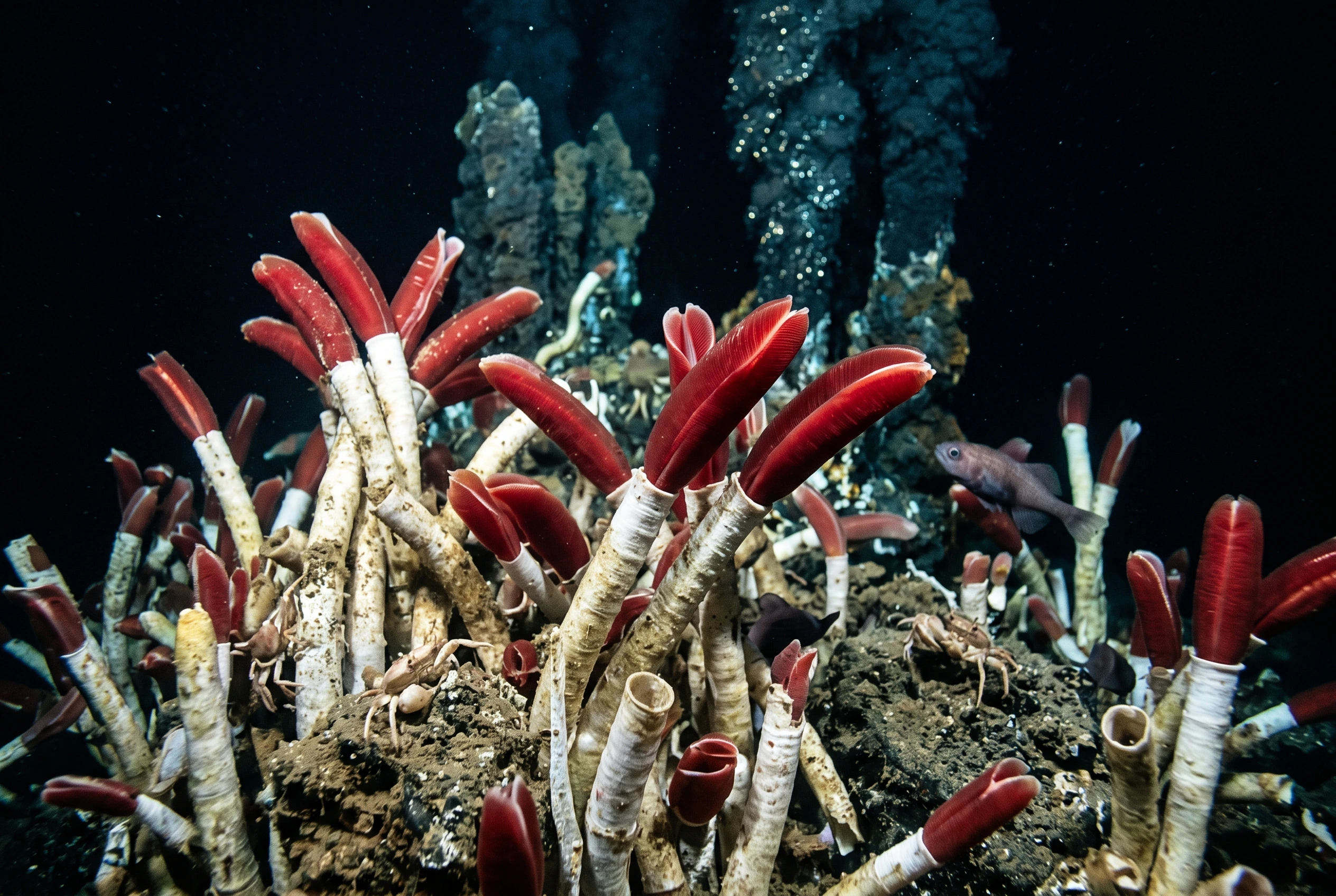
The base of that food web is chemosynthesis. Bacteria and archaea oxidize chemicals in the vent fluid, particularly hydrogen sulfide, and use the energy to build organic matter, exactly as plants use sunlight. Everything else at the vent feeds on that.
The giant tube worm Riftia pachyptila took it furthest. It has no mouth and no digestive system. Inside it is an organ called the trophosome packed with sulfur-oxidizing bacteria, and the worm supplies them with the raw materials while they feed it. It was the first animal shown to live by symbiosis with chemoautotrophic bacteria, described in Science in 1981.
That discovery mattered beyond marine biology. It established that a complete ecosystem can run with no connection to sunlight, which changed what counts as a plausible habitat.
💡 Bottom Line: Entire deep-sea food webs thrive without a single ray of sunlight by using chemosynthesis, a process where bacteria convert toxic vent chemicals into usable energy.
Why this shapes the search for life elsewhere
The vent ecosystems are the reason icy moons are taken seriously as places to look.
Europa and Enceladus are thought to hold liquid water oceans under ice, with rocky floors where similar chemistry could occur. Before 1977 an ocean sealed under kilometers of ice with no sunlight would have been dismissed. The Galápagos Rift showed that the sun is not a requirement, only a convenience.
That is an argument about possibility, not evidence of life. No organism has been found anywhere off Earth. What the deep sea provides is a worked example that the conditions are not disqualifying.
What we still have not looked at
The honest state of knowledge is that most of the seafloor has never been examined closely.
As of World Hydrography Day 2025, the Nippon Foundation-GEBCO Seabed 2030 project reported that 27.3 percent of the ocean floor had been mapped to modern resolution standards. That is mapping, not biological survey, and it is a considerable improvement on where the figure stood a decade ago. It still leaves roughly three quarters of the seafloor known only in rough outline.
The 8,200 meter fish limit was found by noticing what was missing from samples. It is worth wondering what else is currently missing simply because nobody has been there yet.
FAQ
Generally, no. While they will not explode or be physically crushed by a lack of pressure, the sudden temperature change and the expansion of dissolved gases in their blood as they are hauled up usually prove fatal.
es, many do. Even in the midnight zone, eyes are highly useful for spotting the bioluminescence of predators, prey, or potential mates. Some deep-sea fish actually have highly specialized, sensitive tubular eyes to capture the faintest possible light.
The vast majority of the deep ocean sits just above freezing, typically between 1°C and 4°C (34°F to 39°F). The only exceptions are near hydrothermal vents, where water can reach over 400°C (750°F) but does not boil due to the extreme pressure.