

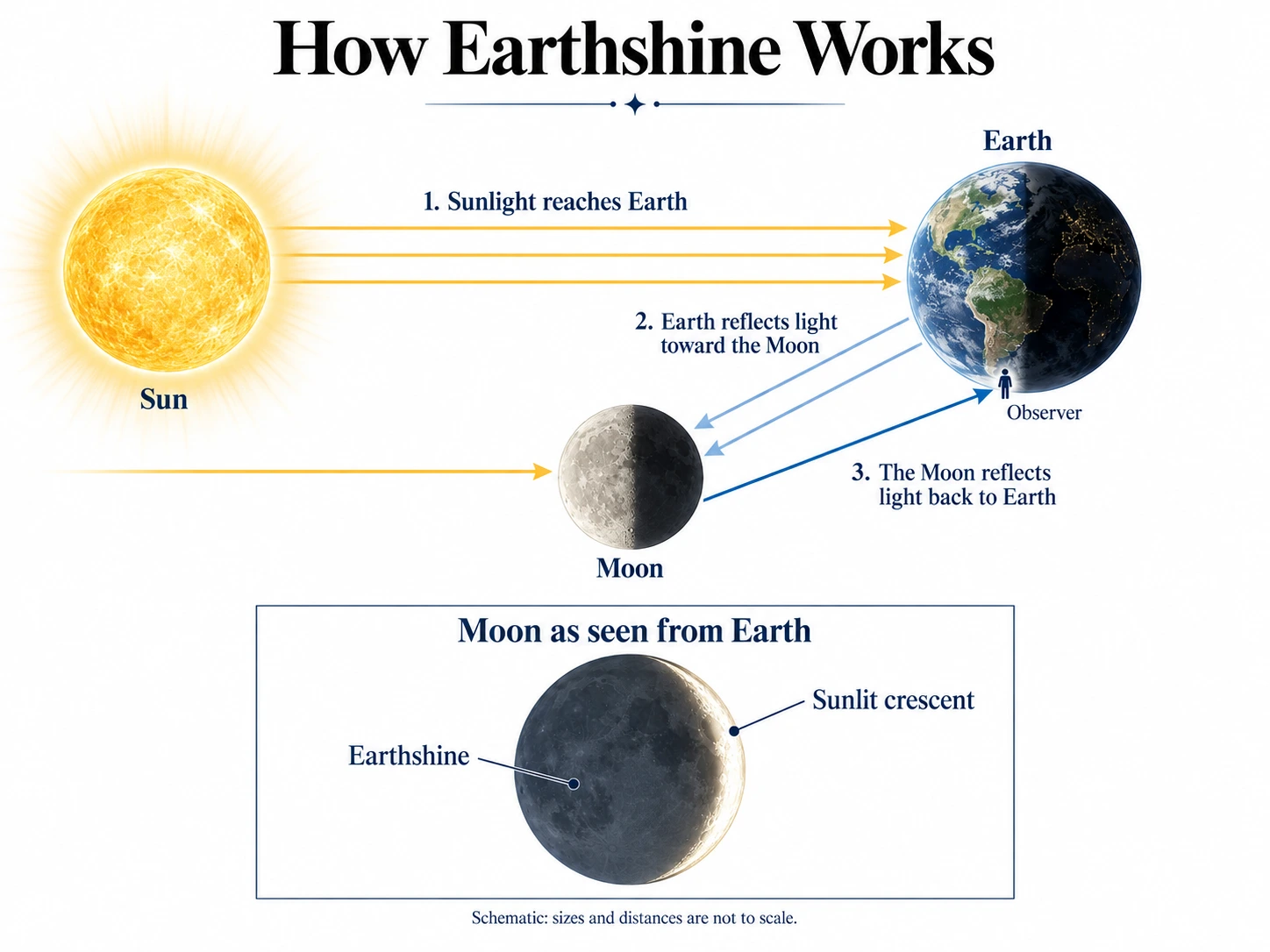
Catch a slim crescent moon low in the evening sky, a few days after new moon, and you might notice something that looks almost like an optical illusion: the rest of the lunar disk, the part that should be pitch dark, glowing faintly silver-blue. That soft glow is earthshine and it isn’t sunlight leaking around the edges or a trick of your eyes adjusting to the dark. It’s light that has already made one trip to Earth, bounced off clouds and oceans and ice, and traveled another quarter-million miles back out to paint the Moon’s night side.
What Earthshine Actually Is?
Picture the scene from the Moon’s perspective. If you were standing in that “dark” crescent region, Earth would hang in your sky nearly full and enormous, roughly four times the diameter of the Moon we see from home. That’s a huge, brilliant disk reflecting sunlight down onto the lunar surface, illuminating it just enough for us, a quarter-million miles away, to pick out the faint glow with the naked eye. The brighter crescent you see is direct sunlight. The dim glow filling in the rest of the disk is Earth’s light, reflected twice before it reaches your retina.
“The old moon in the new moon’s arms” is a traditional folk name for this sight. The description still holds up: a thin crescent cradling the ghostly outline of the full lunar sphere.
| A 500-year-old insight. In the early 1500s, Leonardo da Vinci correctly recognized the basic mechanism behind earthshine: sunlight reflected from Earth was illuminating the Moon’s night side. He thought Earth’s oceans supplied most of that reflected light; today we know clouds and other bright surfaces also play a major role. |
The Best Time to See It
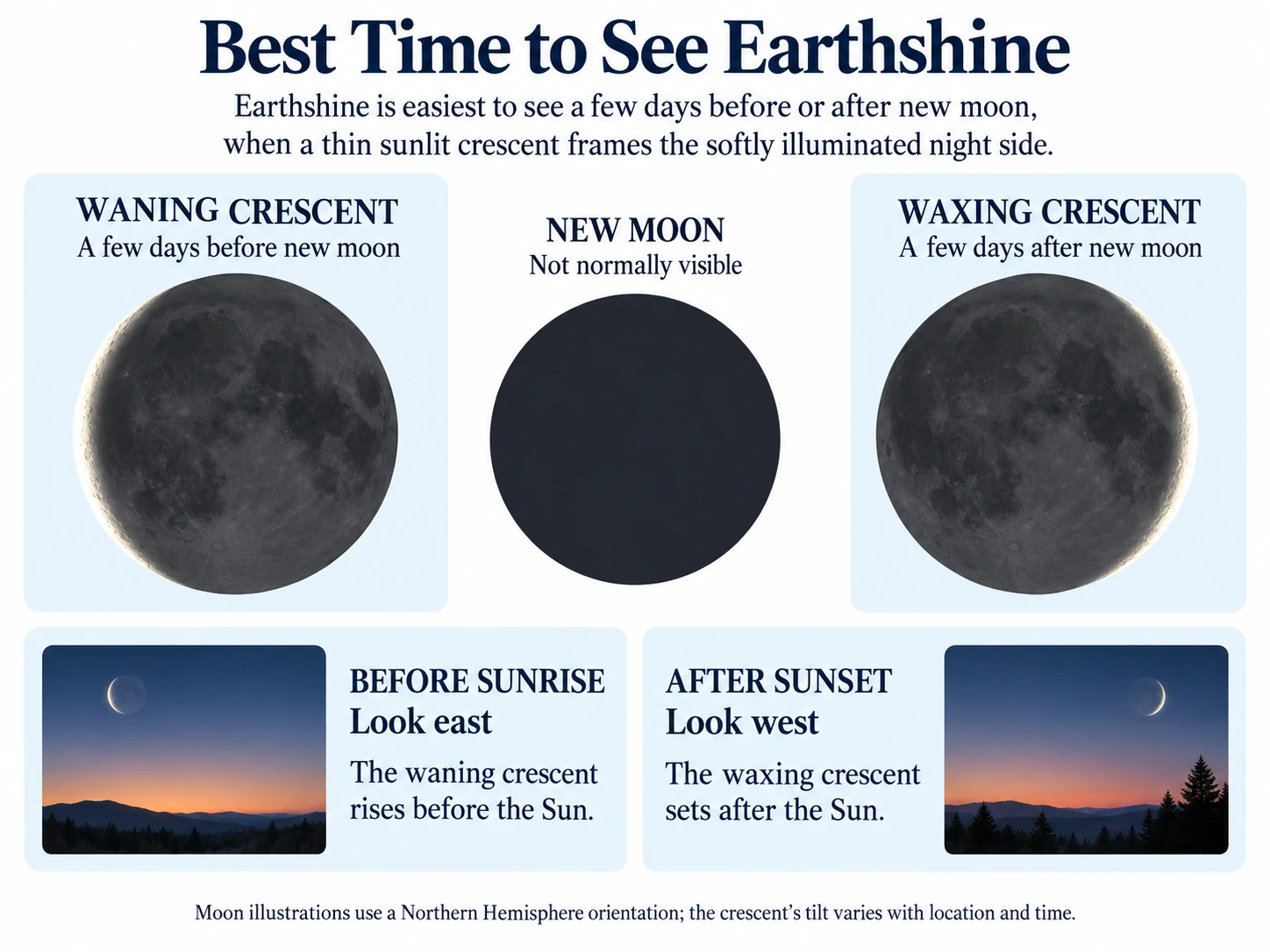
Earthshine shows up most clearly within a few days of new moon, when the crescent is thin and the sky is dark enough that the faint glow isn’t washed out by the Moon’s own brightness. Twilight, just after sunset or before sunrise, is prime viewing time, since the sky still holds a little color but hasn’t gone fully black. If you’re just getting comfortable finding your way around the night sky, our beginner’s guide to stargazing walks through what else is worth looking for during that same crescent window.
No telescope required. Binoculars help resolve the maria and craters on the Earth-lit portion, but plenty of people spot earthshine with nothing but a clear western horizon and a few patient minutes.
Measuring a Reflection of a Reflection
Here’s where earthshine stops being a pretty sight and starts being genuinely useful science. Because that dim glow is literally sunlight that has bounced off Earth, measuring its brightness tells you something about Earth itself: how much sunlight our planet reflects back into space, a quantity scientists call albedo.
The modern measurement technique traces back to French astronomer André Danjon, who began systematically observing earthshine in the 1920s. Researchers at the Big Bear Solar Observatory in California revived and modernized his approach starting in the 1990s, comparing the brightness of the Moon’s sunlit crescent against its earthshine-lit portion on the same night. Oceans generally have low albedo, while clouds, snow, and ice can reflect much more incoming sunlight. As the balance of clouds, ocean, snow, and ice changes over the hemisphere facing the Moon, the brightness of earthshine changes too.
That’s the part worth sitting with: astronomers can infer something about cloud cover over the Pacific Ocean by watching how brightly the “dark” part of the Moon glows on a given night.
What Long-Term Earthshine Measurements Reveal
This is where earthshine becomes more than a beautiful sight. A widely reported 2021 study using Big Bear Solar Observatory measurements from 1998 to 2017 found a decline in Earth’s albedo over that period, with most of the decrease occurring in the final. The researchers associated much of the decline with changes in low-level cloud cover over the eastern Pacific Ocean, meaning less incoming sunlight was being reflected back into space.
An earlier 2016 analysis of measurements from 1998 to 2014 found modest decadal-scale variations in Earth’s albedo but no statistically significant net change during that shorter period. When researchers extended the observational record, however, the longer dataset revealed a clearer decline in reflectivity.
Earth’s albedo can vary for several reasons. Changes in cloud cover, sea-surface temperatures, aerosols, snow, and ice all affect how much sunlight the planet reflects. That makes earthshine useful as one part of a much broader effort to understand changes in Earth’s energy balance and climate.
Photographing the Glow
Earthshine is dim enough that a phone camera on auto mode will usually blow out the bright crescent trying to expose for it, or lose the earthshine entirely trying to protect the highlights. Because the bright crescent and faint earthshine differ greatly in brightness, try several exposures rather than relying on a single long shot. Brace the phone against something solid or use a tripod, then capture shorter exposures for the bright crescent and slightly longer ones for the dim Earth-lit portion. HDR or exposure bracketing can help preserve detail in both.
If you’ve already read through our guide to photographing the Milky Way on a smartphone, the same manual-exposure principles apply here, just aimed at a much brighter and much closer target.
The next new moon puts a fresh crescent back in the evening sky within a few days, which makes earthshine one of the more reliably repeatable sights in backyard astronomy. No special equipment, no rare alignment, just a clear western horizon at the right hour and a planet quietly lighting up its own moon.
Want more moon-watching in your evenings? Our breakdown of the Beaver Moon 2026 covers what’s coming up next on the lunar calendar.
FAQ
The name describes exactly what’s happening: light reflected from Earth faintly illuminates the Moon’s night side. The phenomenon is also traditionally known as ‘the old moon in the new moon’s arms.”
A few days before or after new moon gives you the thinnest crescent and the darkest sky background, which makes the glow easiest to spot. Look toward the western horizon shortly after sunset, or the eastern horizon before sunrise, depending on the lunar phase.
No. Earthshine is visible to the naked eye under reasonably dark skies. Binoculars sharpen the view and let you pick out lunar features like the maria within the earthshine-lit portion, but they’re optional.
No — they’re unrelated phenomena that happen at opposite lunar phases. Earthshine appears during the crescent phase, when Earth reflects sunlight onto the Moon’s night side. A lunar eclipse happens at full moon, when Earth’s shadow falls directly across the Moon’s sunlit face.
Indirectly, yes. Because earthshine brightness depends on how much sunlight Earth reflects, measuring it over time provides an estimate of Earth’s albedo. Changes in cloud cover, oceans, snow, ice, and aerosols can all affect that reflectivity, making long-term earthshine observations useful alongside satellite measurements for studying Earth’s energy balance and climate.
It fades from view as the crescent widens and the Moon’s own sunlit glare grows bright enough to overpower it, roughly a week or so after new moon. It returns with the next new moon, making it one of the more reliably repeatable sights in casual stargazing.