
Mount Teide stands at the center of Tenerife, the largest of Spain’s Canary Islands, in the Atlantic off the northwest coast of Africa. Its national park is one of the few places in Europe where you can drive to about 2,350 meters (7,700 feet), park above the cloud layer, and look up at a sky that professional astronomers picked for the same reason you did.
Here is the part most guides leave out. The sky above Teide is genuinely very good, but the quality of your night depends far more on two decisions you make weeks before you arrive than on anything you do on the mountain: which month you come, and how close your dates fall to a new moon. A 42 euro telescope session on a moonless July night will show you more than a 182 euro tour four nights before a November full moon.
This Teide stargazing guide covers the park after dark: what the sky is actually like, when to come, where to go inside the park, whether to book a tour or drive yourself, what it costs, and the access rules that catch visitors out. It does not cover climbing to the 3,715 meter (12,188 foot) summit, which is a separate daytime activity with its own permit and, since January 2026, its own fee.
Why astronomers chose this mountain
Teide National Park works as an observing site for one reason above all others: altitude relative to a cloud layer, not altitude on its own.
Tenerife sits under a trade-wind regime that produces a near permanent temperature inversion. Moist marine air is trapped below it, and above it the air is dry and stable. The park floor sits above that inversion for much of the year, which is why visitors so often describe driving up through cloud into clear sky. The clouds are not gone. You are standing on top of them.
The Instituto de Astrofísica de Canarias runs the Teide Observatory at Izaña, at 2,390 meters (7,841 feet), a few kilometers from the main road through the park. Its site selection is the strongest endorsement the sky here has: research telescopes are expensive, and they are not put in mediocre places.
Two further things protect it. The park was inscribed as a UNESCO World Heritage Site in 2007. And Spain passed Ley 31/1988 on 31 October 1988, the first national sky protection law anywhere in the world, which requires the IAC to issue binding reports on external lighting, radio emitters and industrial installations above 1,500 meters. One honest caveat on that law, because it is often overstated in travel writing: its lighting provisions are aimed at La Palma and the part of Tenerife directly visible from La Palma, so it is not a blanket island-wide lighting code for Tenerife.
Since 2014 the sky over the national park has also held Starlight Tourist Destination certification from the Starlight Foundation, Volcano Teide’s astronomy sessions are led by Starlight guides.
What the sky here actually gives you that home does not
The specific gift of Tenerife is not just darkness. It is latitude.
The park sits at roughly 28 degrees north. That puts the southern horizon about 23 degrees further down the sky than it is from London and about 12 degrees further down than from New York, which changes what is observable and, more importantly, how high it climbs.
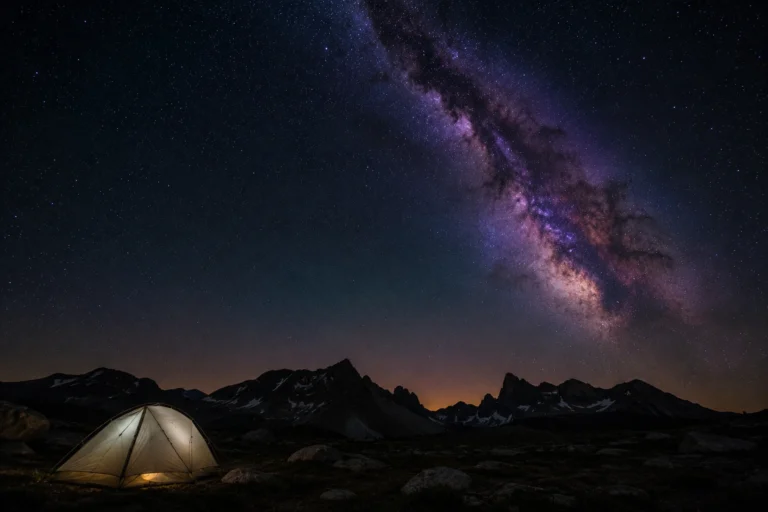
The clearest example is the center of the Milky Way. The galactic center sits at a declination of about minus 29 degrees. From the latitude of Teide it reaches roughly 33 degrees above the horizon at its highest. From London the same point barely clears 10 degrees, where it is smeared through the thickest, murkiest part of the atmosphere. From New York it manages about 20 degrees. That difference is the whole reason the Milky Way looks like a structure here rather than a smudge.
Some real southern targets come within reach too. Canopus, the second brightest star in the sky, at declination minus 53 degrees, climbs to about 9 degrees. Omega Centauri, the finest globular cluster in the sky, at minus 47 degrees, reaches about 14 degrees.
Now the honest limits, because this is where tour marketing tends to oversell. Alpha Centauri, at declination minus 61 degrees, transits less than a degree above a theoretical flat horizon, which in practice means you will not see it. Most of the Southern Cross stays below the horizon: its brightest star, Acrux, at minus 63 degrees, never rises. Neither does the Large Magellanic Cloud at minus 70 degrees. The far southern constellations, Octans, Apus, Chamaeleon, Mensa, Musca and Volans, are permanently out of reach.
Volcano Teide, the park’s cable car operator, states that 83 of the 88 recognized constellations can be seen from Tenerife. That is their figure, and it is consistent with the geometry above, but read it as a catalogue count rather than a promise about what will look good. A constellation scraping the horizon at 3 degrees is technically visible and practically useless.
One group should adjust expectations in the other direction. If you are travelling from Australia or New Zealand, the southern sky is not the draw. From Sydney the galactic center passes almost directly overhead. What Teide offers you instead is the northern sky, plus reliability and easy road access.
The month you choose matters more than the site you choose
This is the section that should decide your booking, and it is the one competing guides handle worst.
Tourism material about Teide very commonly claims more than 300 clear nights a year. That figure is repeated widely and I could not find a meteorological or astronomical source that supports it. The measured data tells a more useful story, and it is not a flat number across the year.
Spain’s national weather agency, AEMET, publishes long-term climate normals for its Izaña station at 2,369 meters (7,772 feet), which is effectively the same altitude as the park’s main stargazing area. Its standard climate values for the 1981 to 2010 period include a count of cloudless days per month:
| Month | Cloudless days | Mean overnight low |
|---|---|---|
| June | 23.8 | 9.9 °C / 50 °F |
| July | 27.0 | 14.0 °C / 57 °F |
| August | 24.2 | 13.8 °C / 57 °F |
| September | 16.5 | 10.4 °C / 51 °F |
| October | 11.7 | 6.9 °C / 44 °F |
| November | 9.4 | 4.5 °C / 40 °F |
| December | 10.8 | 2.4 °C / 36 °F |
Read that carefully, because it reframes the trip. July averages 27 cloudless days. November averages 9.4. The site does not change. Your odds nearly triple.
Two qualifications matter. AEMET counts cloudless days, a daytime measure, so use it for the seasonal pattern rather than as a tally of usable nights. And these are averages from a thirty-year period, not a forecast for your week.
For nights specifically, the best evidence comes from satellite work. Cavazzani and Zitelli analyzed GOES 12 satellite data for 2008 and 2009 across four observatory sites and published the results in Monthly Notices of the Royal Astronomical Society (DOI 10.1093/mnras/sts311). At Izaña they found a two-year mean of 68.6 percent completely cloud-free nights, and 62.6 percent meeting the stricter stability standard that corresponds to photometric quality. The variation between years was large: 63.8 percent of nights were clear in 2009, and in December 2009 alone the figure fell to 29 percent.
So the realistic picture is a very good site with a strong seasonal signal, not a place where the sky is a certainty. Roughly two nights in three are clear across the year, closer to four in five at midsummer, and in a bad December closer to one in three.
💡 Bottom Line If the night sky is the reason for your trip, come between June and September, when AEMET’s normals show 16 to 27 cloudless days a month. If you are visiting in November or December for other reasons, book a stargazing session early in your stay so a clouded-out night can be repeated later in the week.
Working around the moon
Cloud is the risk you cannot control. The Moon is the one you can, and it is the single cheapest improvement you can make to the night.
A bright Moon does not dim the Milky Way slightly. It erases it. The band of the galaxy is a low-contrast object, and moonlight raises the brightness of the whole sky background. Planets, the Moon itself and bright double stars survive it perfectly well, which is why a guided telescope session still works near full Moon. Naked-eye Milky Way viewing and astrophotography do not.
The practical rule: aim for the week centered on the new moon, accept the three or four nights either side of that, and avoid the five nights around full moon entirely if the galaxy is what you came for.
The International Meteor Organization’s 2026 calendar lists this year’s remaining phases. For the rest of 2026:
| New moon (best) | Full moon (avoid) |
|---|---|
| 11 September | 26 September |
| 10 October | 26 October |
| 9 November | 24 November |
| 9 December | 24 December |
A new moon falls roughly every 29.5 days, so you can extend that pattern forward with reasonable accuracy, but check a lunar calendar before you commit to dates more than a few months out.
One more timing detail, because it decides your evening. Full astronomical darkness arrives about an hour and a half after sunset. Calculated for the park’s coordinates, sunset on 21 December 2026 falls at 18:16 local time with full darkness at 19:39, while on 21 June sunset is at 21:08 and darkness does not arrive until 22:40. That is why organized sessions in midsummer start so late, and why a winter visit gets you home at a civilized hour.
Best Places for Teide Stargazing
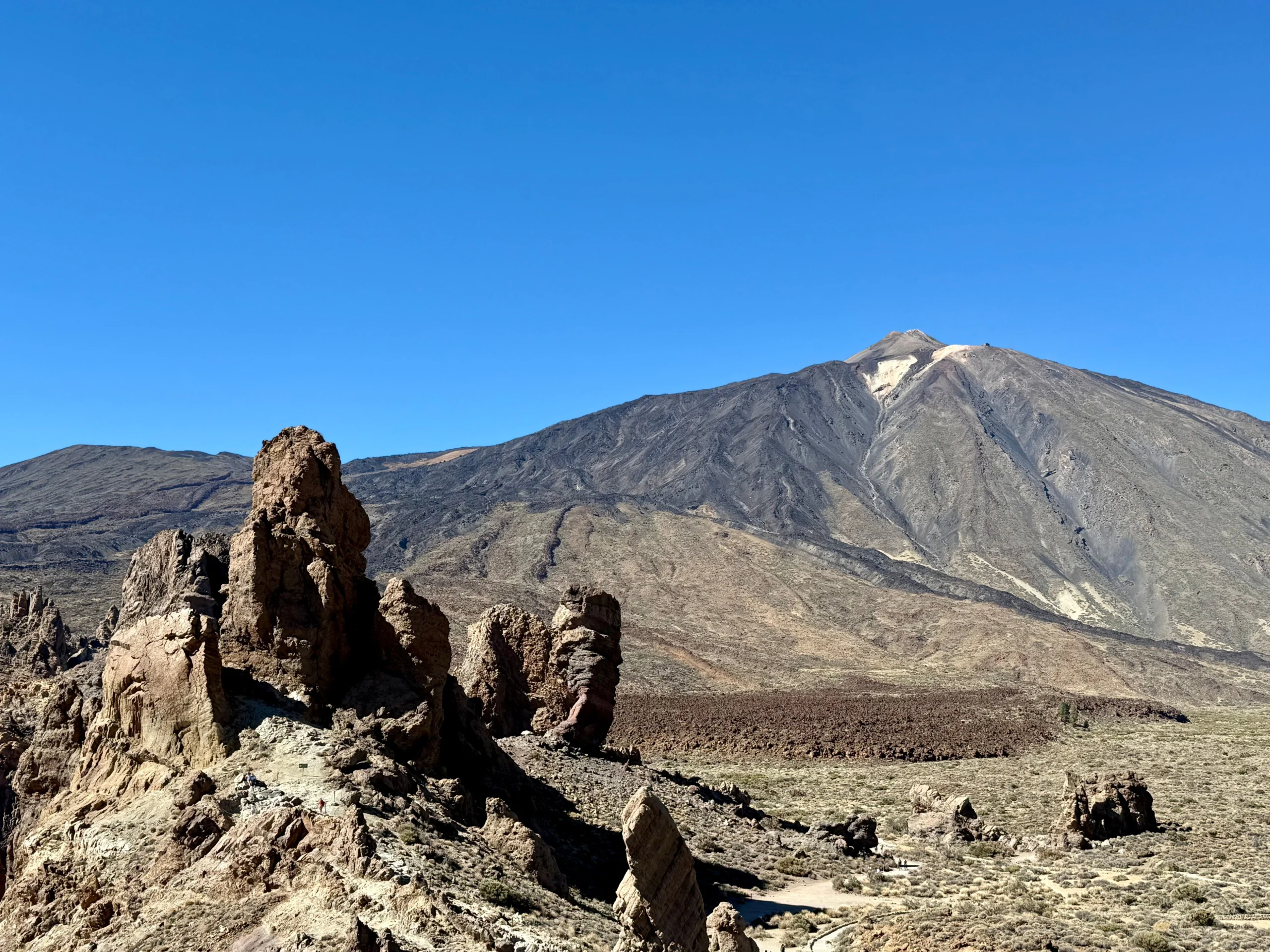
The park is not one viewpoint. It is a caldera roughly 2,000 to 2,400 meters up, crossed by the TF-21, with several places where you can pull off, park and set up. Public viewpoints do not require a stargazing ticket, but individual parking areas may have restricted opening hours.
The cable car base station, at km 43 of the TF-21 and 2,356 meters (7,730 feet), is where every licensed operator runs its telescope sessions. There is a large sealed car park, it is easy to find in the dark, and it has the most open sky of the accessible pull-offs. If you are driving yourself and want the simplest option, this is it. It is also the busiest, since it is where the tour groups gather.
Minas de San José, on the TF-21 between El Portillo and the cable car, is the astrophotographers’ choice. It is a wide pumice field with parking areas, an unusually low and unobstructed horizon, and pale ground that photographs well under starlight. There is nothing there at all, which is the point.
El Portillo, at the junction of the TF-21 and TF-24, has the visitor center (daytime only) and parking. It is the closest of the three to the northern towns, so it suits anyone based around Puerto de la Cruz who wants a shorter drive back.
Roques de García, near the Parador, gives you the park’s most recognizable rock formations in the foreground. Its car park is often full to overflowing during the day and usually quiet after dark, which makes it a better night destination than a day one.
If you do not have a car, TITSA bus line 341 stops at El Portillo, El Portillo Alto and Minas de San José. Check the timetable carefully in both directions before you rely on it, because the useful stargazing hours fall outside most scheduled services.
Two rules apply everywhere in the park and are worth knowing before you plan a long night. Camping and tents are prohibited, and so is sleeping in a vehicle or parking a motorhome overnight outside designated sites. Bivouacking is allowed only above 2,500 meters, in designated moderate-use areas, with a permit obtained in advance, and still without a tent. Drones are prohibited across the whole park.
Guided tour or your own car
Both work. They suit different people, and the deciding factor is usually equipment and confidence rather than money.
| Licensed tour | Driving yourself | |
|---|---|---|
| Cost per person | 42 euros upwards, 77 euros upwards with hotel pickup | Car hire plus fuel |
| Telescopes | Celestron CPC 9.25 inch and a 30 cm Dobsonian, with a Starlight guide | Whatever you brought |
| Mountain driving at night | Someone else does it | You do it, descending in the dark |
| Timing | Fixed, about an hour of observing | Yours, all night if you want |
| Bad weather | Refunded or rescheduled | Your loss |
| Children | Under 8 not accepted | No restriction |
Choose a tour if you do not own a telescope, if you want someone to name what you are looking at, or if you are not comfortable driving an unlit mountain road down from 2,350 meters after several hours in the cold. The optics involved are genuinely good, and the sky through a 30 cm Dobsonian is not something you can approximate with binoculars.
Drive yourself if you have your own gear, if you want to shoot the Milky Way, or if an hour is not enough. Self-driving is also the only way to be at Minas de San José at two in the morning, which is when the site is at its best.
The one thing self-drivers consistently underestimate is the descent. It is a long, winding road, often below freezing at the top, with no lighting and occasional loose volcanic grit. Plan to drive it slowly and do not schedule an early flight the next morning.
💡 Bottom Line First visit and no equipment: book the telescope session. Own a camera and a tripod: drive yourself to Minas de San José on a new moon. Doing both on separate nights is the best value of all, because the tour teaches you the sky and the second night lets you use it.
What it costs
These are the prices published by Volcano Teide, the park’s cable car operator and the main licensed operator for night activities, at the time of research on 4 September 2026. Conversions use European Central Bank euro reference rates for 3 September 2026 and are rounded, so treat them as indicative rather than exact.
| Experience | EUR | USD | GBP | AUD | NZD |
|---|---|---|---|---|---|
| Telescope session, no transport | from 42 | 49 | 36 | 68 | 83 |
| Telescope session with hotel pickup | from 77 | 89 | 66 | 124 | 152 |
| Observatory visit, daytime | from 21 | 24 | 18 | 34 | 42 |
| Observatory visit plus stargazing | from 109 | 127 | 94 | 176 | 216 |
| Sunset, dinner and stargazing | from 182 | 211 | 157 | 294 | 360 |
What separates the cheapest option from the most expensive is transport, food and a cable car ride at sunset, not the quality of the sky or the telescopes. The 42 euro session and the 182 euro package use the same optics in the same car park at 2,356 meters.
The sunset package is worth its price for a specific reason that has nothing to do with astronomy: riding to La Rambleta at 3,555 meters (11,663 feet) in the last light, above the cloud layer, with the neighboring islands visible across the top of it, is the best hour of the day in this park. It runs about eight hours door to door, with pickups from 14:15 to 16:30 depending on the season, and includes a picnic dinner. It also states no access for visitors with physical disabilities, and it excludes the observatory visit.
Note that the observatory visit is a daytime activity. You tour a working solar research facility; you do not observe through its research telescopes at night. Children aged 8 to 16 go free on that visit, and under 8s are not admitted. Volcano Teide’s night sessions also exclude under 8s.
The access rules that catch people out
Park entry is free, there is no ticket for stargazing, and the roads through the park are open at night. That is the normal state of affairs, and it is what makes independent stargazing here so easy. But there are four exceptions, and the first one has ruined a lot of trips.
Peak meteor shower nights. For the Perseids on 12 and 13 August 2026, the Cabildo de Tenerife barred private vehicles from the national park between 17:00 and 05:00, with checkpoints on the TF-21 at La Orotava and Vilaflor, the TF-24 at La Esperanza and the TF-38 at Chío. Goods vehicles, scheduled public transport and buses with more than nine seats were exempt, and TITSA ran special services from 19:30 to 02:30. Past Perseids had drawn more than 2,000 vehicles into the park. This has become the pattern rather than a one-off, so if you are planning a trip around mid-August, check the Cabildo’s announcement before assuming you can drive up, and book a coach-based tour or a shuttle if the restriction is in force.
Snow and ice. Winter storms close the access roads outright, sometimes for days. In December 2025 the Cabildo ran a controlled-access operation from 18:00 on Friday 19 December until 10:00 on Monday 22 December, with closure points on the TF-21 at Aguamansa and Boca Tauce and on the TF-24, plus a closure inside the park between Portillo Alto and the cable car, and free shuttle buses ascending only between 10:00 and 14:00. Check road status the same day in winter.
The summit trails, which are not what you want anyway. Since 19 January 2026, access to trails PNT 10 and PNT 07 carries a public tariff during specified daytime slots. On trail PNT 10 Telesforo Bravo, open 09:00 to 17:00, non-residents pay 15 euros, residents of other Canary Islands 6 euros, and Tenerife residents and under-14s nothing. On trail PNT 07 Montaña Blanca to La Rambleta, open 09:00 to 15:00, non-residents pay 6 euros on weekdays and 10 euros at weekends and on holidays. Booking is through the TenerifeON platform, a new week of slots opens each Monday at 07:00 Canary time on a 28-day rolling window, and reservations are non-refundable except when weather or a cable car outage closes access. None of this applies to stargazing. The tariff covers the final climb to the crater in daylight, and the observing areas are 1,200 meters lower down.
Sunrise and sunset summit permits. For completeness, the park’s visitor regulations for the Telesforo Bravo trail do provide two mountaineering permit types outside cable car hours, one from 06:00 to 09:00 for sunrise and one from 18:00 to 22:00 for sunset. Trail capacity is 50 people at any one time and 10 on the section bordering the crater, and walking around or into the crater is prohibited. Whether the 2026 tariff applies to those out-of-hours slots is not stated in the sources I could reach, so confirm it at the point of booking.
What to bring, and why people get the clothing wrong
The single most common mistake is dressing for the island you flew to rather than the altitude you drove to.
Using AEMET’s normals for the same two stations, the average overnight low in August is 21.1 °C (70 °F) at Tenerife South airport and 13.8 °C (57 °F) at Izaña. In January it is 15.2 °C (59 °F) at the airport and 1.1 °C (34 °F) at Izaña. So a January night in the park runs about 14 °C (25 °F) colder than the coast you left, and those are averages, meaning colder nights are routine. Add wind and standing still for an hour and the effective difference is larger again.
What actually matters:
- Layers, including a windproof outer shell. A fleece alone is not enough above 2,300 meters in winter.
- A hat and gloves, from October through April. Fingers go first when you are holding a phone or focusing a camera.
- Closed shoes with grip. The ground is volcanic grit and the car parks are unlit.
- A red light, not a white one. Your eyes need 20 to 30 minutes to dark-adapt and one white phone torch resets everyone nearby. Our guide to why a red headlamp preserves night vision explains how dim it actually needs to be.
- Water. The air above the inversion is very dry, and dehydration at altitude is easy to miss in the cold.
If you want photographs, a tripod is not optional, and the park is a genuinely good place to try this with a phone rather than a camera. Our walkthrough on photographing the Milky Way with a smartphone covers the settings and the limits.
On altitude: 2,356 meters is high enough to leave some people short of breath but is not usually a problem for healthy visitors. The cable car to 3,555 meters is a different matter, and Volcano Teide advises against it for people with cardiac or respiratory conditions.
Getting there
Tenerife has two airports. Tenerife South (TFS) takes most international flights and serves the southern resorts, Costa Adeje and Los Cristianos. Tenerife North (TFN) is closer to Puerto de la Cruz and mostly handles domestic and inter-island routes.
From either coast, the drive up to the park takes roughly an hour to an hour and a half depending on your exact start point and the road you take. The southern resorts approach via the TF-21 through Vilaflor; Puerto de la Cruz and the north approach via the TF-21 through La Orotava or the TF-24 from La Esperanza. Check your own route timing before you commit to a session start time, because these are mountain roads and average speeds are low.
A hire car is the better choice if you intend more than one night in the park, want to reach Minas de San José, or plan to shoot the sky. Hotel pickup, at 77 euros upwards, is better value than car hire if a single guided session is all you want.
If you are flying from the United States, Australia or New Zealand, be realistic about the shape of the trip. Tenerife is not a practical standalone long-haul destination for one stargazing session. It works as a leg of a wider Spain or Europe itinerary, or as a week-long island stay with two or three sky nights inside it.
Is it worth it?
Yes, with conditions attached, and the conditions are what most recommendations skip.
Worth planning a trip around if you have never seen the Milky Way properly and can travel between June and September near a new moon. The combination available here, a genuinely dark and high site you can reach by paved road in an hour, above the cloud layer, with the galactic center a third of the way up the sky, is close to unique in Europe.
Worth a night if you are already going at any other time of year. A 42 euro telescope session is good value even under an imperfect sky, because planets and the Moon are unaffected by moonlight and by thin cloud.
Worth postponing if your dates fall within a few nights of a full moon and the Milky Way is specifically what you came for. Move it to the other end of your stay. That flexibility is worth more than any upgrade you can buy.
Probably not worth planning a dedicated trip around if a single fixed night is your only chance in November or December. If you are travelling with children under 8, check other operators: Volcano Teide’s listed night sessions exclude them, but some family-friendly tours accept younger children.
The most useful thing you can do is treat the sky as a probability rather than a booking. Pick the month on the AEMET numbers, pick the nights on the lunar calendar, keep one spare evening in reserve, and let the mountain do the rest.
FAQ
Yes. Park entry and the roads through it are free and open at night, and there is no ticket or permit for stargazing. You need your own transport, your own equipment and warm clothing. The exceptions are peak meteor shower nights and winter snow operations, when the Cabildo can bar private vehicles.
Not to observe. The IAC facility at Izaña is a working research site, and public access is a daytime guided visit from 21 euros. Tours that pair an observatory visit with stargazing do the observing outdoors afterwards, at the cable car base station, using portable telescopes.
Not for independent stargazing at the public roadside viewpoints described here. Guided activities require a booking. Access to regulated mountain trails is separate: permits can be required outside daytime hours too, while the 2026 fees apply to specified time slots on PNT 07 and PNT 10.
Yes, but age limits vary by operator. Volcano Teide’s night sessions and observatory visits do not admit children under 8, while some other operators accept younger children. Independent stargazing at public viewpoints has no tour-imposed minimum age, though cold temperatures and late starts need consideration.
Later than most people expect. Full darkness in late June does not arrive until about 22:40 local time, which is why organized pickups run as late as 16:30 for an evening that ends after midnight.
Access rules, tariffs and prices in this article were verified on 4 September 2026 against the Cabildo de Tenerife, the TenerifeON platform, the national parks visitor regulations and the operator’s published prices. Climate figures are AEMET standard climate values for the 1981 to 2010 period at the Izaña and Tenerife South stations. Earthshinejournal has not conducted first-hand observation at this site; this guide is built from official and published sources.