

Winter van camping has a particular appeal. Clear nights, quiet campsites, and long hours of darkness can make for excellent stargazing—but once the temperature drops, keeping a camper van comfortable becomes part of the challenge.
Staying warm in a small, sealed vehicle creates its own tradeoffs. Run the wrong heater the wrong way and you’re dealing with carbon monoxide risk, condensation soaking your bedding, or a fire hazard from a heater set too close to a curtain. It means choosing a heating method on purpose, not grabbing whatever’s cheapest at the hardware store.
This guide covers safe portable heaters for camper vans: setups you bring in, use, and take back out without cutting into your van’s floor or walls. Permanently installed diesel systems are a separate project requiring professional installation.
Why Heating a Camper Van Requires Extra Care
A camper van isn’t a bedroom. It’s a small, sealed box with limited air exchange, so any problem with a heat source gets concentrated fast.
Carbon Monoxide
Carbon monoxide is colorless and odorless, formed when fuel doesn’t burn completely. Any fuel-burning appliance can create a CO hazard if it malfunctions, gets misused, or its exhaust reaches the living space. That’s not the same as saying every propane or diesel heater is quietly leaking CO. Properly functioning equipment, used as directed, is a different situation than a misused heater or a cracked exhaust seal.
Condensation
Burning propane indoors releases water vapor along with heat, sometimes called “wet heat”: fogged windows, damp cushions, a clammy feeling by morning. Electric heat skips this, since there’s no combustion inside the space.
Fire and Electrical Hazards
Any portable heater can ignite bedding, curtains, or clothing if placed too close or left unattended. Electric heaters remove the CO risk but still carry fire, overheating, and tip-over risks.
Manufacturer instructions outrank anything written here.
💡Bottom Line
No portable heater is risk-free. Knowing which kind of risk you’re managing, CO, moisture, or fire, is what keeps you safe.
Quick Comparison: Portable Camper Van Heating Options
| Heating Type | Best For | Shore Power Needed? | CO Concern | Adds Interior Moisture? | Off-Grid Practicality |
|---|---|---|---|---|---|
| Electric space heater | Campsites with hookups | Usually yes | Heater itself produces no CO | No combustion moisture | Low |
| Portable external diesel heater | Off-grid winter camping | No, but requires 12V electrical power | Possible if exhaust is improperly managed | Combustion stays outside when properly configured | High |
| Unvented propane heater | Short-term heating when manufacturer permits | No | Yes | Yes | Moderate |
Not a lab ranking, just a starting point.
Electric Space Heaters: The Simplest Option With Shore Power
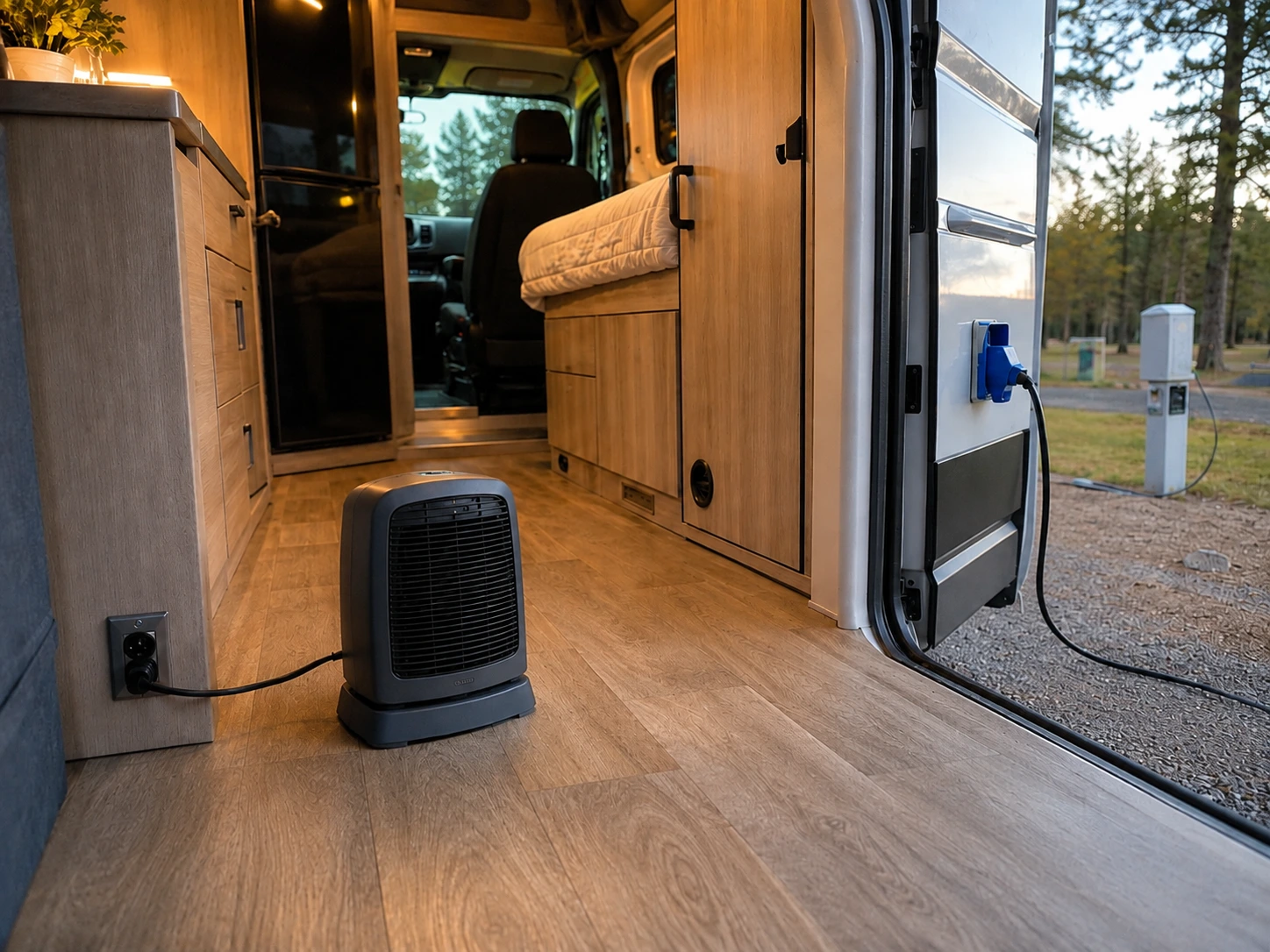
With reliable shore power, a 120V electric space heater is usually simplest: ceramic fan heaters, small radiant units, oil-filled radiators. None burn fuel, so none produce carbon monoxide.
That’s not the same as calling them safe. Look for tip-over and overheat protection. Keep clearance from bedding, curtains, and clothing (three feet is a commonly cited minimum, though your manual is the real authority). Plug directly into an outlet rather than an extension cord, and don’t leave it running while you sleep.
Battery Reality
A typical high-output space heater draws around 1,500 watts. Running that through an inverter off a 12V battery bank drains stored energy fast, faster than most people expect. A modest battery bank won’t sustain it for long. A large lithium bank with a properly sized inverter might, and a big power station could run one temporarily, but check its output rating first.
💡Bottom Line
Electric heaters are simplest with shore power, and a poor fit for sustained off-grid battery use.
Portable All-in-One Diesel Heaters: A Practical Off-Grid Option
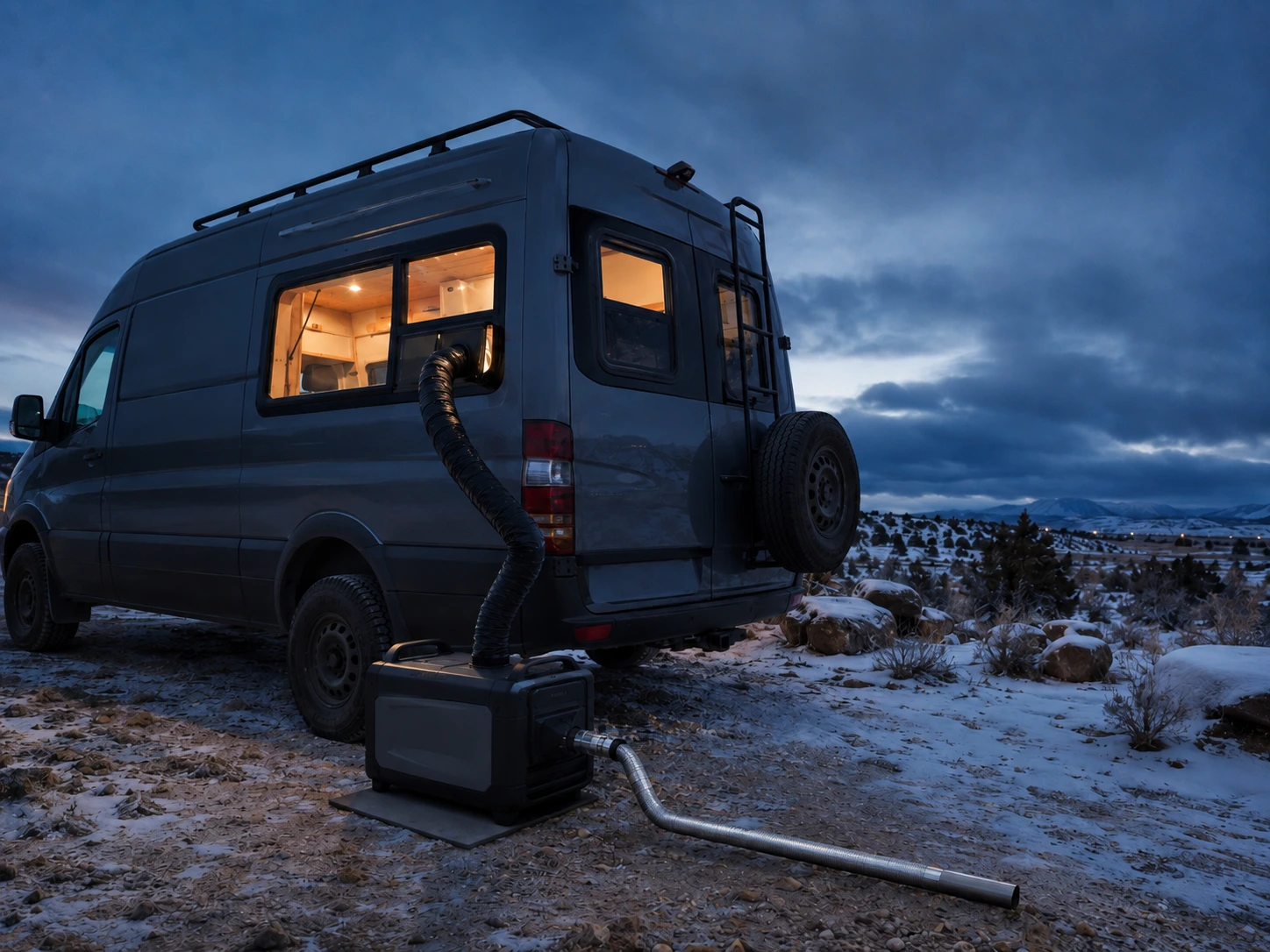
These differ from diesel heaters permanently mounted into a van’s floor. A portable all-in-one unit packages the burner, fuel tank, and controls into something closer to a toolbox, meant to sit outside while ducting warm air in. Non-negotiable: the combustion unit stays outside unless the manufacturer says otherwise.
Critical Safety Requirement
Warm air gets ducted in through heat-resistant ducting, per install instructions. The exhaust stays outside: away from doors, windows, roof vents, and air intakes, angled so gases can’t drift back in, clear of anything combustible. Done right, combustion and combustion moisture stay entirely outside the living area.
Electrical Consumption
Diesel heaters still need power for the glow plug, fuel pump, fan, and electronics. Not “almost no electricity,” but the draw is typically much lower than resistance heat off the same battery, part of why these show up in setups built around a portable diesel heater for winter camping. You’ll still need an adequate 12V supply.
Downsides
More setup than an electric heater. Fuel to store. Exhaust placement to rethink at every campsite. Pump and fan noise.
💡Bottom Line
A properly configured portable external diesel heater can be one of the most practical tools for off-grid winter camping, but the exhaust setup isn’t optional.
Portable Propane Heaters: Convenient, but Require Extra Caution
Portable propane heaters, including familiar radiant-style units, are popular for good reason: no shore power needed, inexpensive, near-instant heat. Not every one is approved for use inside an RV, so check rather than assume. Use only a unit the manufacturer permits for the space, and follow the manual and local regulations.
| Advantages: no shore power required, portable and inexpensive, fast radiant heat. |
Important Risks and Limitations
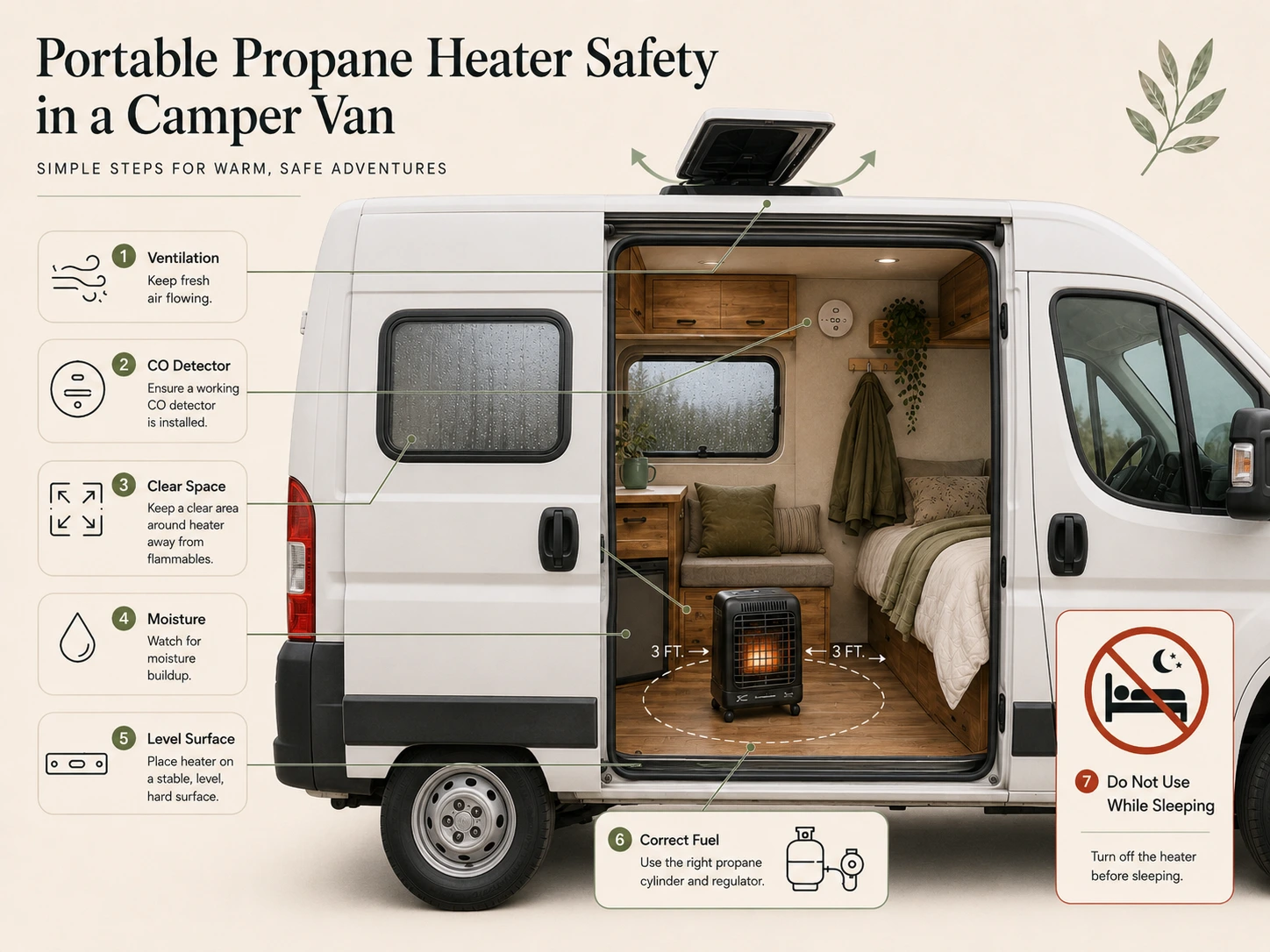
Unvented propane heaters consume oxygen, produce combustion gases, and add water vapor to the air, meaning ventilation stops being optional. What that ventilation needs to look like, a cracked window, a roof vent, something else, depends on the appliance, so follow the manufacturer’s requirement.
A working CO alarm is essential whenever a fuel-burning appliance runs. Some newer propane heaters include an oxygen depletion sensor that shuts the unit off if oxygen drops, an improvement over older designs. Even so, don’t run one while asleep. Some states also restrict indoor use of certain propane heaters.
💡Bottom Line
Propane heaters offer convenient heat with no shore power required, but demand more attention to ventilation and moisture than electric heating does.
How to Heat a Camper Van Without Shore Power
The honest answer has less to do with the heater than everything around it. Good insulation, a properly rated sleeping bag, warm base layers, window coverings, and controlled ventilation do more heavy lifting than people expect. The heater supplements that foundation, not replaces it.
For sustained off-grid heat, a correctly installed portable external diesel heater tends to be most practical. Propane can cover shorter stretches where permitted. Electric resistance heating generally doesn’t fit off-grid use unless the van’s electrical system was built for that load.
The Non-Negotiable Camper Van Heating Safety Checklist
- Install and test working CO and smoke alarms.
- If you carry propane, install proper LP-gas safety equipment where required
- Follow manufacturer ventilation requirements, not a guess
- Follow manufacturer clearance distances
- Keep heaters away from bedding, curtains, clothing, upholstery
- Keep a fire extinguisher within reach
- Never block ventilation to hold in heat
- Keep exhaust outside, away from openings where fumes could re-enter
- Inspect fuel lines, connections, ducting, and components regularly
- Never operate a heater in a way its manufacturer prohibits
- Never use a camp stove, grill, or oven as a space heater
- Avoid relying on unvented combustion heaters while you sleep
- Know CO symptoms (headache, dizziness, nausea) and get to fresh air if an alarm sounds
What About Heating the Van While You Sleep?
This is where most winter camping worries live. The safest overnight approach depends on the heater and what its manufacturer says about unattended operation. No single universal answer here.
What helps regardless of heater choice: a properly rated sleeping bag, an insulated pad, warm base layers, a hat, dry socks, insulated window coverings, and cutting drafts. Get the sleep system right and the van needs a lot less ambient heat. Running an unvented propane heater while you sleep isn’t something to rely on.
Permanent, professionally configured RV heating systems designed for overnight operation are a different category from the portable heaters discussed here.
FAQ
Depends on the type and what the manufacturer approves. Electric skips the combustion gas issue but still needs fire and electrical precautions. Fuel-burning units need ventilation, a CO alarm, and strict adherence to the manual.
Yes, quickly. A heater pulling around 1,500 watts can deplete ordinary battery storage faster than most assume, which is why electric heat generally belongs on shore power.
The heater itself won’t produce CO, but any other combustion source in the van still calls for a working CO alarm.
No single answer. With shore power, a properly used electric heater removes combustion-related CO risk at the source. Off-grid, a correctly configured external diesel heater can work well. Safety comes down to installation, ventilation, and following instructions.
Depends on the setup: shore power, an electric space heater; extended off-grid stays, a properly configured portable external diesel heater; short-term fuel heat, an approved propane heater used exactly as its manual specifies.
Final Thoughts
Pick the heating method based on where you’ll be parked and what power you’ll have, not on which sounds most impressive on the shelf. Electric makes sense with shore power. A properly set up portable diesel heater earns its keep on serious off-grid winter trips. Propane demands the most attention to ventilation and moisture of the three.
None of that matters as much as the basics: insulation, the right sleeping bag, warm layers, ventilation that works, and alarms that are tested. The heater helps. It’s not the whole plan.