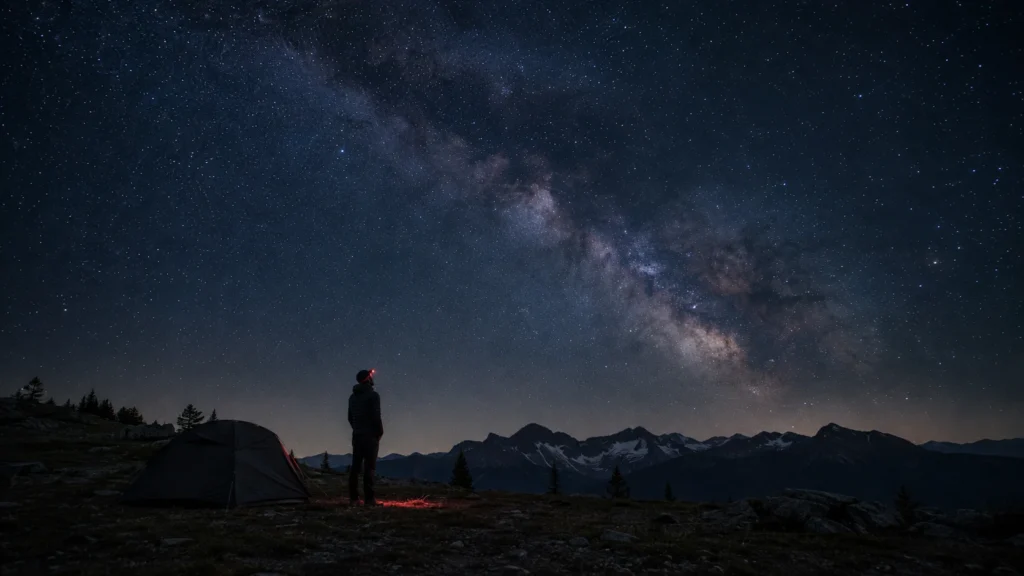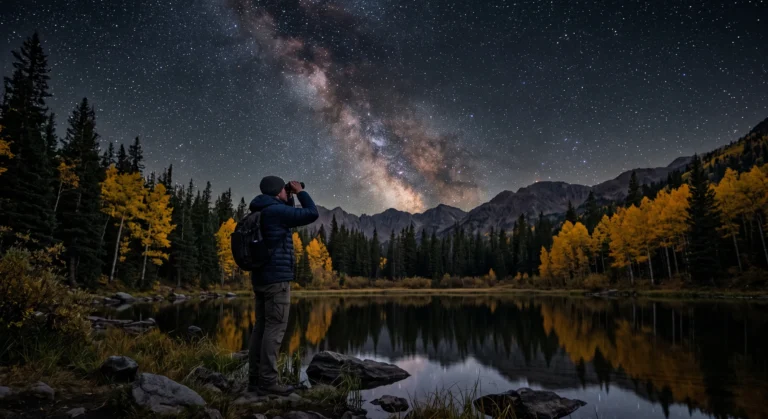

There is a thing that happens to people the first time they see a truly dark sky.
I’ve watched it happen to others, and I remember it happening to me. You step out of your tent, walk away from the campfire, or switch off your headlamp—and then you look up.
Something shifts.
The sky is not dark. It is full. Terrifyingly, overwhelmingly full. A river of cold white light stretches from one horizon to the other, textured and three-dimensional in a way no photograph has ever truly captured. Your brain—this magnificent, overconfident, pattern-recognizing machine that usually has an explanation for everything—simply goes quiet.
Because what you’re looking at isn’t a backdrop. It’s your home.
That glowing band overhead is the combined light of roughly 100 to 400 billion stars spread across the Milky Way’s flattened disk, seen edge-on from our position about two-thirds of the way out from the galactic center. You’re looking at your own galaxy from the inside. You are inside the painting, looking at the canvas.
Most people on Earth never experience this. A 2016 study published in Science Advances, which used satellite data to create the first global atlas of artificial night-sky brightness, estimated that roughly one-third of humanity, including 60% of Europeans and about 80% of Americans, can no longer see the Milky Way from where they live because of light pollution. A sky that every human before the electric age took for granted has, in just a few generations, become something people must deliberately travel to find.
This guide is about five of the best places on Earth to do exactly that. Each offers exceptionally dark skies, unforgettable camping, and the chance to experience the Milky Way as most people alive today never will.
Dark Sky Camping: What You’re Actually Looking At
Before we talk about destinations, I want to give you one piece of scientific context that will make the experience even richer.
When you stand beneath a truly dark sky, you are not seeing one of the Milky Way’s spiral arms as a distinct, sweeping structure the way space telescopes photograph them. After all, we’re inside the galaxy, and the view from within is very different from the view from outside.
What you are actually seeing is the galactic plane: the dense, flattened disk of the Milky Way, filled with hundreds of billions of stars, dark dust clouds, and glowing nebulae, viewed edge-on from our position in the Orion Arm (also called the Local Arm), between the larger Sagittarius and Perseus arms.
When you look toward the constellation Sagittarius during Northern Hemisphere summer, you’re looking almost directly toward the Milky Way’s galactic centre, about 26,000 light-years away. Hidden there is Sagittarius A*, the supermassive black hole at the heart of our galaxy, surrounded by an extraordinarily dense concentration of ancient stars. The view overhead may not resemble the classic spiral photographs you’ve seen from space—but it is something even more remarkable: the experience of seeing your own galaxy from within.
Astronomers use the Bortle Scale to describe the darkness of the night sky. Developed by amateur astronomer John E. Bortle and published in Sky & Telescope magazine in 2001, it ranks skies from Class 1 (the darkest) to Class 9 (the brightest urban skies). Under a Bortle 9 sky, only the Moon, planets, and a handful of stars remain visible. Under a Bortle 1 sky, the Milky Way becomes richly textured, dark dust lanes are obvious, the Andromeda Galaxy is easy to spot with the naked eye, and even the faint natural glow of Earth’s atmosphere—known as airglow—can sometimes be seen.
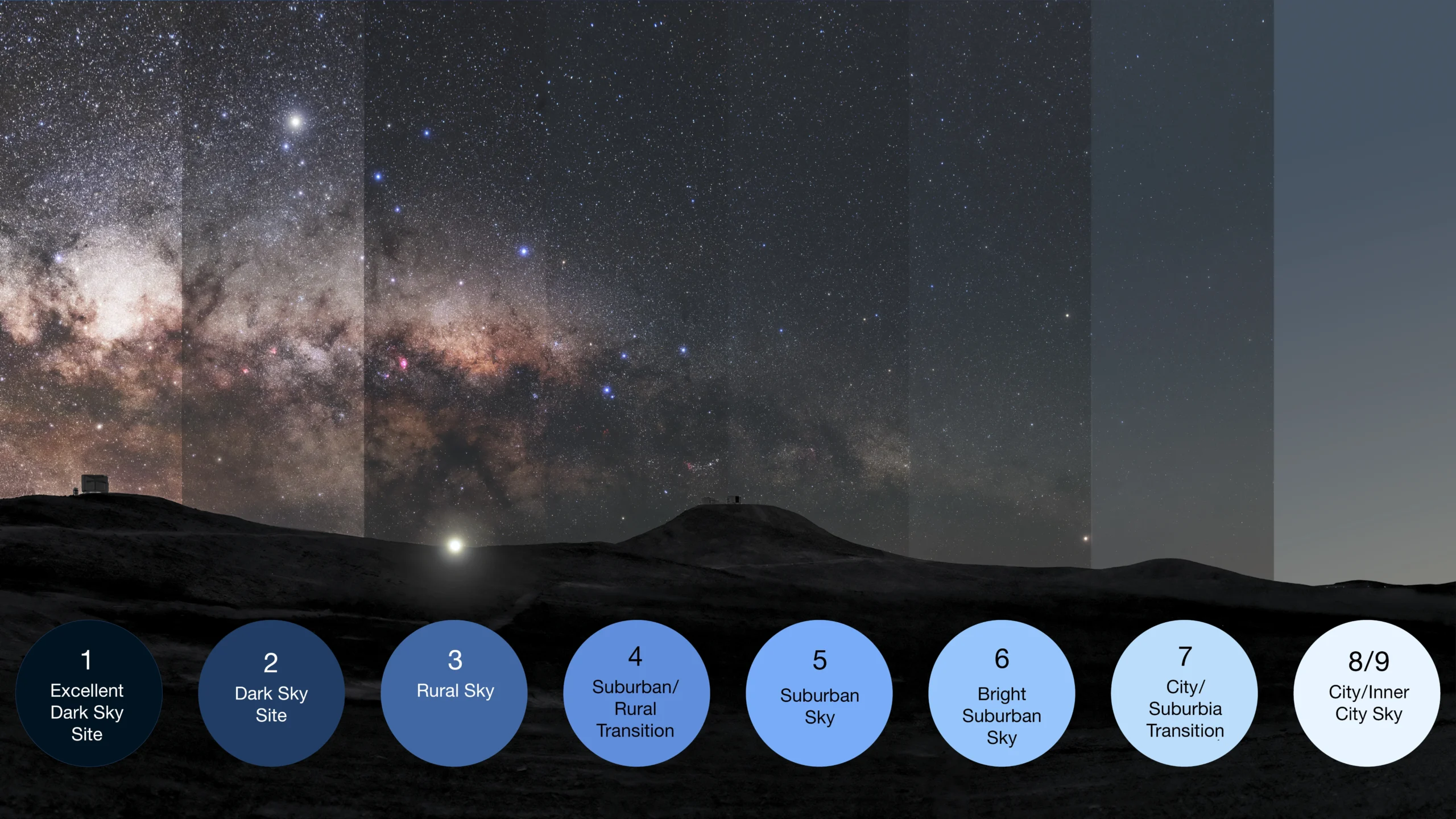
Every destination in this guide offers Bortle Class 1 or Class 2 skies, among the darkest and clearest you can experience anywhere on Earth.
Before You Pack
No matter where you go, three things will matter more than the destination itself:
Choose a moonless night. A bright Moon can wash out much of the Milky Way, even in the world’s darkest locations.
Check the weather. Clear skies and low humidity make an enormous difference to visibility.
Give your eyes time to adjust. Avoid white lights and allow 20–30 minutes for your night vision to fully develop.
1. The Atacama Desert, Chile — The Best Sky in the World Has a Street Address
Bortle Scale: 1 | Coordinates: ~22°S, 68°W | Best months: May through November (Southern Hemisphere autumn and winter)
If you asked professional astronomers, the scientists whose careers depend on the quality of the night sky, to point at a map and say, “Here. This is the best sky on Earth,” a significant majority of them would point to a high plateau in northern Chile and not move their finger.
The Atacama Desert is home to more major astronomical observatories than any other place on the planet, including the European Southern Observatory’s Very Large Telescope at Paranal, the ALMA radio telescope array at Llano de Chajnantor, and the future Extremely Large Telescope under construction at Cerro Armazones.
These facilities are not in the Atacama by accident. They are there because the combination of conditions that define this sky is almost impossibly good.
Altitude plays a major role. San Pedro de Atacama sits at roughly 2,400 metres above sea level, while many of the observatories are even higher. The desert is also extraordinarily dry. Some parts receive less than one millimetre of rain each year, making it the driest non-polar desert on Earth.
Add hundreds of kilometres of isolation from major population centres and exceptionally stable atmospheric conditions that minimise the turbulence that blurs starlight, and you have one of the clearest observing sites on the planet.
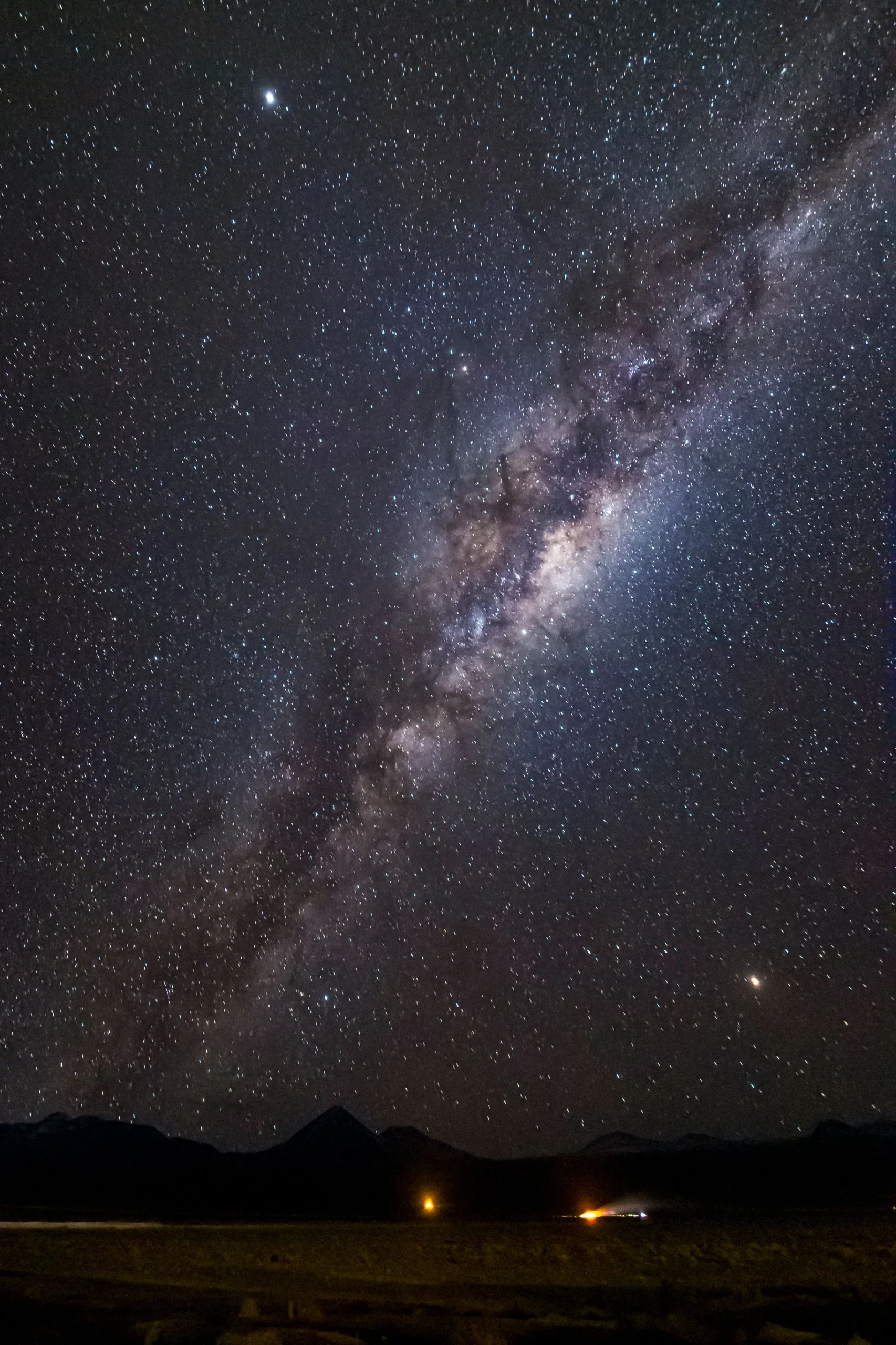
In practical terms, there is almost no humidity to scatter light, few aerosols, very little cloud cover, and virtually no city glow. Just the sky at a level of clarity that first-time visitors often describe as almost surreal.
What you’ll actually see
Under a Bortle 1 Atacama sky, the Milky Way is not simply a band of light. It becomes a structure. Dark dust lanes stand out as distinct, three-dimensional shadows winding through dense star fields.
The Eta Carinae Nebula, a vast stellar nursery about 7,500 light-years away, is visible to the naked eye as a bright, diffuse patch. The Large and Small Magellanic Clouds, companion dwarf galaxies orbiting the Milky Way at distances of roughly 160,000 and 200,000 light-years respectively, appear like detached fragments of the galaxy itself.
On moonless nights near the spring equinox, you may also see the Zodiacal Light, a faint cone of light extending along the plane of the Solar System, created by sunlight reflecting from interplanetary dust. It is one of the most subtle and beautiful sights visible to the naked eye.
If you want to capture a view like this, our guide on How to Photograph the Milky Way With Your Smartphone explains how to do it without expensive gear.
For the camper
Valle de la Luna and Valle de la Muerte, just outside San Pedro de Atacama, offer spectacular camping opportunities with outstanding access to dark skies. Travelling south toward Salar de Atacama takes you even farther from the small amount of light pollution generated by the town.
Bring serious cold-weather clothing regardless of the season. High-altitude desert nights are surprisingly harsh, and temperatures regularly fall to -5°C or lower, even during the Southern Hemisphere summer.
If you’re planning your first overnight stargazing trip, our guide to camping safely under dark skies covers wildlife awareness, campsite safety, and other essentials before you head out.
2. NamibRand Nature Reserve, Namibia — The First Dark Sky Reserve in Africa
Bortle Scale: 1 | Coordinates: ~25°S, 16°E | Best months: May through August (Southern Hemisphere winter, dry season)
NamibRand is Africa’s first International Dark Sky Reserve, officially certified by the International Dark-Sky Association (IDA) as a Gold Tier reserve in 2012, the highest designation the organization awards.
It sits deep within the Namib Desert in southern Namibia, one of the oldest deserts on Earth, estimated to be between 55 and 80 million years old. The reserve covers roughly 2,000 square kilometres of remote desert landscape, including sand dunes, gravel plains, isolated rocky inselbergs, and an almost complete absence of artificial light.
The science behind Namibia’s extraordinary sky is similar to the Atacama’s. Extreme aridity, high elevation, and genuine remoteness from major population centres combine to produce exceptionally dark, stable skies.
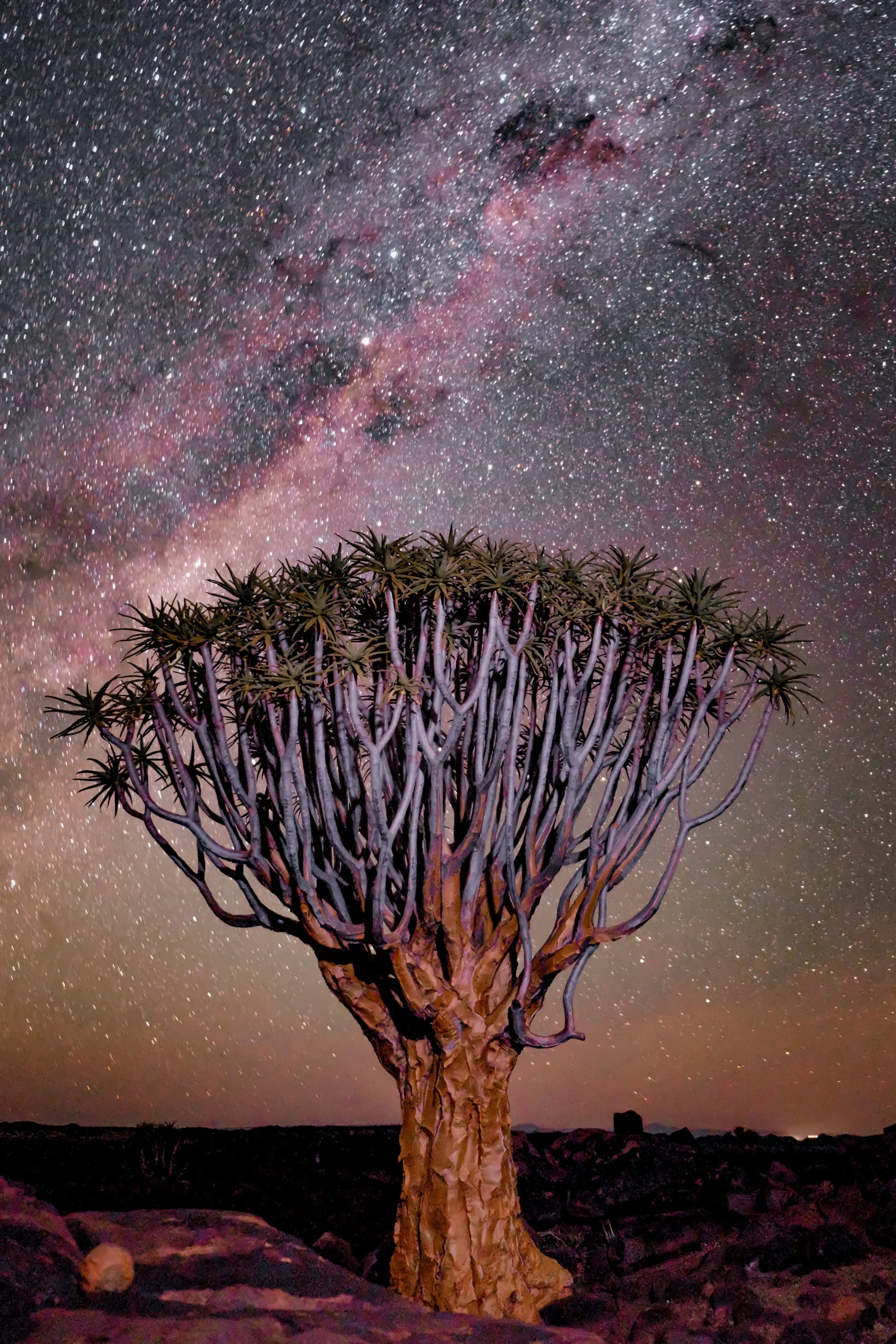
But NamibRand offers something the Atacama cannot.
The landscape is so visually spectacular that the ground competes with the sky for your attention. During the day, the dunes glow amber, ochre, and deep red beneath the desert sun. After sunset, they become black silhouettes beneath a sky filled with more stars than most people have ever imagined.
What you’ll actually see
From roughly 25° south latitude, NamibRand offers an outstanding view toward the Milky Way’s galactic centre. During winter evenings, the Milky Way can appear almost vertical as it climbs across the sky, giving the remarkable sensation of looking directly into the brightest, most densely populated region of our galaxy.
The Southern Cross (Crux), invisible to anyone north of about 25°N latitude, hangs prominently in the southern sky. The Eta Carinae Nebula and Omega Centauri, a globular cluster containing roughly 10 million ancient stars about 17,000 light-years away, are both visible to the naked eye under excellent conditions.
On the very best nights, experienced observers even report seeing faint shadows cast by the light of the Milky Way on pale surfaces.
For the camper
NamibRand operates as a private nature reserve and conservation concession, so camping requires booking through one of the lodges or properties within the reserve. This is not a destination where you simply arrive and pitch a tent.
The reward, however, is extraordinary. The reserve’s dark sky certification requires strict lighting standards throughout the property, ensuring that even the small amount of human infrastructure has minimal impact on the night sky.
3. Aoraki Mackenzie International Dark Sky Reserve, New Zealand — The Largest Dark Sky Reserve on Earth
Bortle Scale: 1–2 | Coordinates: ~43°S, 170°E | Best months: June through September (Southern Hemisphere winter)
The Aoraki Mackenzie International Dark Sky Reserve on New Zealand’s South Island is one of the largest dark sky reserves in the world, covering approximately 4,300 square kilometres of the Mackenzie Basin and the surrounding mountain landscape, including Aoraki / Mount Cook National Park.
It received International Dark-Sky Association (IDA) certification in 2012 as the first Gold Tier reserve in the Southern Hemisphere. Today, it remains one of the few places where a permanent community lives beneath a protected dark sky.
The reserve is centred on the Mackenzie Basin, a high-altitude glacial plain bordered by the Southern Alps to the west and the Two Thumb Range to the east.
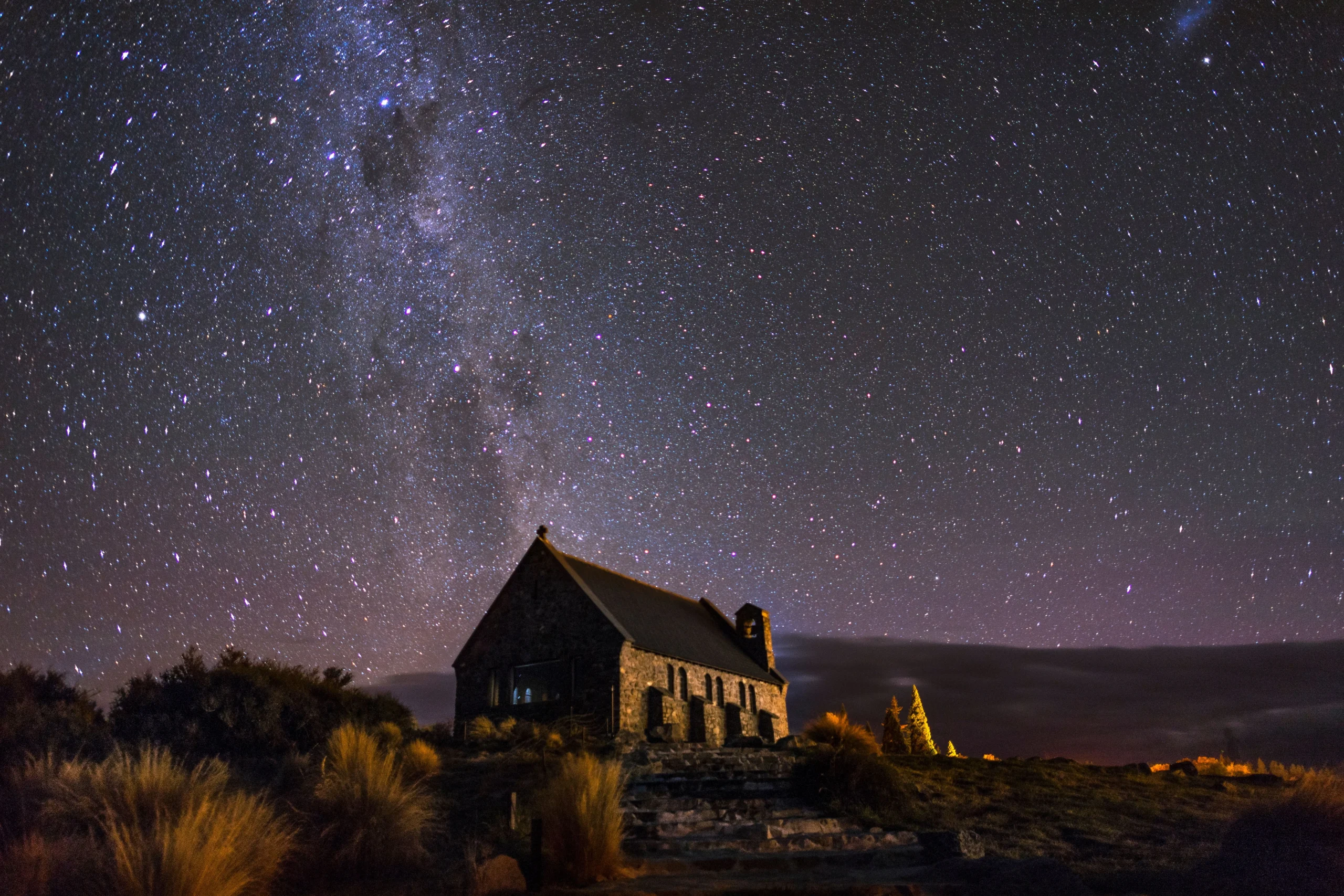
Its geography is a major reason for the exceptional observing conditions. The basin sits inland, away from the coastal moisture that affects much of New Zealand. At an elevation of roughly 700 to 800 metres and far from the South Island’s modest population centres, it benefits from remarkably low levels of light pollution.
Regional lighting ordinances further protect the darkness by regulating the colour temperature and direction of outdoor lighting across the district.
What you’ll actually see
By day, Lake Tekapo is famous for its vivid turquoise water. At night, its calm surface often reflects the stars with remarkable clarity, creating one of the world’s most photogenic night landscapes.
Both the Large and Small Magellanic Clouds are easily visible. The Milky Way’s galactic centre rises high in the northern sky, which, from the Southern Hemisphere, is the direction of the celestial equator.
Visitors from the Northern Hemisphere often find the familiar constellations delightfully disorienting. Orion appears upside down, Scorpius stretches high across the sky, and the Southern Cross quietly points toward the south celestial pole.
The reserve also offers exceptional naked-eye views of Omega Centauri, the Eta Carinae Nebula, and the Carina-Sagittarius region of the Milky Way with extraordinary clarity.
For the camper
New Zealand’s Department of Conservation (DOC) operates several campgrounds throughout the reserve, including sites in the Mackenzie Basin and Aoraki / Mount Cook National Park. Lake Tekapo also offers accommodation, supplies, and other essential services for travellers.
July and August provide some of the year’s finest night skies, but temperatures regularly fall well below freezing.
New Zealand’s well-established freedom camping system also gives self-contained camper vans with approved waste facilities access to many designated overnight locations throughout the region.
4. Cherry Springs State Park, Pennsylvania, USA — The Island of Darkness in the East
Bortle Scale: 2 | Coordinates: ~41.6°N, 77.8°W | Best months: April through October
Every location on this list so far has been in the Southern Hemisphere or in a remote desert.
Cherry Springs earns its place precisely because it shouldn’t be here.
It is in Pennsylvania, in the eastern United States, within a day’s drive of Philadelphia, New York City, Pittsburgh, and Washington, D.C. Together, these metropolitan areas are home to tens of millions of people and some of the most severe light pollution in North America.
And yet, on a clear, moonless night, Cherry Springs State Park offers Bortle 2 skies.
The explanation is equal parts geological luck and political will.
The park sits on a ridge about 694 metres above sea level in the Pennsylvania Wilds, surrounded by hundreds of thousands of acres of Susquehannock State Forest. The surrounding ridges help block light from nearby towns and cities, creating a natural pocket of darkness that is exceptionally rare in the eastern half of the continent.
Recognising the value of this resource, Pennsylvania designated Cherry Springs as the first Dark Sky Park in the eastern United States and introduced lighting policies to help preserve its remarkable night sky.
What you’ll actually see
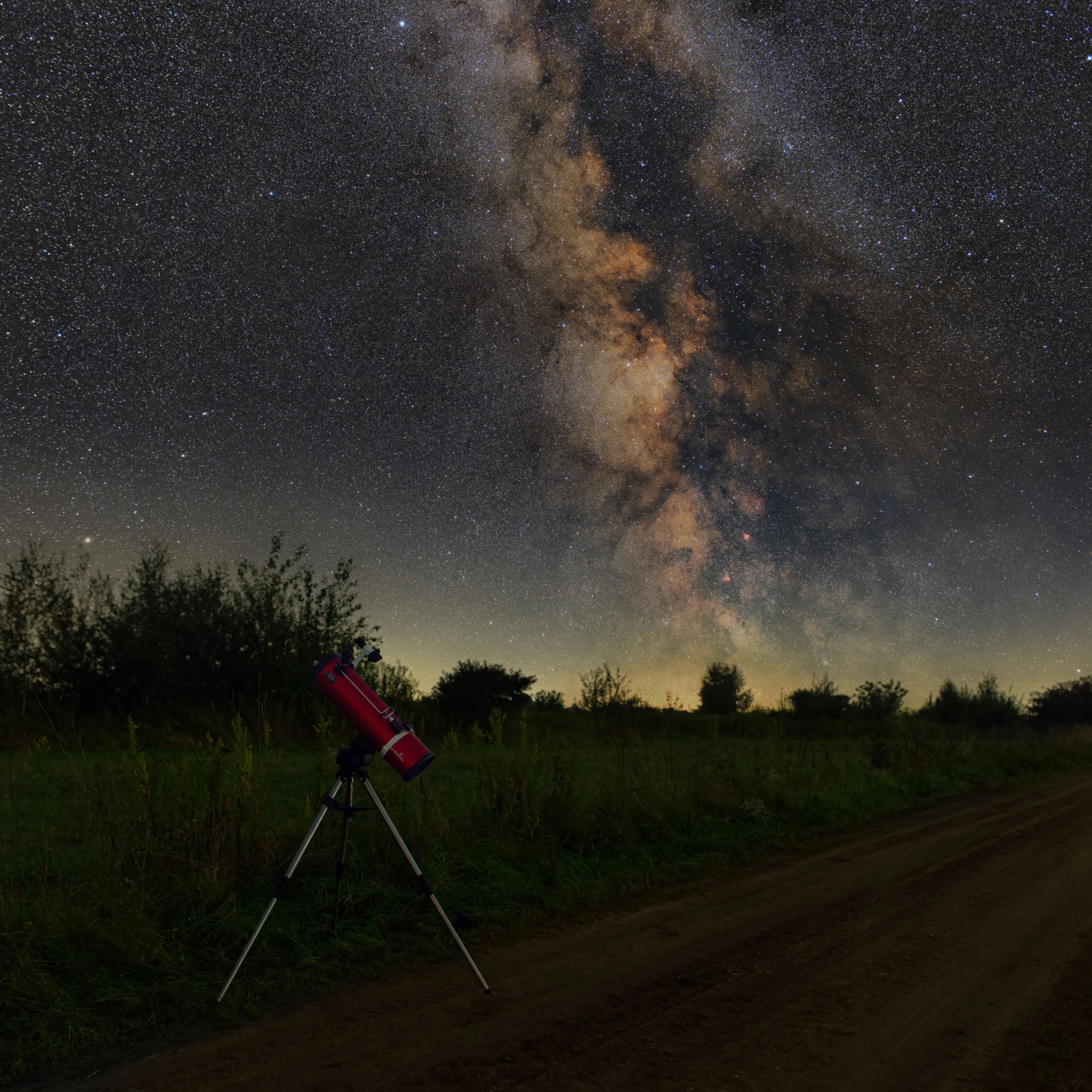
For travellers in eastern North America who cannot easily reach Chile or Namibia, Cherry Springs offers something genuinely rare: a place where the Milky Way appears not as a faint haze but as a richly textured river of light crossing the sky.
Although the galactic centre sits lower above the southern horizon than it does from Southern Hemisphere destinations, it remains an unforgettable sight. Dense star clouds and prominent dark dust lanes become clearly visible to the naked eye under good conditions.
The Andromeda Galaxy (Messier 31) is also easy to spot as a large, elongated glow. The photons entering your eyes left that galaxy roughly 2.5 million years ago, when Homo habilis was still working out what hands were for.
Cherry Springs also features a dedicated astronomical observing field designed to minimise even the smallest sources of artificial light. After sunset, white lights are prohibited to protect everyone’s night vision.
One of the park’s greatest strengths is its community. Amateur astronomers, astrophotographers, and first-time visitors gather on the observing field, and it is not unusual for complete strangers to invite others to look through their telescopes.
For the camper
Cherry Springs offers overnight camping on its dedicated Astronomy Observation Field, specifically designed for stargazers. Summer weekends and new moon periods often book months in advance, so reservations through Pennsylvania State Parks are strongly recommended.
The campground is simple, well maintained, and purpose-built for astronomy. If possible, plan your visit around the new moon, when the Milky Way is at its most spectacular.
5. Wadi Rum, Jordan — Where the Desert Remembers the Stars Have Names
Bortle Scale: 2–3 | Coordinates: ~29.6°N, 35.4°E | Best months: April through November
Wadi Rum is the place that makes you understand why ancient civilizations built their ideas of time, navigation, religion, and cosmology around the night sky.
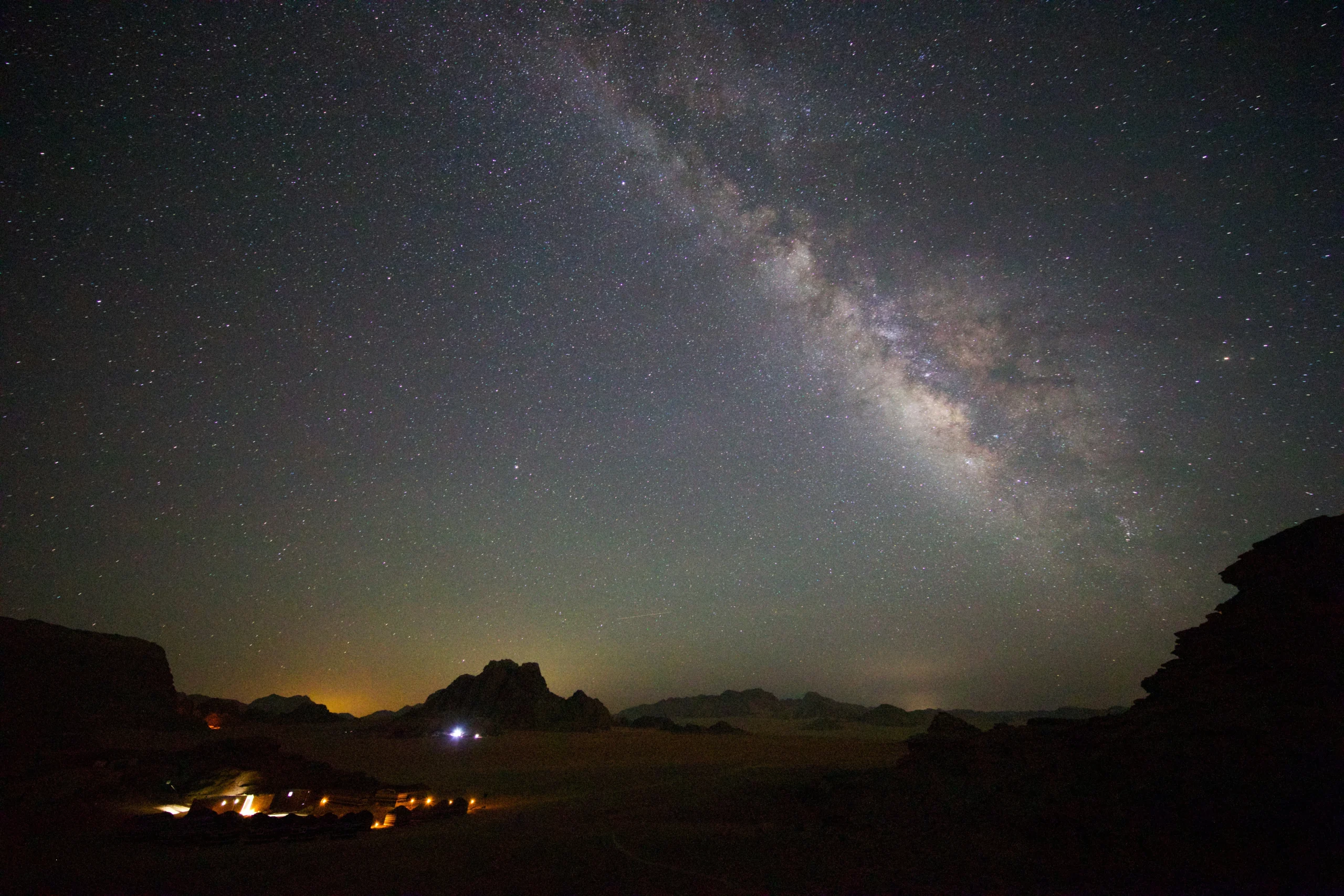
This landscape of sandstone mountains and red desert valleys lies in southern Jordan, about 60 kilometres from Aqaba near the Saudi border. It is a UNESCO World Heritage Site, recognised for both its dramatic natural landscape and the thousands of years of human history carved into its rock faces.
Nabataean inscriptions, prehistoric rock art, and archaeological sites share the desert with memories of the Arab Revolt, when T. E. Lawrence passed through these valleys during 1917 and 1918. More recently, Wadi Rum has stood in for Mars in countless films.
At night, however, it becomes something else entirely.
What makes Wadi Rum unique on this list is not that it is the darkest destination. The Atacama Desert and NamibRand are slightly darker. Instead, it may be the most accessible world-class dark sky experience anywhere on Earth.
The landscape transforms after sunset. The red desert floor releases the warmth it absorbed during the day. Towering sandstone formations become black silhouettes against a sky overflowing with stars. Bedouin camps offer sweet tea, conversation, and a chance to experience the desert with people whose families have lived beneath these skies for generations.
Many of the star names used in modern Western astronomy are derived from Arabic. Experiencing the night sky alongside Bedouin guides who still know those traditional names adds a cultural dimension that is difficult to find anywhere else.
What you’ll actually see
Under Bortle 2 to 3 skies, Wadi Rum offers an exceptional view of the Milky Way from roughly April through November, with the galactic centre well placed in the southern sky during the summer months.
From Jordan’s latitude of about 30°N, observers enjoy a much better view of the southern Milky Way than they would from most of Europe or northern North America. Scorpius, Centaurus, and the lower reaches of the galactic core all become prominent features of the night sky.
The desert’s character also helps. The air is typically very dry, often producing excellent atmospheric transparency on clear nights.
Lying on warm desert sand while the Milky Way slowly rotates overhead is unforgettable. Then, just when you think the night cannot become more memorable, a Bedouin guide quietly points toward another constellation, sharing stories and names passed from one generation to the next.
For the camper
Numerous Bedouin-operated camps offer overnight stays with transparent tent roofs or open sleeping areas designed specifically for stargazing. Guided jeep tours and overnight hikes venture deep into the desert, far beyond the small visitor centre and its limited lighting.
Jordan is also surprisingly accessible. Queen Alia International Airport in Amman connects with major international hubs, and the drive south to Wadi Rum is straightforward.
If you’re planning your visit during Ramadan, check schedules in advance, as accommodation, dining hours, and other services may operate differently.
One Last Thing: The Light Pollution Map Is Free
Before you go anywhere, there is a tool I want you to know about. It is called Light Pollution Map (lightpollutionmap.info), and it overlays satellite-measured sky brightness data — from the research behind that 2016 Science Advances atlas mentioned at the top of this piece — onto a standard interactive map. You can zoom anywhere on Earth and see, in real time, the actual Bortle classification of that location.
The first time you use this tool, do something for me. Zoom out. Look at Europe, look at the eastern United States, look at coastal China and Japan. Then look at the deserts, the mountain ranges, the empty oceans. Then understand: the darkness is not gone. It has simply retreated to the places that require intention to reach.
That’s not a tragedy. That’s an invitation.
Somewhere on that map, under a sky that has not meaningfully changed in a billion years, a patch of wilderness is waiting. The galaxy is turning overhead, indifferent and magnificent. The arm you want to see is 100,000 light-years wide, made of stars older than the Earth itself, and on a clear moonless night from any one of these five coordinates, it fits completely inside your field of view.
Dark sky camping isn’t just about finding darker skies. It’s about reconnecting with a night sky most people never get to experience.
Pack a sleeping bag rated five degrees colder than you think you’ll need. Leave the headlamp in the bag. Walk away from the fire.
And look up.
Where was the first truly dark sky you ever saw? Drop it in the comments. I collect these stories, and I’ve never read one that wasn’t worth reading.