

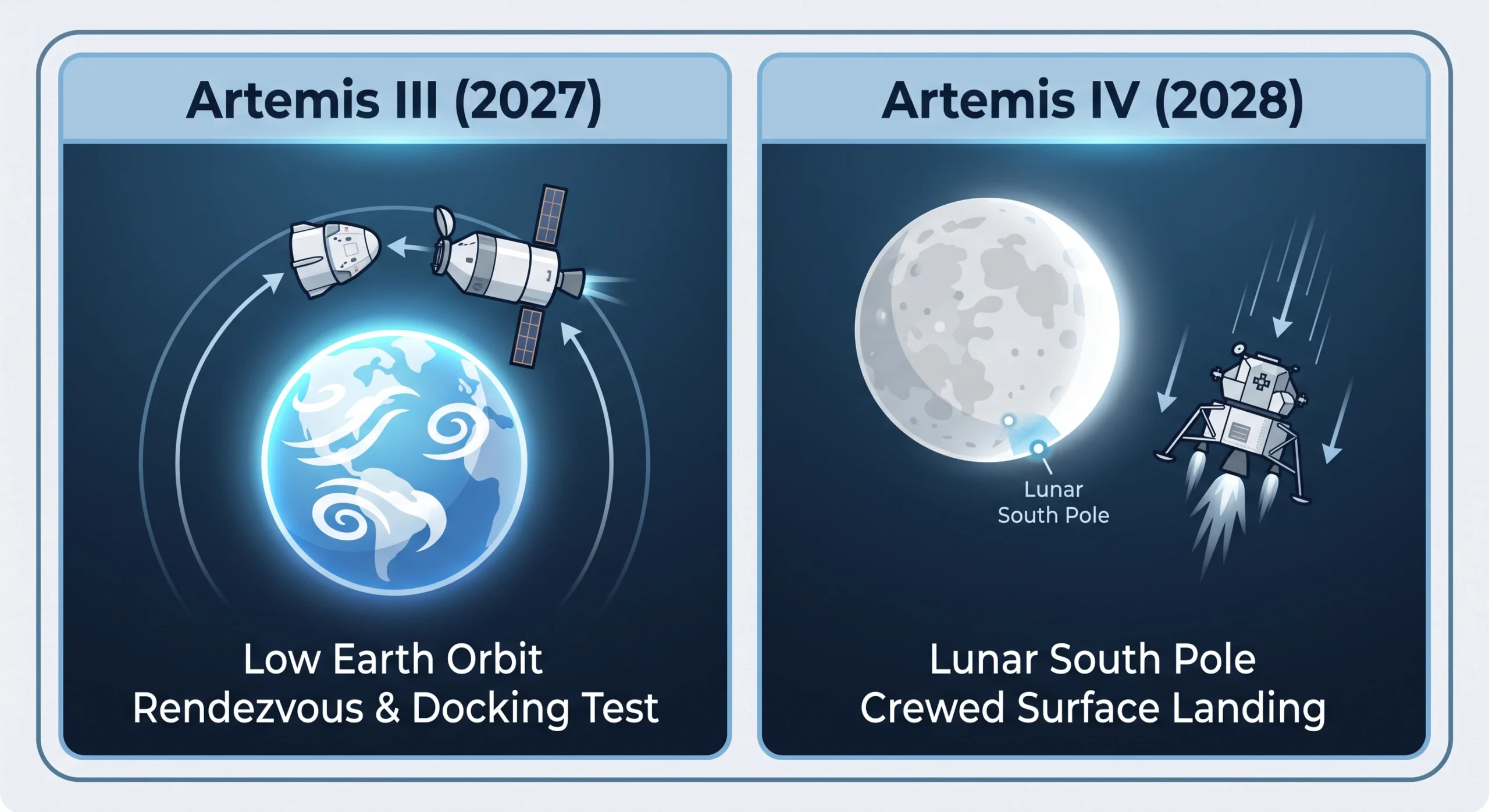
If you look up Artemis III today, most of what you find will tell you it is the mission that puts humans back on the Moon at the lunar south pole. That was true until February 2026, when NASA restructured the mission.
Artemis III is now a two-week crewed test flight in low Earth orbit, targeted for 2027. It does not go to the Moon. The first crewed landing at the lunar south pole is now Artemis IV, planned for 2028.
This matters if you are following the programme, because a great deal of published material, including some pages that have not been updated, still describes the old plan. Here is what the mission actually is now, why it changed, and what it means for the landing everyone is waiting for.
What Artemis III will actually do in 2027
Artemis III has become a rendezvous and docking demonstration, and it is a more useful mission than that description makes it sound.
Four astronauts launch aboard Orion on the Space Launch System into low Earth orbit. Over roughly two weeks they will rendezvous and dock with test versions of the two commercial human landing systems under development, SpaceX’s Starship HLS and Blue Origin’s Blue Moon Mark 2. The plan involves docking with one or both pathfinder vehicles for systems checks and technology demonstrations.
NASA named the crew on 9 June 2026:
- Randy Bresnik (NASA), commander
- Luca Parmitano (ESA), pilot, the first European Space Agency astronaut assigned to an Artemis mission
- Andre Douglas (NASA), mission specialist
- Frank Rubio (NASA), mission specialist
- Bob Hines (NASA), backup
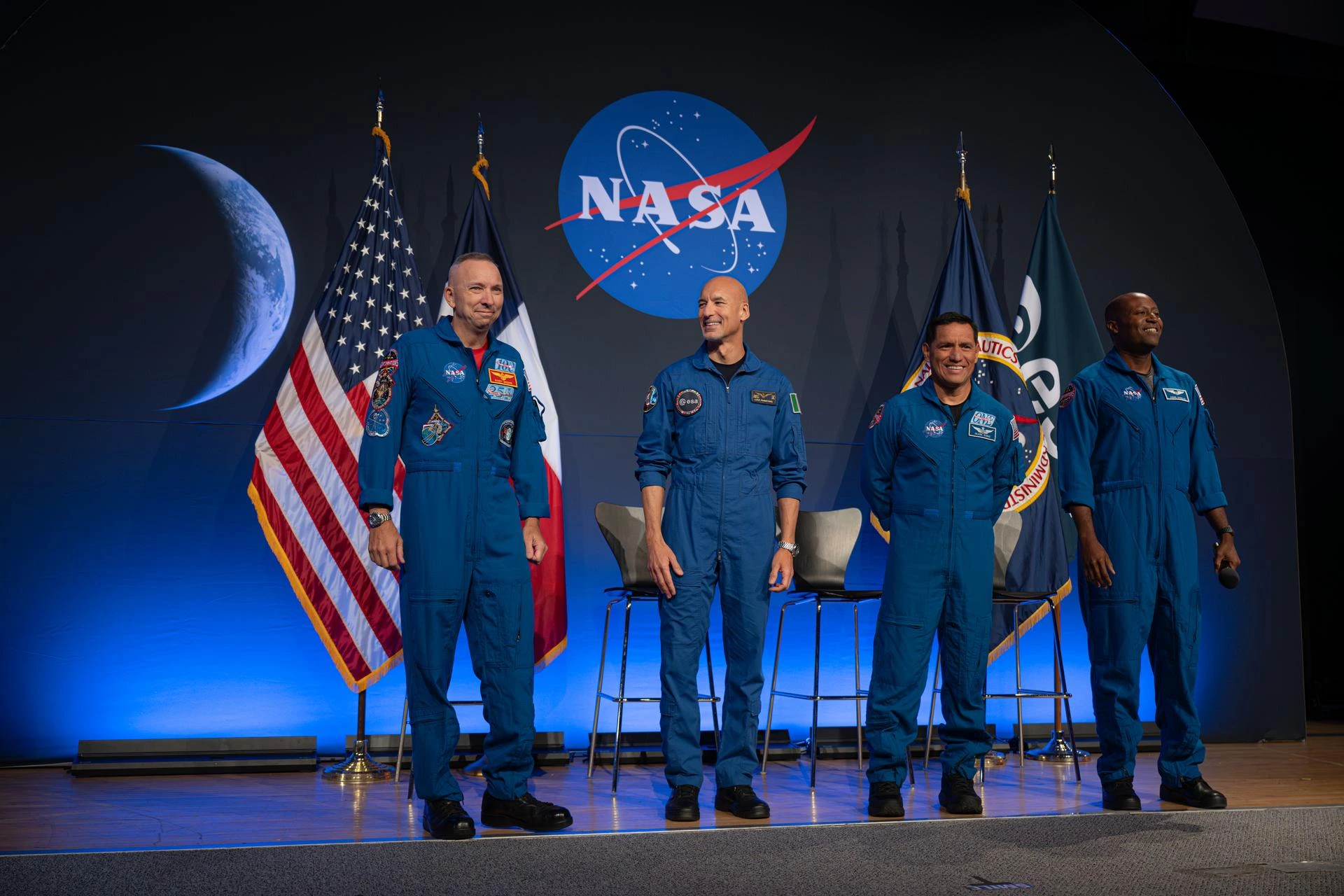
Photo Credit: (NASA/John Kraus)
The docking is the point. Before a crew can ride a lander down to the lunar surface, Orion has to be able to meet that lander in space and transfer people between two vehicles built by different organisations to different standards. Doing that for the first time in Earth orbit, where an abort means coming home in hours, is a reasonable way to find problems.
Why NASA made the change
The restructure was driven by the landers not being ready, and by a quieter scheduling problem that turns out to matter just as much.
The Starship Human Landing System has run behind schedule. A 2026 report from NASA’s Office of Inspector General flagged the risk that the lander might not be ready even for a 2028 landing, and pointed at two milestones that have not happened: SpaceX has not demonstrated in-space propellant transfer, and has not flown an uncrewed Starship HLS test mission to the Moon. Propellant transfer is not a detail. The Starship lander architecture requires multiple tanker flights to refuel a depot in orbit before the lander can depart for the Moon, so if that does not work, nothing downstream works.
The second reason is about launch windows. A mission that leaves Earth orbit for the Moon has to depart within a narrow window determined by orbital geometry. A mission that stays in low Earth orbit does not. With three separate vehicles involved, each with its own launch preparation and its own chance of a delay, keeping everything in Earth orbit widens the window enormously and raises the odds that the mission flies at all.
So the change is less a retreat than a reordering. The hardware that exists gets tested now, and the landing waits for the lander.
The south pole landing is now Artemis IV
The mission everyone actually wants has moved by roughly a year and changed its number.
Artemis IV, planned for 2028, is now the first crewed mission to the lunar south pole. A crew would descend aboard the Starship Human Landing System and take the first human steps on the Moon since December 1972, when Apollo 17 left.
Treat the 2028 date with the same caution as every previous Artemis date. The programme has a consistent record of schedule slips, and NASA’s own inspector general has already questioned whether the lander will be ready for it. Nobody outside the programme should be confident about the year.
Why the south pole, and not somewhere easier
The destination has not changed even though the mission numbering has, and the reason is water.
The Moon has almost no axial tilt, about 1.5 degrees, compared with Earth’s 23.4. That means near the poles the Sun never rises far above the horizon. And while the rest of the lunar night is frequently illuminated by the faint reflected glow of earthshine, the floors of deep polar craters never see light at all. These are permanently shadowed regions, and some of them have been dark for billions of years.
They are also extraordinarily cold. Temperatures in the coldest permanently shadowed regions fall to around 40 kelvin, roughly minus 233 Celsius, which is among the lowest natural temperatures anywhere in the solar system. At that temperature a water molecule that lands on the surface does not have enough thermal energy to escape again. A molecule deposited on a crater floor two billion years ago is, in all likelihood, still sitting exactly where it landed.
The evidence that this actually happened is direct. In 2009 NASA’s LCROSS mission deliberately crashed a spent rocket stage into Cabeus crater near the south pole and flew a second spacecraft through the debris plume to analyse it. It found water ice, along with other volatiles. Ice in the Cabeus ejecta reached roughly 5.6 percent water by mass, considerably more than pre-mission estimates.
Later work suggests that in some permanently shadowed regions around 20 percent of the near-surface material may be water ice. The cold traps capable of holding it cover something like 40,000 square kilometres in total, with around 60 percent of that in the southern polar region.
Water is the reason this is worth the difficulty. It is drinking water, it is breathable oxygen, and split into hydrogen and oxygen it is rocket propellant. Every kilogram already on the Moon is a kilogram that does not have to be launched from Earth.
Shackleton Crater and the problem of standing in the dark
The landing sites under consideration solve a specific and slightly strange engineering problem.
Shackleton Crater sits almost exactly at the lunar south pole. It is roughly 21 kilometres across and about 4 kilometres deep, and its floor is permanently shadowed, holding at around 90 kelvin.
The useful feature is not the floor but the rim. At least three points on Shackleton’s rim are collectively sunlit for more than 90 percent of the year, and the dark gaps between are short enough to be covered by battery storage. Portions of three of the thirteen candidate landing regions announced for the crewed landing appear in imagery of this crater.
That combination is what makes the south pole work: near-continuous sunlight for power, within walking or driving distance of permanent darkness holding ice. Nowhere else on the Moon offers both.
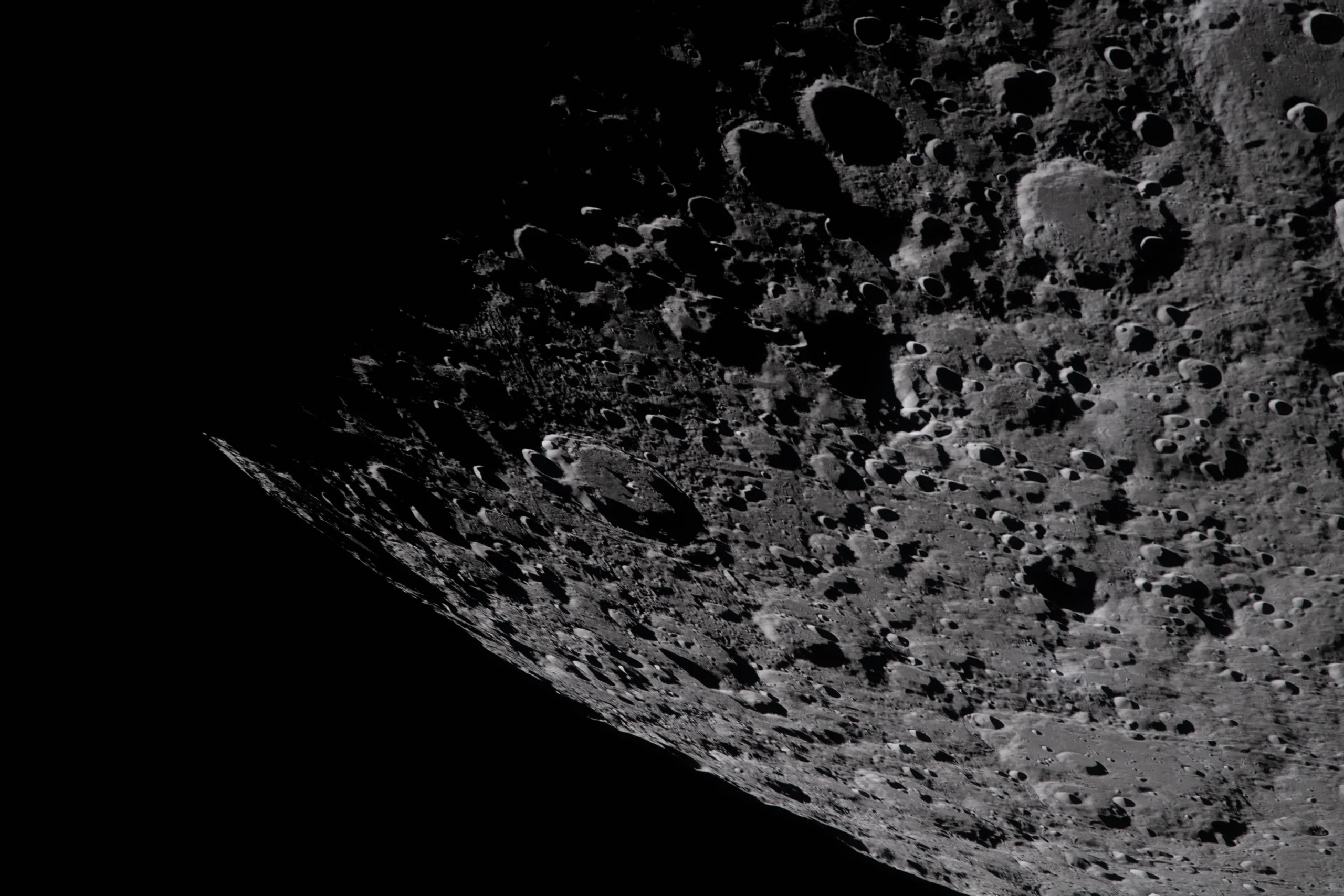
Image Credit: NASA
The operational picture that follows is unlike Apollo. Apollo landed in daylight near the equator and worked in it. A south pole crew works in permanent low-angle sunlight with shadows stretching for kilometres, in a landscape where the Sun skims the horizon and never climbs, and where stepping into a shadow means stepping into something close to the coldest place in the solar system.
The suit is being built for that, and it still has to be ready
The spacesuit for the surface mission is a genuinely difficult piece of engineering, and it is on the critical path.
NASA selected Axiom Space to build the surface suit, designated the AxEMU. It is derived from NASA’s own xEMU development work rather than starting from scratch.
The temperature range it has to survive is the headline requirement. At the lunar south pole, surfaces in direct sunlight can reach around 120 Celsius while permanently shadowed regions sit near minus 200. The suit is specified to withstand the full range and to endure the coldest shadowed conditions for at least two hours.
Some other details worth knowing:
- It is designed to accommodate from the 1st to the 99th percentile of body sizes, a direct response to the Apollo and shuttle era problem of suits built around a narrow range of body sizes.
- It allows the wearer to kneel and work at ground level, which Apollo suits made close to impossible.
- The outer layer was developed with Prada, using materials and stitching intended to reflect solar radiation and keep abrasive lunar dust out of the inner layers.
- The helmet uses an Oakley visor system with a gold coating to filter harmful wavelengths.

The dust problem is not a minor one. Lunar regolith is sharp, electrostatically clingy and got into everything during Apollo, degrading seals and visors over a handful of surface excursions. A suit intended for repeated use at a long-duration site has to handle it far better than Apollo’s did.
FAQ
No. Following a mission restructure in early 2026, Artemis III will remain in low Earth orbit. It is now a two-week demonstration flight designed to safely test critical rendezvous and docking procedures with commercial human landing systems before attempting a lunar descent.
The first crewed lunar landing is now assigned to the Artemis IV mission. NASA is currently targeting 2028 for this milestone, though the timeline remains heavily dependent on the readiness of the SpaceX Starship lander and successful in-space refuelling tests.
In the Artemis architecture, astronauts launch from Earth in the Orion spacecraft but must transfer to a separate commercial lander to reach the lunar surface. Practicing this complex docking manoeuvre in low Earth orbit allows engineers to test the systems safely, knowing the crew can return home in hours rather than days if an emergency abort is necessary.
The primary reason is water. Permanently shadowed craters at the lunar south pole act as deep-freeze traps, preserving ancient water ice. This ice is crucial for long-term space exploration, as it can theoretically be harvested and processed into drinking water, breathable oxygen, and rocket propellant.
The Apollo suits were designed for relatively brief excursions in equatorial daylight, and their rigid design made kneeling on the lunar surface almost impossible. The new Axiom surface suits (AxEMU) must allow for far greater mobility while keeping astronauts alive in the extreme, minus-200-Celsius cold of permanently shadowed polar craters.
What to expect, and what not to
The honest summary is that the programme is proceeding and the timeline is not reliable.
What is reasonably firm: Artemis III flies in Earth orbit, targeted for 2027, with a named crew, and demonstrates docking with lander test articles. That mission depends on hardware that largely exists.
What is genuinely uncertain: whether Artemis IV lands in 2028. That depends on Starship HLS completing in-space refuelling and an uncrewed lunar landing test first, neither of which has happened, and NASA’s own inspector general has said so plainly.
If you want one thing to watch that will tell you more than any press release, watch for a successful in-space propellant transfer between two Starship vehicles. Until that works, the lunar landing date is an intention rather than a schedule.