

Saturn has long been the crown jewel of the solar system, famous for its grand, sweeping rings. But every 15 years, those iconic features perform a stunning vanishing act. While 2026 is set to be a landmark year for skywatchers, especially for those chasing the 2026 total solar eclipse, Saturn is quietly staging an equally dramatic, if far subtler, optical show of its own as its rings reach an edge-on orientation relative to Earth.
If you pointed a telescope at Saturn right now, something would feel immediately off. As skywatchers gear up for the Saturn ring plane crossing 2026, the planet is still there: golden, steady, and unmistakable, but its famous rings look like someone drew a thin pencil line through the middle and called it a day. You’re not imagining it; the reason why is one of the more quietly mind-bending things in all of amateur astronomy.
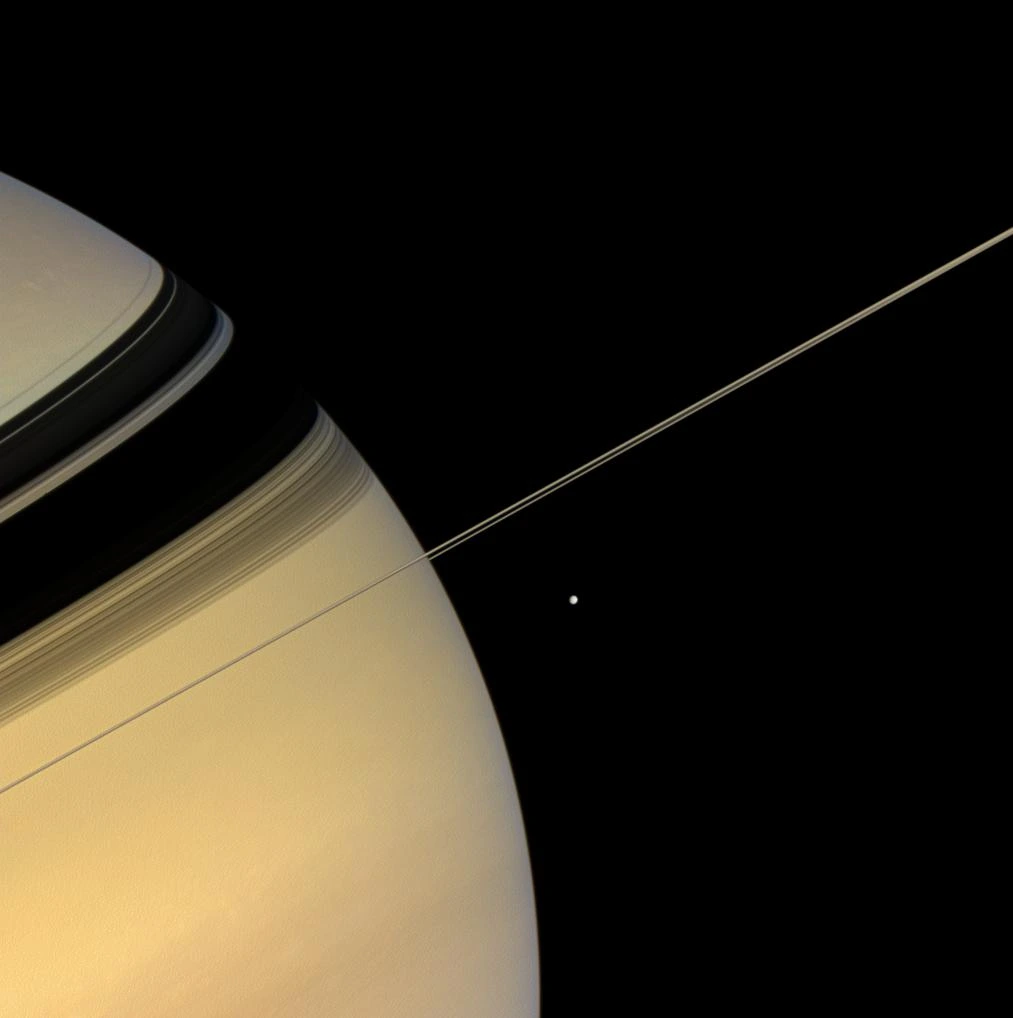
Image Credit: NASA / JPL-Caltech / Space Science Institute
What Galileo Saw And What It Did to Him
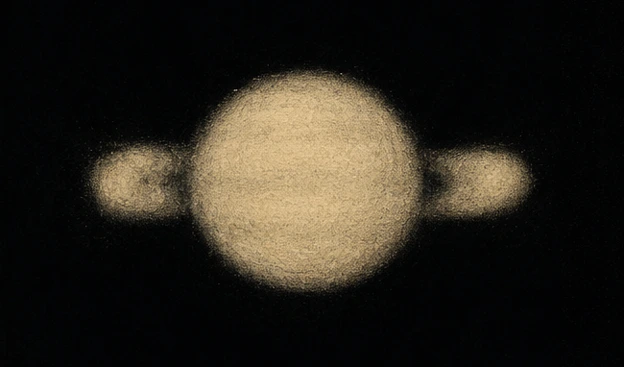
In 1610, Galileo became the first person to observe Saturn through a telescope. What he saw confused him completely. He wrote to his Medici patrons that he had found “another very strange wonder”, the planet appeared to have two round companions pressed right up against its sides, almost like ears. He thought they might be large moons.
Then in 1612, he looked again. The ears were gone. Just Saturn, alone, a plain circular disc. He wrote: “I do not know what to say in a case so surprising, so unlooked for and so novel.”
He reportedly stopped studying Saturn for a period. Gave up on it, more or less.
A few months later the ears came back. Then changed shape again. Galileo never figured out what he was seeing. It wasn’t until 1655, thirteen years after his death, that the Dutch astronomer Christiaan Huygens studied Saturn with a better telescope and finally worked out the truth: the planet was surrounded by a flat ring, inclined at an angle to its orbit, that changes its apparent shape as our viewing angle shifts.
What Galileo called “ears” was actually Saturn’s ring system changing appearance as Earth and Saturn moved through their orbits. During a ring-plane crossing, those rings become nearly invisible.
Understanding the Geometry of the Saturn Ring Plane Crossing 2026
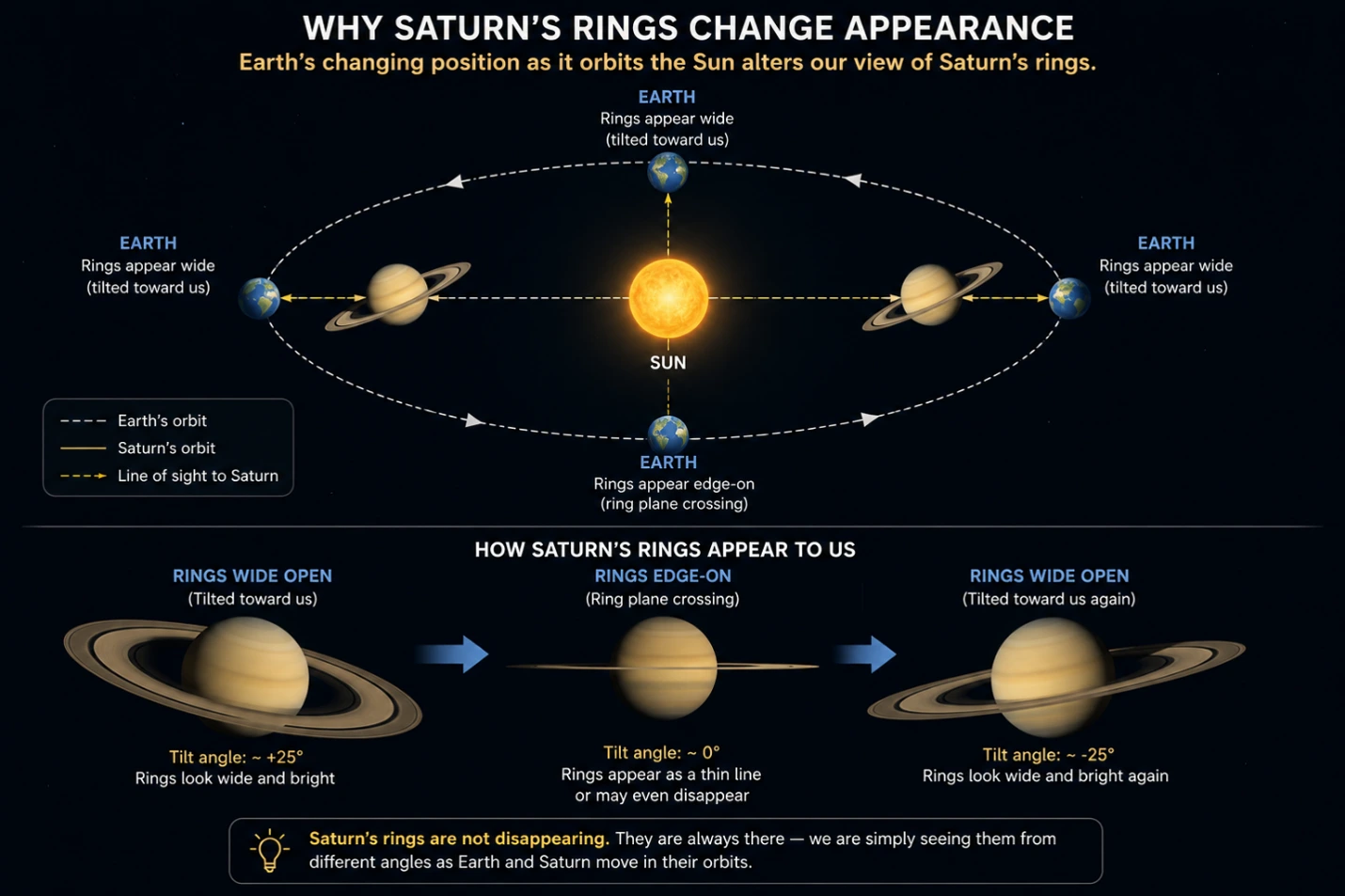
Saturn is tilted. Its axis leans at about 26.7 degrees relative to its orbital path around the Sun, not too different from Earth’s 23.5 degree tilt, which is what gives us our seasons. As Saturn makes its slow 29.5-year journey around the Sun, that tilt stays pointed in roughly the same direction in space while Saturn keeps moving. Which means our viewing angle on the ring changes continuously over time.
Think of holding a dinner plate at arm’s length. Tilt it toward you and you see the full face, a beautiful open circle. Now slowly rotate it back to edge-on. At a certain point it almost disappears. You’re looking at the edge of something that’s just not very thick.
That’s exactly what’s happening with Saturn’s rings.
Twice during Saturn’s orbit, Earth crosses the plane of the rings; an event astronomers call a ring plane crossing. The most recent one happened on March 23, 2025. Unfortunately, Saturn was too close to the Sun at that point to observe properly from Earth. But the geometry has been playing out ever since. In late 2025, around November 23rd, the rings reached their minimum apparent thickness as seen from our vantage point. Since then, they’ve been slowly, very slowly, tilting back toward us.
By the time Saturn reaches opposition on October 4, 2026, the rings will be tilted roughly 7.5 degrees relative to our line of sight. That’s better than November 2025. But it’s still quite shallow. For context, back in 2017 the rings were showing at about 27 degrees, nearly their maximum openness. That’s when the “classic” Saturn views come from, the ones on posters and phone wallpapers.
At only 7.5°, Saturn presents a dramatically different appearance.
Why the Rings Can Vanish at All
Here’s the part that should make your head spin a little.
Saturn’s main ring system stretches somewhere between 282,000 and 300,000 kilometers across. That’s nearly three-fourths of the distance from Earth to the Moon. An absolutely staggering width.
The thickness? Somewhere between 10 meters and about 1 kilometer, depending on which part of the ring system you’re measuring. The densest parts of Saturn’s main rings are thought to be only around 10 meters thick, although thickness varies across the ring system and can reach hundreds of meters in some regions.
So, you have a structure that is, in one direction, nearly tens of millions of times wider than they are thick. A piece of standard writing paper is over ten thousand times thicker than Saturn’s rings, proportionally. If you wanted to make a scale model of the rings using a sheet of paper, that paper would need to stretch for roughly 2–3 km long, depending on the assumed ring thickness.
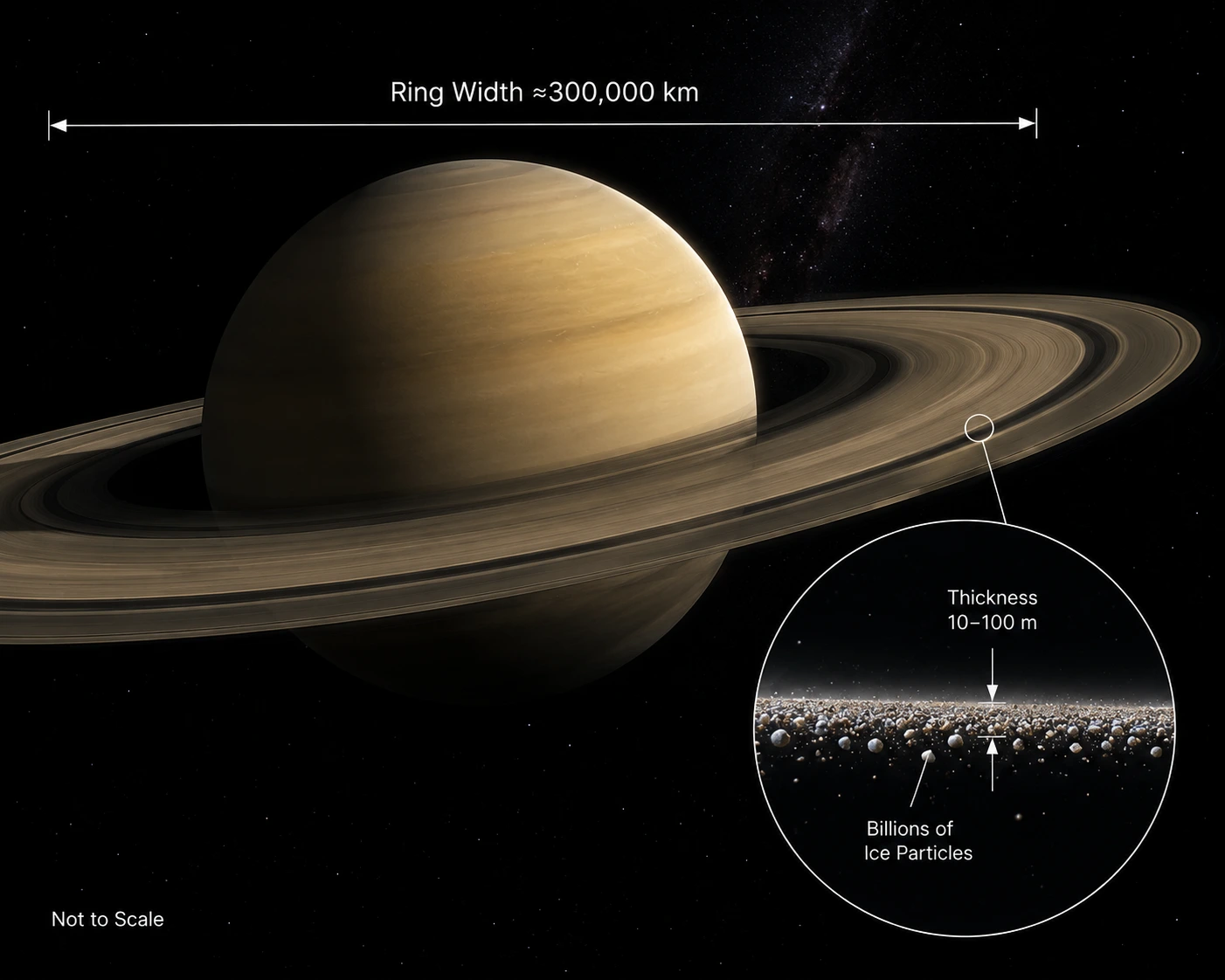
At zero degrees, perfectly edge-on, that structure becomes geometrically invisible to any telescope from this distance. It collapses to a line thinner than can be resolved. And even at small angles like 7.5 degrees, it’s a faint compressed stripe that looks wrong to anyone who’s seen Saturn before.
The rings didn’t go anywhere. The same billions of particles of water ice and rocky debris are still out there, orbiting in that impossibly thin sheet. We’re just looking at the edge of a piece of paper.
Why This Happens: The Physics Behind the Flatness
This is where it gets genuinely interesting.
The rings are flat because of orbital mechanics. Every particle in the ring system is essentially an independent moon, orbiting Saturn on its own path. Originally, those particles probably had all kinds of orbital inclinations; some tilted this way, some that way. But here’s what happens when two particles on slightly different orbital planes collide: they lose a small amount of energy to heat, and their vertical motion nudges slightly closer to the shared plane.
Do that billions of times over billions of years, and you get a disc. The random vertical energy bleeds off with each collision while the overall rotational energy, the shared orbit around Saturn, stays conserved. Every flat ring system in the solar system forms this way, and so, on a much larger scale, did the disc of the solar system itself.
Saturn’s rings are, in a sense, a miniature replay of how planets formed.
The Long Slow Return
The good news is that things only improve from here.
The 7.5-degree tilt at October’s opposition is already more than the rings have shown since 2023. By 2027 and 2028, the angle will widen further. By 2032, the rings will be tilted at about 27 degrees, their maximum, showing Saturn’s southern face in what will probably be the best views most amateur observers will get in their lifetime. Not quite as open as 2017, but close.
The next ring plane crossing, when the rings will be edge-on again, won’t come until October 2038. So, there’s time.
For October 4, 2026, opposition night, when Saturn rises at sunset and stays up until dawn, a 70mm refractor at decent magnification will show the rings clearly separated from the planet’s disc. A larger scope, 130 mm or more, on a steady night, can even resolve the Cassini Division: the 4,800-kilometre gap between the A and B rings that Giovanni Cassini first noticed in 1675. At 7.5 degrees it’s at the edge of detection in smaller instruments, but it’s there.
The rings won’t look like the posters. They’ll look like a thin slash of light, slightly brighter toward the outer edges, with the planet floating at the center of it all. Quiet and strange and smaller than you expect.
But here’s the thing about seeing it for yourself. When you understand why it looks this way. When you can feel the geometry in your head, the dinner plate tilting, the billions of icy particles all orbiting in a disc ten meters thick across three hundred thousand kilometers, the thin line stops being a disappointment and becomes something else entirely.
Whether you are viewing through a small backyard scope or a large observatory instrument, witnessing the Saturn ring plane crossing 2026 offers a rare, real-time glimpse into orbital mechanics at work.
It becomes the same geometric puzzle that puzzled Galileo more than four centuries ago. The same puzzle he stared at in 1612 and couldn’t solve. And you already know the answer.
Field Ephemeris: 2026 Observation Parameters
| Parameter | Value / Target Data |
| 2026 Opposition Date | October 4, 2026 |
| Apparent Ring Tilt | ~7.5° South (Gradually widening from 2025 minimum) |
| Max Ring Openness | ~27° (Expected in 2032) |
| Next Plane Crossing | October 2038 |
| Main Ring Dimensions | ~282,000 to 300,000 km wide | 10 to 20 meters mean thickness |
| Target Infrastructure | Cassini Division (4,800 km vacuum gap between A and B rings) |
| Optimum Optics | 70mm refractor (minimum resolution) | 130mm+ aperture (optimal) |
Want to see Saturn for yourself? Clear dark skies, a stable night, and even a basic 60–70mm telescope will show you the rings in October 2026. Find your darkest local spot and look southeast after midnight.
Frequently Asked Questions
Saturn’s axis is tilted about 26.7°, so as it orbits the Sun over 29.5 years, our viewing angle on the rings changes. Twice per orbit, Earth crosses the ring plane and the rings appear edge-on; so thin they nearly vanish.
Yes. By October 2026 the rings are tilted about 7.5°, thin but visible in a small telescope, not the wide “poster” view, but a clear thin line separated from the planet’s disc.
They’ll keep widening through 2027–2028, reaching their maximum tilt of about 27° in 2032, which is close to the best views since 2017.
October 2038, when the rings go edge-on again.
A 70mm refractor at decent magnification will separate the rings from the disc. A 130mm+ scope on a steady night can resolve the Cassini Division.