


Why do we dream? It’s a question I’ve turned over in my head more nights than I can count, usually right after waking from something so strange I have to write it down before it disappears.
Scientists still don’t have one complete answer. But they do know that your brain is far from switched off while you sleep. It moves through different stages, changes its chemistry, processes memories, and sometimes creates experiences vivid enough to feel completely real.
What Happens to Your Brain When You Dream?
Sleep isn’t like turning off the lights in a house. Your brain stays remarkably active.
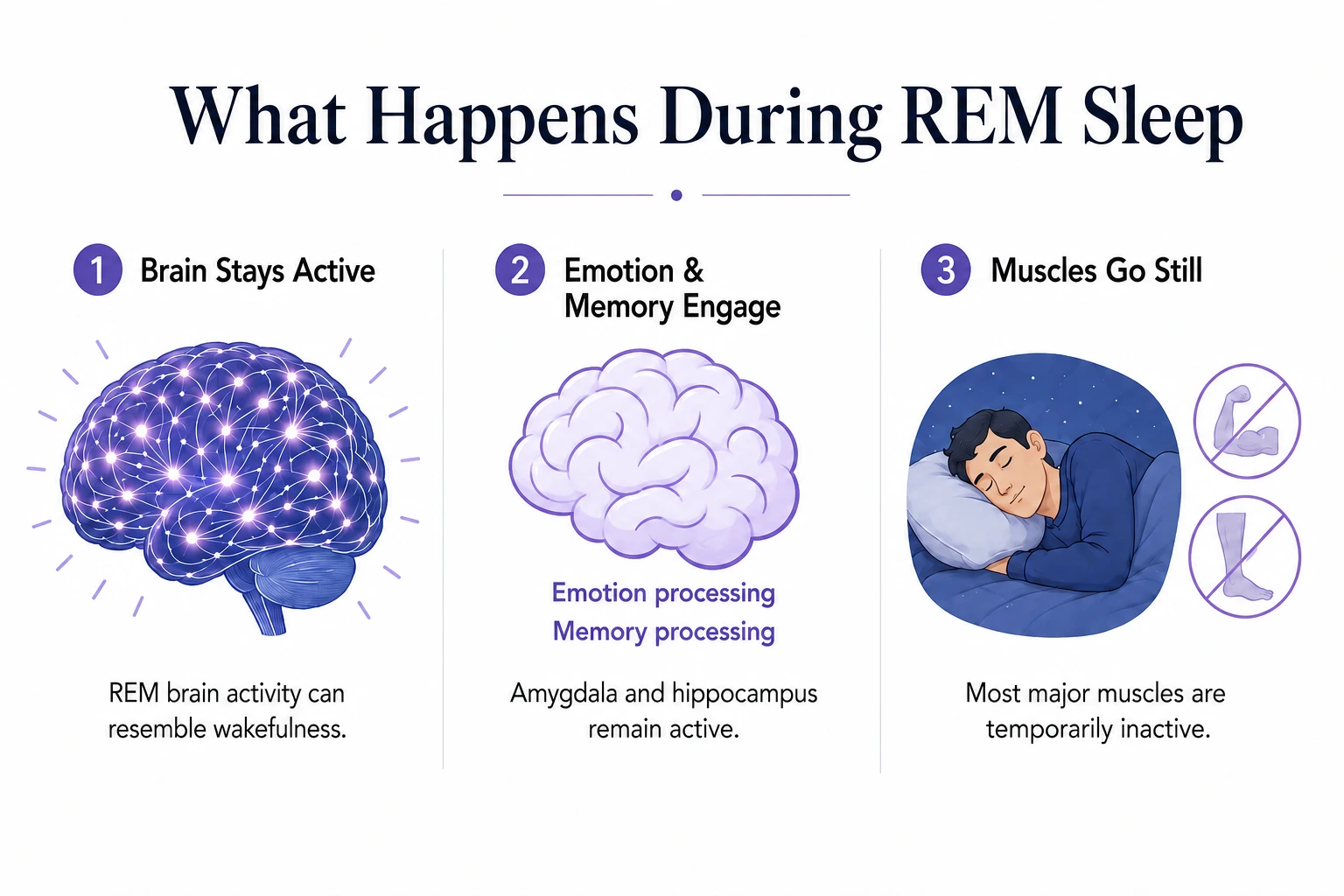
During REM sleep, the stage associated with many of our most vivid dreams, brain activity can look surprisingly similar to wakefulness. Areas involved in emotion, memory, and visual processing remain active even though your eyes are closed.
At the same time, most of your major muscles become temporarily inactive. This normal REM phenomenon, called muscle atonia, helps stop you from physically acting out your dreams.
The National Heart, Lung, and Blood Institute explains that REM sleep becomes more prominent later in the night, while deeper non-REM sleep is concentrated earlier.
| Did you know? REM periods usually get longer as the night goes on. That’s one reason your most vivid and memorable dreams often happen close to morning. |
Your Feelings Take the Wheel
Dreams can feel intensely emotional while making almost no logical sense.
One reason may be the way different brain regions behave during REM sleep. Areas such as the amygdala, involved in processing emotions, and the hippocampus, involved in forming memories, remain active. Meanwhile, some areas of the prefrontal cortex involved in critical thinking and planning behave differently than they do when you’re awake.
That may help explain why a dream where you’re late for a flight to a city that doesn’t exist, piloted by your childhood dentist, can feel completely normal until you wake up.
Your usual mental fact-checker simply isn’t working in quite the same way.
Why Do We Dream?
This is where scientists still debate the answer. Several ideas have research behind them, but none explains every dream.
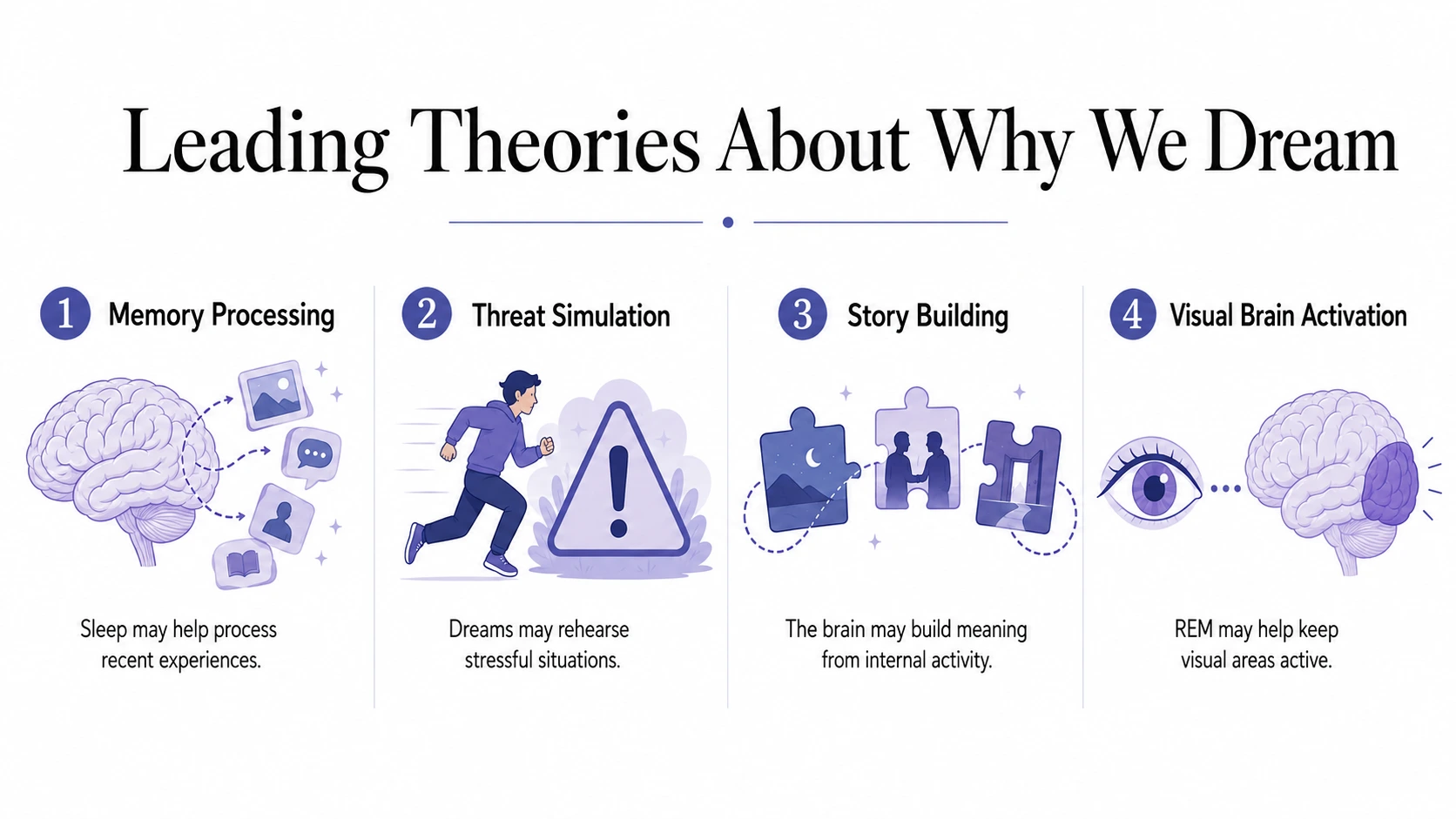
Dreams May Help Process Memories
Your brain keeps working with recent experiences while you sleep.
In a 2025 study indexed by PubMed, researchers suggest that experiences and information encountered before sleep can influence later dream content. This supports the broader idea that the sleeping brain continues working with recent experiences, although it does not prove that dreaming itself is necessary for memory storage.
Dreams Might Rehearse Threats
Another idea, called threat simulation theory, suggests that dreams may give the brain a safe place to rehearse dangerous or stressful situations. It could help explain why dreams about being chased, trapped, lost, or unable to escape are so common.
Some studies support parts of the theory, while others don’t, so it remains an interesting hypothesis rather than a settled explanation.
Dreams May Be the Brain Building a Story
One influential theory suggests that dreams emerge as the brain tries to organize internally generated activity during sleep. Your brain is naturally good at connecting information and creating meaning. During sleep, it may combine fragments of memories, emotions, images, and recent experiences into a story.
The result isn’t always logical, but dream plots rarely are.
Dreams Might Keep Your Visual Brain Busy
Here’s one of the stranger theories.
In 2021, researchers David Eagleman and Don Vaughn proposed the Defensive Activation Theory. They suggest that activity during REM sleep may help keep the brain’s visual cortex active while your eyes are closed, potentially preventing other senses from taking over that neural territory.
The researchers found that primate species with greater brain plasticity also tended to spend more time in REM sleep. However, this is still a hypothesis rather than a proven explanation for dreaming.
It’s still speculative, but it’s an interesting example of just how many possible functions scientists are exploring. You can read the original theory in Frontiers in Neuroscience.
Chances are, no single idea explains everything. Dreaming may involve several overlapping processes involving memory, emotion, perception, and normal sleeping brain activity.
You Don’t Only Dream During REM Sleep
REM sleep gets most of the attention, but it isn’t the only time you dream.
People also report dreams after being awakened from non-REM sleep. These dreams tend to be shorter and more thought-like, while REM dreams are generally more vivid, emotional, and story-driven.
So dreaming isn’t an on-or-off switch that begins when REM starts. It’s more like a spectrum from a vague image or thought to a full-blown nighttime movie.
Why Do We Forget Most Dreams?
Dream memories are surprisingly fragile.
The brain’s chemical environment during sleep is different from when you’re awake, which may make dreams harder to store as lasting memories. The way you wake up matters too.
If you wake immediately after a vivid dream, you may remember it clearly. Roll over, fall back asleep, and try to recall it ten minutes later, and half the story may already be gone. That’s why writing a dream down as soon as you wake up can make such a difference.
Why This Matters
Dreaming may still be mysterious, but sleep itself isn’t optional background time for the brain.
Across both REM and non-REM sleep, your brain supports memory, learning, emotional regulation, and other essential functions. Because REM periods become longer toward morning, regularly cutting your sleep short can reduce some of that later-night REM sleep. But REM isn’t the only important stage, your brain needs the full cycle.
If you’re looking for a more intentional way to prioritize rest, explore our guide to the Best Sleep Retreats in 2026, featuring hotels and resorts designed around better sleep and relaxation.
Scientists still don’t know exactly why we dream. Dreams may reflect memory processing, emotional experiences, threat simulation, internally generated brain activity, or a combination of these processes.
What researchers do know is that the brain remains remarkably active during sleep. So, the next time you wake from a dream involving impossible places, forgotten friends, or a completely nonsensical plot, remember: your sleeping brain may be doing far more than simply entertaining itself.
FAQ
No single explanation has been proven. Leading theories connect dreaming with memory processing, emotion, threat simulation, and normal patterns of brain activity during sleep.
No. Dreams also occur during non-REM sleep, although REM dreams tend to be more vivid, emotional, and story-like.
During REM sleep, the brain normally suppresses movement in most major muscles. This temporary muscle atonia helps prevent you from physically acting out your dreams.
Dream memories are fragile, and the brain’s chemistry during sleep may make them harder to store. Dreams are generally easier to remember when you wake directly from them.
Possibly, but researchers still don’t know whether dreaming itself has a specific biological function. Dreams may instead be an experience that accompanies other important processes happening in the sleeping brain.