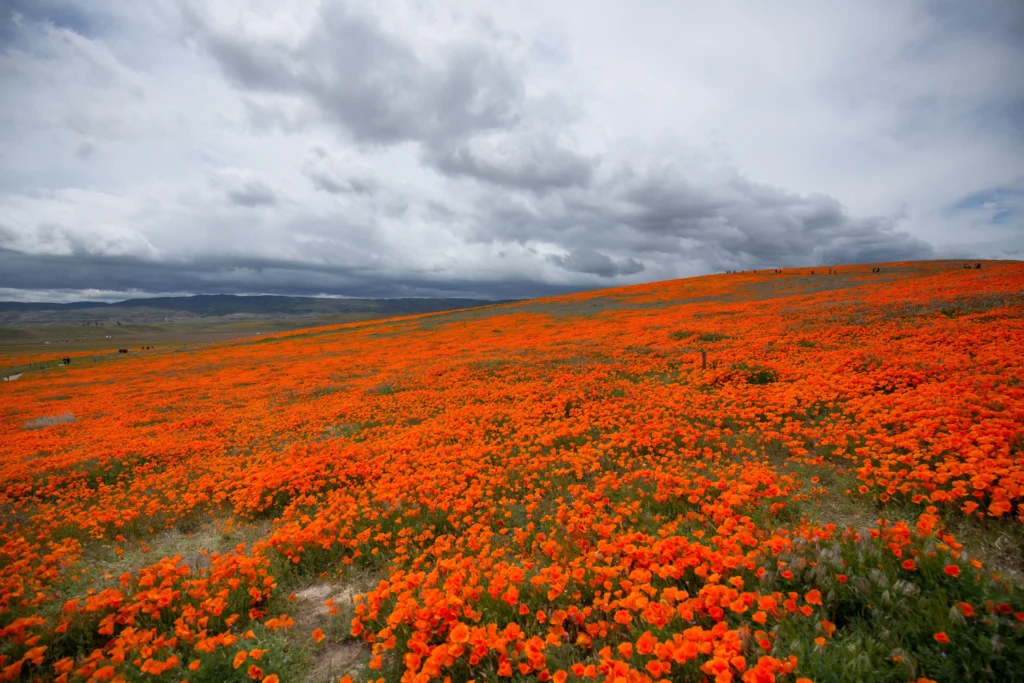


There’s a moment right before a summer storm — the sky darkens, the air goes still, and then the first fat drops hit the sidewalk. Almost instantly, a smell rises up: earthy, mineral-like, and sometimes faintly sweet.
For most of us, this comforting scent evokes memories of warm afternoons, sudden thunderstorms, and the refreshing feeling of rain after a dry spell. But have you ever wondered why does rain smell so good?
Far from being just a poetic metaphor for nature cleaning the air, this familiar aroma is the result of a fascinating combination of chemistry, microbiology, and atmospheric physics. Plant-derived compounds, soil microorganisms, and raindrops all play a role in producing the smell we associate with wet earth.
To scientists and outdoor enthusiasts alike, this phenomenon has a proper name: petrichor.
Understanding the science behind this scent transforms a simple sensory experience into a deeper appreciation of the complex interactions happening right beneath our feet.
What Is Petrichor? The Birth of a Term
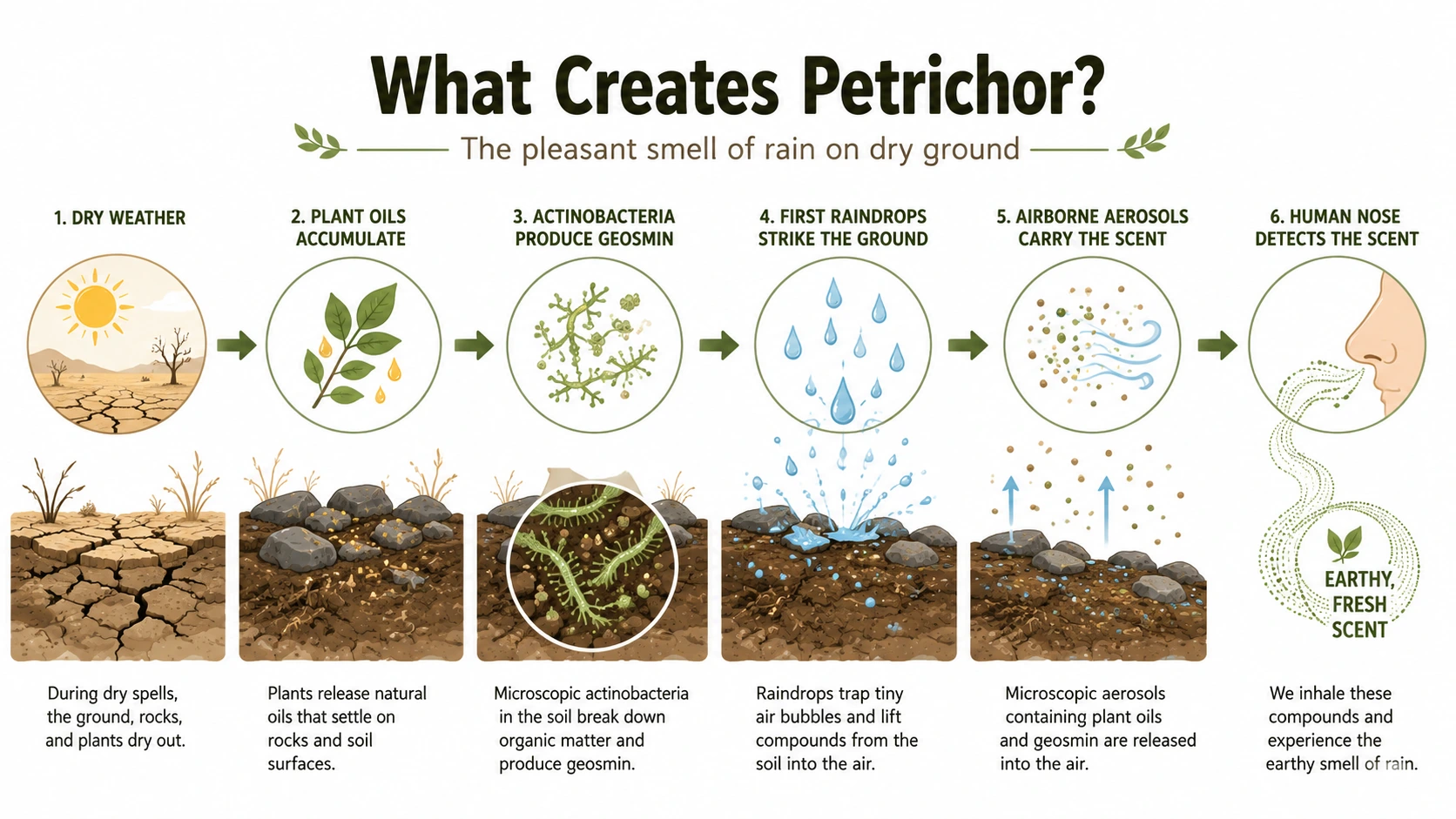
Petrichor is the distinctive earthy smell associated with rain falling on dry ground. It isn’t a single chemical compound. Instead, the aroma comes from a mixture of substances released from soil, rocks, and other surfaces when moisture arrives.
One of the important contributors is geosmin, an organic compound produced by certain microorganisms. Plant-derived oils and other volatile compounds can also contribute to the overall scent.
The word petrichor was coined in 1964 by Australian researchers Isabel Joy Bear and Richard Thomas, who were working at the Commonwealth Scientific and Industrial Research Organisation (CSIRO). They combined the Greek words petra, meaning “stone,” and ichor, the mythical fluid said to flow through the veins of the gods. Literally, “the blood of stone.”
Before their research, the distinctive smell of damp earth was already well known. Bear and Thomas investigated the compounds responsible and found that certain dry soils and rocks could develop an oily substance that was released when moisture reached them. They called this substance petrichor.
Their work helped provide a scientific explanation for a smell that people had noticed for generations, particularly after the first rains following a dry period.
Today, petrichor is better understood as a broader sensory phenomenon involving several different compounds and physical processes rather than a single substance.
💡 Bottom Line
Petrichor is not one chemical. It describes the characteristic earthy smell associated with rain on dry ground, produced by a mixture of compounds released from the environment.
The Secret Ingredients Behind Petrichor
Petrichor isn’t one single compound. It’s a mix of several ingredients that build up in dry soil and get released into the air on impact.
1. Plant oils
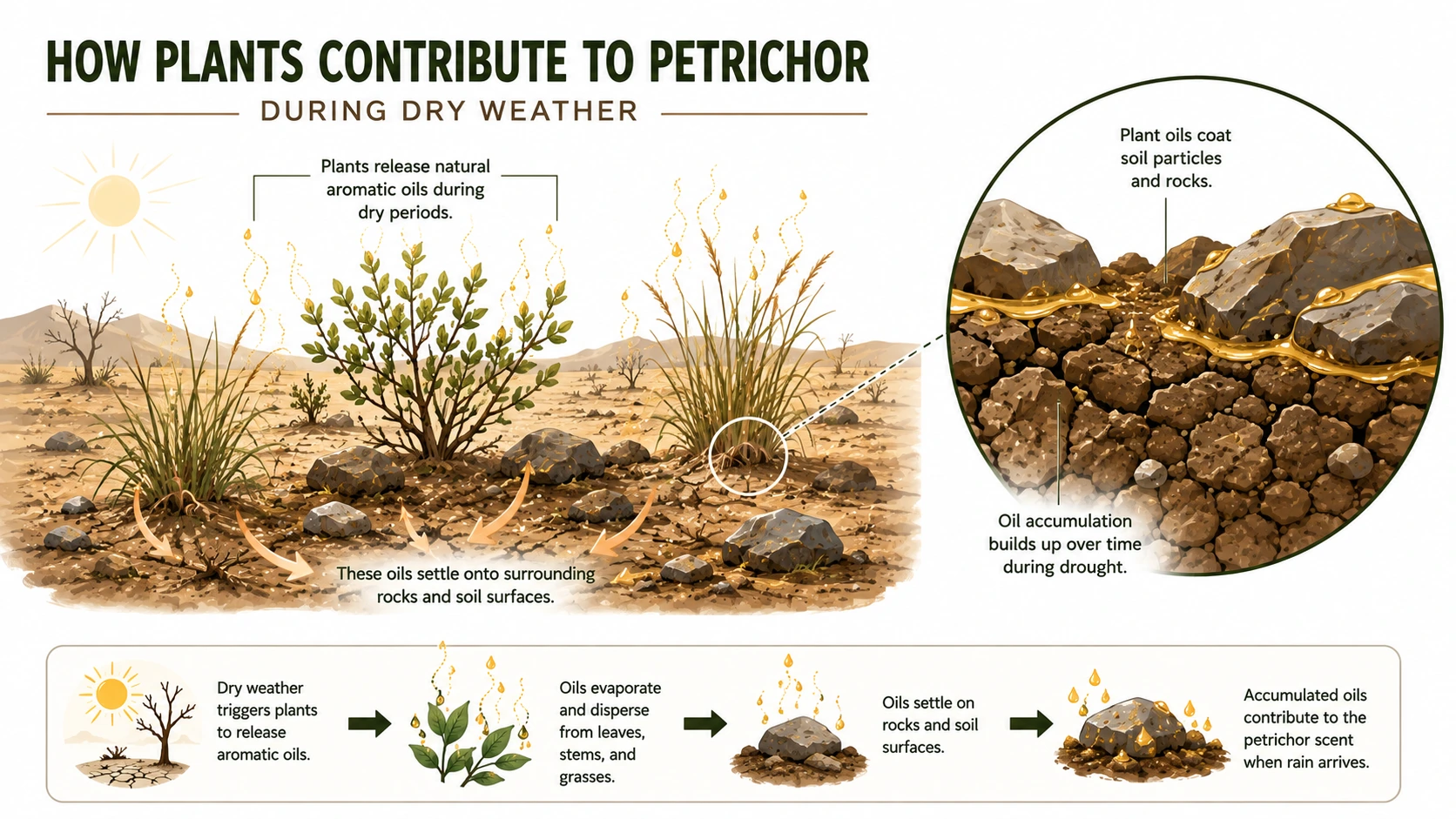
The original research by Bear and Thomas identified an oily substance associated with dry rocks and soils as an important part of petrichor. Their experiments showed that dry conditions allowed these odor-producing substances to accumulate and that moisture could release them into the air.
Plant-derived compounds can also become part of the mixture. During dry periods, organic compounds from vegetation can accumulate on or within surrounding surfaces, where they may remain until moisture and rainfall help release them.
Interestingly, Bear and Thomas later investigated whether the compounds associated with petrichor might influence plant growth. Their 1965 experiments found that oily extracts from petrichor-associated materials could delay seed germination and early growth under laboratory conditions.
That finding is more complicated than the idea that these oils simply act as a form of “chemical drought insurance.” The research showed an effect on germination, but it does not establish that plants deliberately release these oils to prevent seeds from germinating during drought.
When rain finally arrives, these stored oils are released into the air as a fine mist.
💡 Bottom Line
Petrichor can include plant-derived compounds and oily substances associated with dry soil and rocks. Rain helps release these compounds, but their biological role is more complicated than simply acting as a drought signal.
2. Actinobacteria and Geosmin
While plant oils lay the baseline groundwork for petrichor, the most defining and powerful component of the rain scent comes from microscopic life living in the soil: actinobacteria.
These microscopic, filamentous bacteria thrive in warm, damp soils all over the world. As they grow and decompose organic matter, they produce an organic compound called geosmin. Geosmin is a naturally occurring organic compound with an intensely earthy aroma, so powerful that the human nose can detect it at concentrations of just a few parts per trillion.
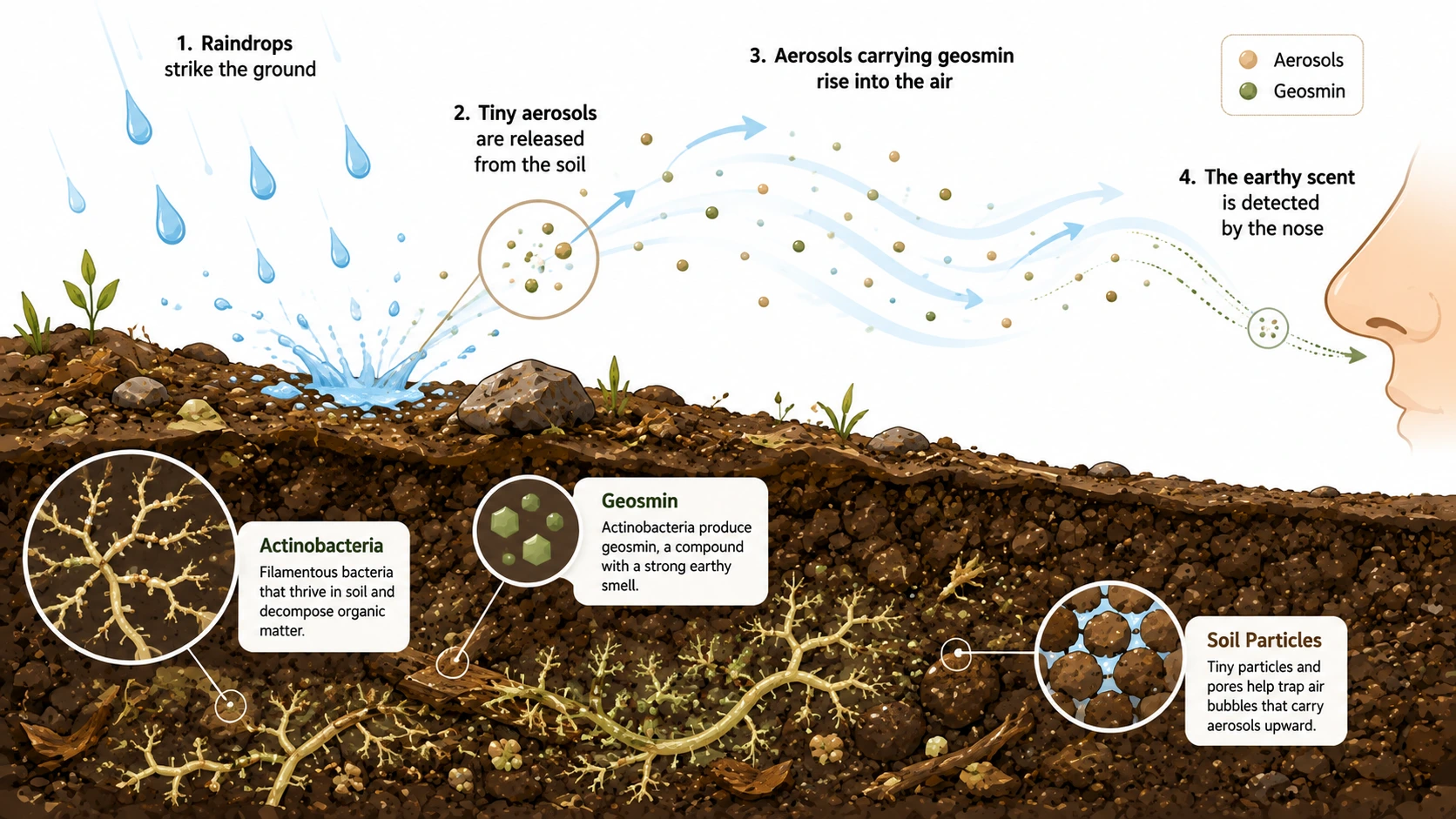
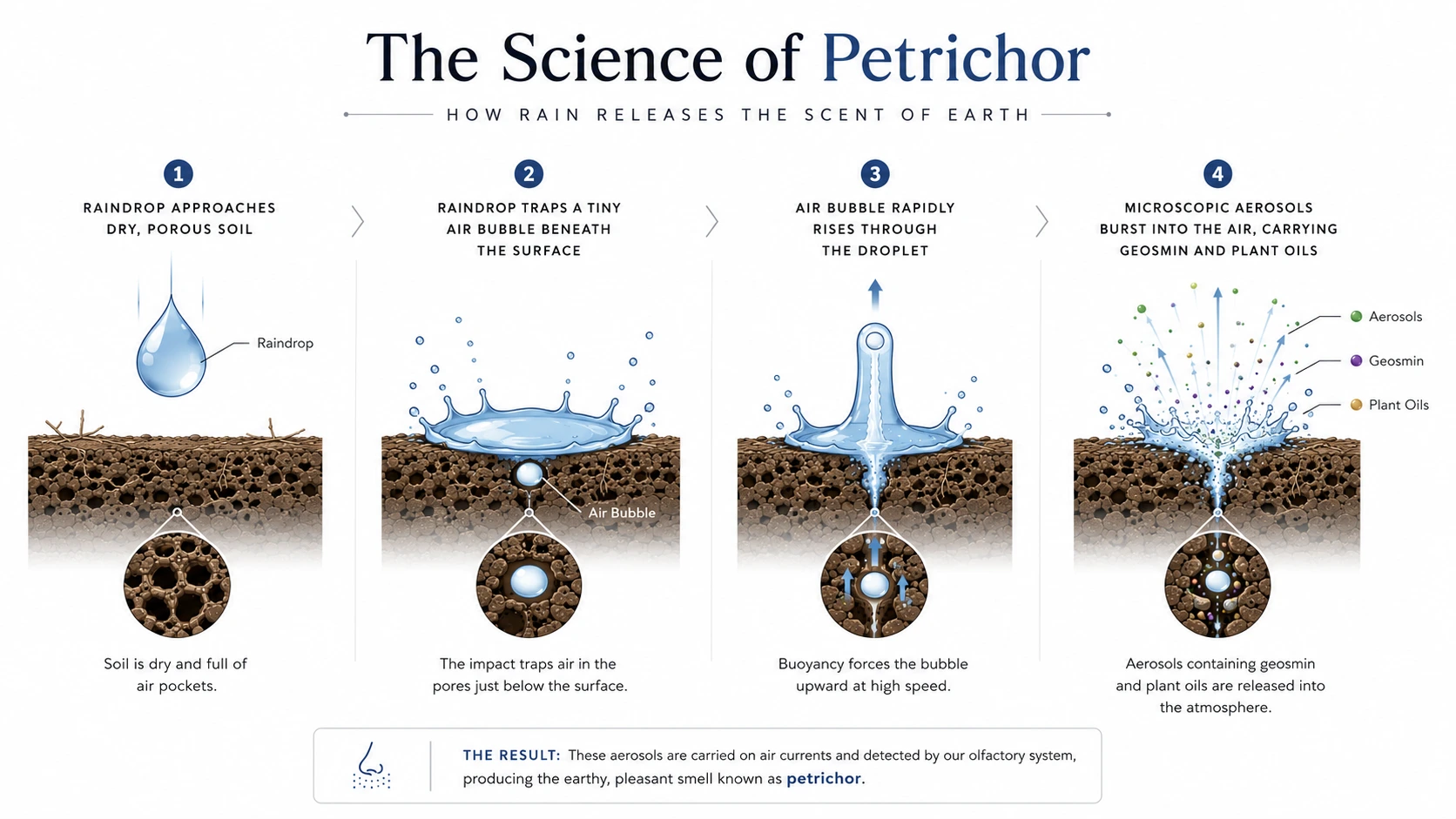
When dry soil experiences a prolonged drought, actinobacteria spore production peaks. The moment raindrops strike the soil surface; they trap microscopic air bubbles in tiny gaps between soil particles. These bubbles rapidly shoot upward through the droplet and burst into the air as microscopic aerosols, carrying geosmin and other volatile compounds into the breeze where we can breathe them in.
Did You Know?
The human nose can detect geosmin at concentrations as low as 5 parts per trillion, making it one of the most detectable natural compounds known.
3. Ozone
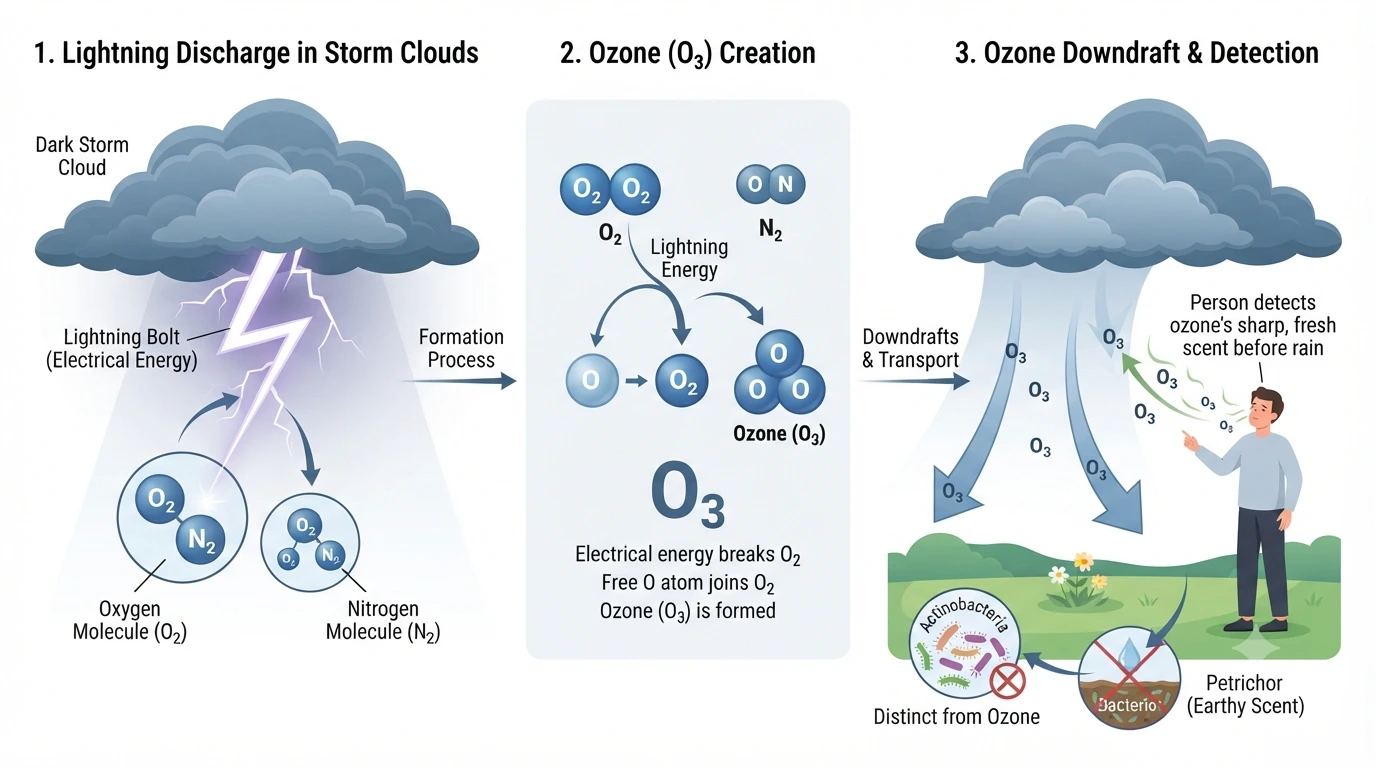
Before a storm, especially a thunderstorm, you may notice a sharper, almost metallic smell. That’s ozone (O₃). Lightning splits nitrogen and oxygen molecules in the atmosphere, and some of the resulting atoms recombine to form ozone, which is then carried down to ground level by downdrafts.
This is a separate phenomenon from petrichor itself, but the two often get lumped together since they show up around the same weather.
💡 Bottom Line
The smell around a storm isn’t necessarily all petrichor. The earthy smell comes largely from compounds associated with the ground, while ozone and other atmospheric chemicals can contribute a sharper scent around thunderstorms.
Why the Smell Feels So Good
There’s a plausible evolutionary story here. For much of human history, the ability to detect rain or even to sense that rain was recently nearby would have been valuable information, signaling water sources, fertile ground, and relief from drought. Some researchers speculate that our sensitivity to geosmin may be an inherited trait from early humans (and possibly camels, who are also known to be remarkably sensitive to it and can detect it from long distances while searching for water).
Whether or not that evolutionary explanation fully holds up, geosmin’s low detection threshold is well established, and the psychological association most people have with “petrichor equals comfort” is strong and nearly universal across cultures.
The Role of Atmospheric Physics: How Rain Drops Release the Scent
The journey from soil to your nose depends just as much on physics as it does on biology. In 2015, researchers at the Massachusetts Institute of Technology (MIT) used high-speed cameras to study how raindrops interact with various surfaces.
Their findings revealed that when a raindrop hits a porous surface like soil, it traps a microscopic pocket of air underneath it. This air bubble shoots upward through the droplet, exiting the top in a sparkling burst of fine aerosols.
- Light to Moderate Showers: Gentle rain is the most efficient at releasing petrichor because it maximizes aerosol creation without washing away or flooding the surface compounds.
- Wind Direction: Once these aerosols are suspended in the air, wind carries them downwind, often alerting people to an approaching storm even before the clouds arrive overhead.
This intricate physical mechanism explains why the scent of rain is often strongest during gentle, sporadic showers following a dry spell.
💡 Bottom Line
Raindrop impacts can create tiny airborne aerosols that carry compounds from the ground into the atmosphere. The process is especially effective under certain light-to-moderate rainfall and surface conditions.
Why It’s Stronger After a Dry Spell
You’ve probably noticed the smell is much more intense after a long dry period followed by rain, and comparatively mild during a rainy season with frequent showers. That tracks with the mechanism: dry spells let plant oils and geosmin accumulate undisturbed in the soil over days or weeks. The first rain releases that whole backlog at once. Subsequent rains simply have less built-up material to release.
Embracing the Chemistry of the Outdoors
At Earthshinejournal, we believe that exploring the outdoors extends far beyond the trail, the campsite, or the horizon. Understanding the natural world means recognizing that even the air we breathe during a rainstorm is a rich tapestry of geology, microbiology, and physics.
The next time you are out on a hiking trail, camping in the backcountry, or simply stepping onto your porch as the sky darkens, take a moment to breathe deeply. That rich, comforting aroma is nature’s own chemistry at work—a living connection between the soil, the plants, and the skies above.
If you enjoy exploring natural phenomena, you might also like: Why Saturn’s Rings Look So Thin in 2026: Ring Plane Crossing Explained.
Frequently Asked Questions
Petrichor is the pleasant earthy smell that occurs when rain falls on dry soil. It is created when plant oils and compounds such as geosmin are released into the air by raindrops.
Rain smells good because it releases natural plant oils, geosmin produced by soil bacteria, and sometimes ozone into the air, creating the distinctive fresh, earthy aroma many people enjoy.
Geosmin is a naturally occurring organic compound produced by certain soil-dwelling bacteria called actinobacteria. It is responsible for much of the earthy smell associated with rain.
During dry weather, plant oils and geosmin accumulate in the soil. The first rainfall releases these compounds into the air all at once, making the scent much stronger than during periods of frequent rain.
No. Petrichor itself is generally harmless for most people. The scent comes from naturally occurring compounds found in soil and plants.
No. Petrichor is caused mainly by plant oils and geosmin released from the ground, while ozone is a separate gas that can form during thunderstorms due to lightning.
Yes. Humans are remarkably sensitive to geosmin and can detect it at concentrations of just a few parts per trillion, making it one of the easiest natural compounds for our noses to recognize.
No. Petrichor is most noticeable when light rain falls on dry, porous soil. Heavy rain or already-wet ground usually produces a much weaker scent because fewer compounds are available to be released.