

Kneel in any forest and press your palm flat against the moss. Somewhere beneath your fingers, threaded through the soil like a nervous system with no body to belong to, is a web of fungal filaments finer than a human hair. It has acquired a popular name that sounds almost too good to be true: the wood wide web.
What Is the Wood Wide Web?
The wood wide web is the popular name for underground connections that can form when mycorrhizal fungal hyphae associate with the roots of more than one plant, creating what researchers call common mycorrhizal networks. Researchers have investigated whether these networks can facilitate the movement of carbon, water, nutrients, and chemical signals between plants, although how widespread and ecologically important these transfers are in natural forests remains debated.
The idea is compelling: ancient trees nurturing seedlings and warning their neighbors through underground fungal connections. But the real science is messier, stranger, and in some ways more interesting than the popular version.
The Fungus That Makes It Possible
Almost every tree you’ll ever walk past has a fungal partner living in and around its roots. This relationship, called mycorrhiza, is ancient; plants and fungi have been striking this particular bargain for hundreds of millions of years. The tree hands over sugars made through photosynthesis; the fungus, in exchange, reaches far into the soil with its hyphae and helps the tree obtain water and mineral nutrients from a much larger volume of soil than its roots could efficiently explore alone.
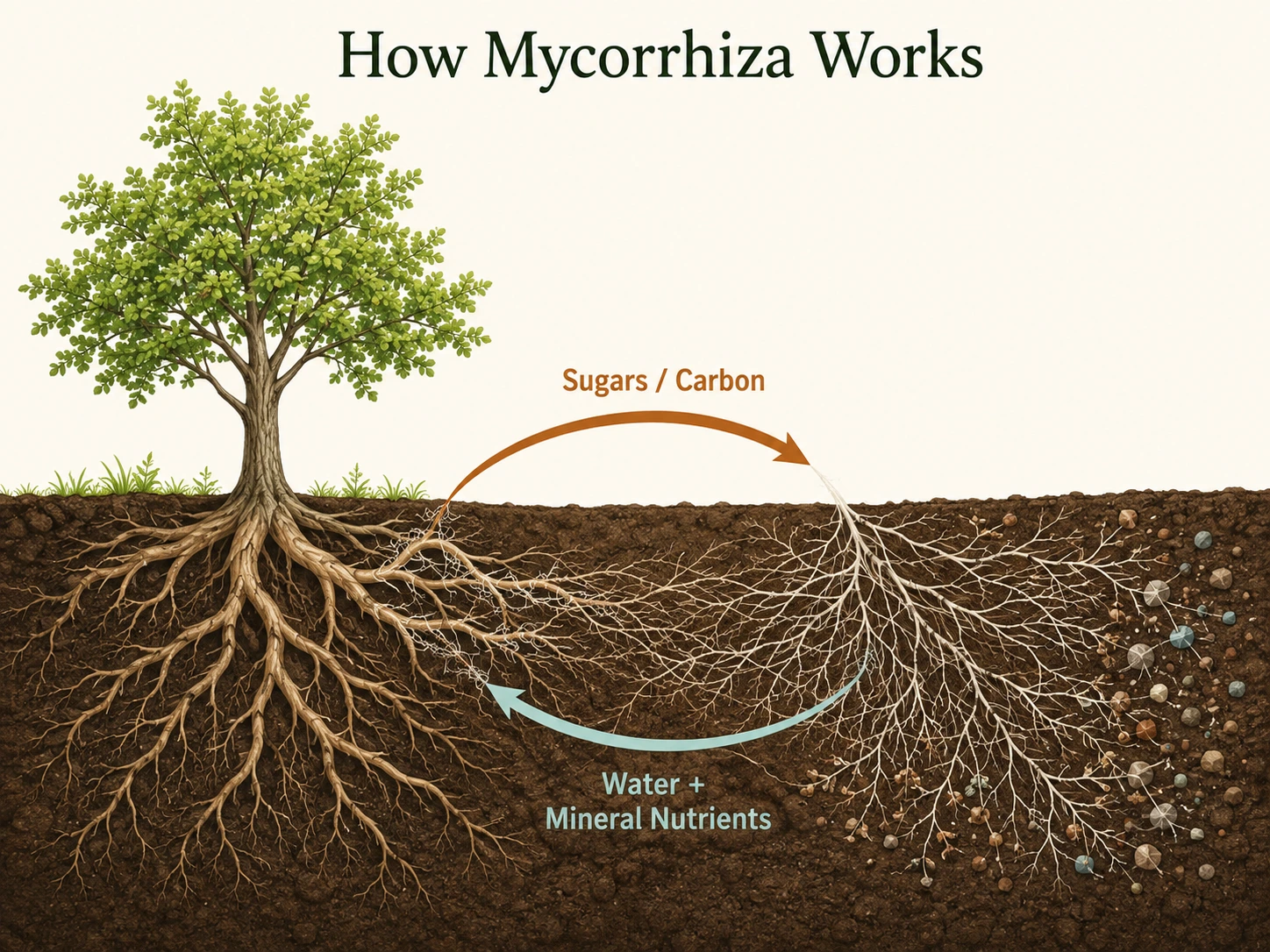
Where things get interesting is when one fungal individual connects to more than one tree at once. When that happens, you get what researchers call a common mycorrhizal network, or CMN, a shared fungal thread running between two or more plants. It’s this shared plumbing that gave rise to the wood wide web idea: if the pipe connects two trees, could resources, or even signals, travel down it from one to the other?
| A useful glow, a useful web: The idea gained widespread attention after forest ecologist Suzanne Simard and colleagues published a landmark 1997 study showing net carbon transfer between paper birch and Douglas-fir in the field. The phrase “wood-wide web” appeared on the cover of that issue of Nature and soon became shorthand for the broader idea of underground fungal connections between plants. You can read more about her original findings and the debate they sparked in Scientific American’s deep dive. |
Talking, Sharing, or Something Else Entirely?
Here’s where I have to be honest with you: the “trees warn and nurture each other like a family” version of this story, the one that shows up in documentaries and bestselling books, has outrun what the data can actually support. In 2023, a team of mycorrhizal researchers published a careful review of the field in Nature Ecology & Evolution, detailed further by science journalists at Undark, and found that not one field study had shown mature trees preferentially transferring resources to their own offspring through these networks. A follow-up 2024 study out of the University of Göttingen found young beech trees passing carbon to nearby fungi, but not on to neighboring trees at all.
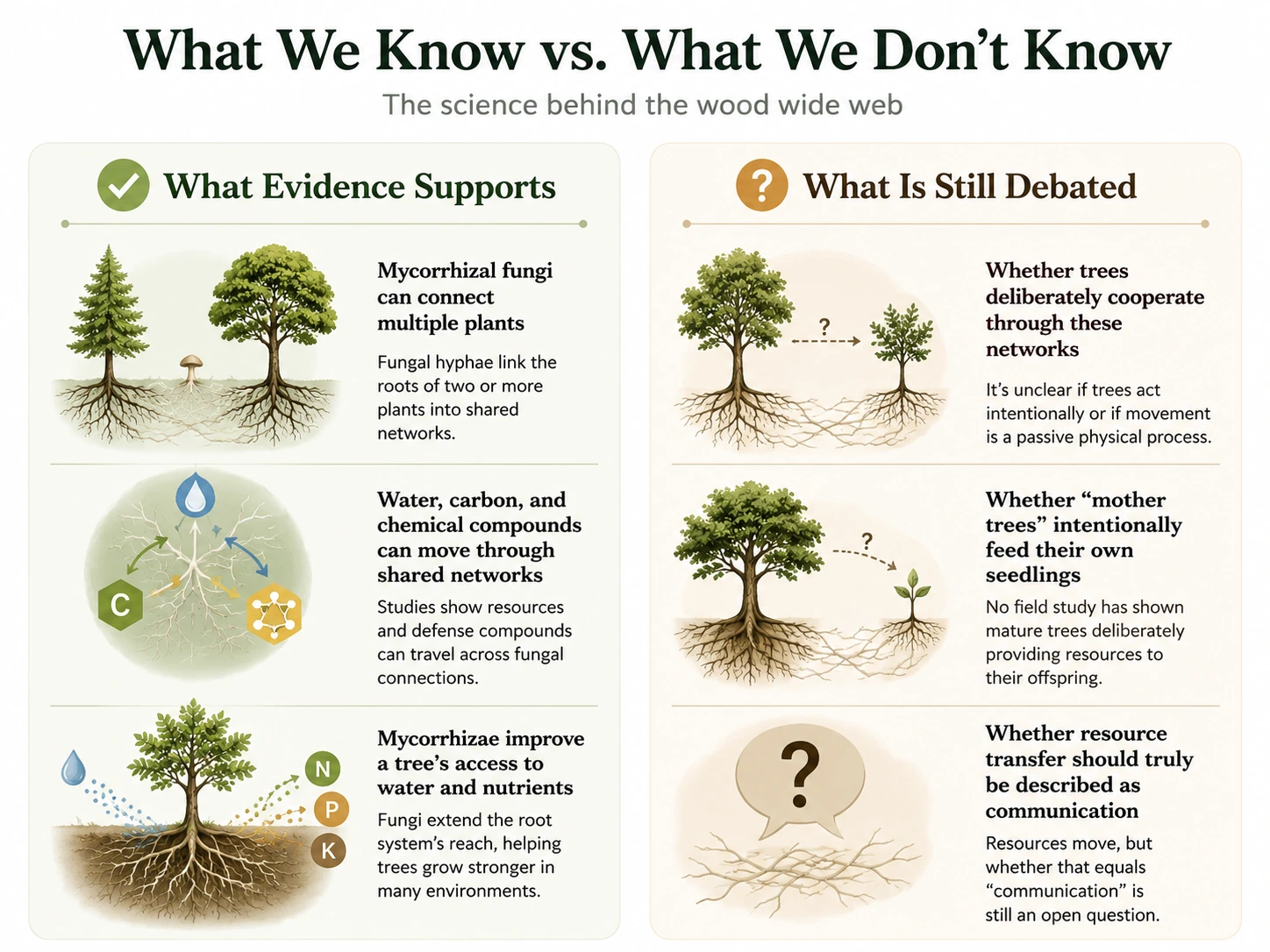
That doesn’t mean the wood-wide web is a myth. It means the truth is more nuanced than the metaphor. Studies have detected movement of carbon, water, nutrients, and signaling-related compounds between plants associated with mycorrhizal fungi under certain conditions. What remains uncertain is how often this movement occurs through confirmed common mycorrhizal networks in natural forests, how ecologically important it is, and whether it represents cooperation between trees.
| Did you know? The word “network” undersells it. A single teaspoon of forest soil can contain miles of fungal hyphae. |
FAQ
Yes, in the basic sense that mycorrhizal fungi can connect the roots of multiple plants. Researchers have also observed movement of resources and signaling-related compounds in experiments involving mycorrhizal connections. What remains debated is how common and important these transfers are in natural forests and whether they represent cooperative tree-to-tree communication.
Maybe, but not in the tidy, parental way it’s often described. Simard’s early research suggested older “mother trees” could pass carbon to nearby seedlings. More recent field reviews haven’t found solid evidence that this happens reliably in wild forests, so for now it’s an open question rather than a settled fact.
There is experimental evidence that defense-related signals can be associated with mycorrhizal connections between plants. However, scientists are still working out how often this happens in natural forests and whether the fungal network itself is responsible rather than other signaling routes.
Mycorrhiza describes the symbiotic association between plant roots and mycorrhizal fungi. A common mycorrhizal network forms when fungal mycelium connects the roots of two or more plants. “Wood wide web” is the popular term for these larger underground connections.
Mostly because it implies more intention and cooperation than the current evidence can support. Researchers worry the catchy metaphor has outpaced the science, leading to claims in books and documentaries that go further than what’s actually been tested in real forests.
What We Do Know for Certain
Strip away the more romantic claims and you’re still left with something remarkable. Mycorrhizal fungi measurably improve a tree’s access to water and nutrients. Experiments have reported defense-related signaling between some plants associated with shared mycorrhizal fungi, with neighboring plants sometimes activating defensive responses. How often this occurs through confirmed CMNs in natural forests, and how important it is ecologically, remains less certain. Whatever is or isn’t happening at the level of intention, the fungal network itself is a genuine, load-bearing part of how a healthy forest functions.
So can trees really talk? I’d put it this way: they’re connected, undeniably, by one of the oldest partnerships in the story of life on land. Whether that connection amounts to conversation, or something quieter and more mechanical, is still being written by scientists standing in the mud with soil samples and a lot of patience. Either way, the next time you’re picking your way through the woods, it’s worth remembering that the ground beneath your boots is far busier than it looks.
Curious what else is happening in that same patch of forest? Read about how fireflies glow after dark. And if it is the smell after rain that draws you outside, our piece on petrichor and geosmin explores the chemistry behind that unmistakable scent.