

Imagine arriving at a tiny bush airstrip with everything packed perfectly, only to discover that your suitcase is too heavy or the wrong shape for the aircraft taking you to camp.
Safari packing is different from packing for an ordinary vacation. Your clothes need to work through cool early-morning game drives, warmer afternoons, dust, strong sun, and biting insects. If your itinerary includes a light-aircraft transfer, your safari luggage may also face much tighter restrictions than it did on your international flight.
The solution isn’t to pack more. It’s to pack more deliberately.
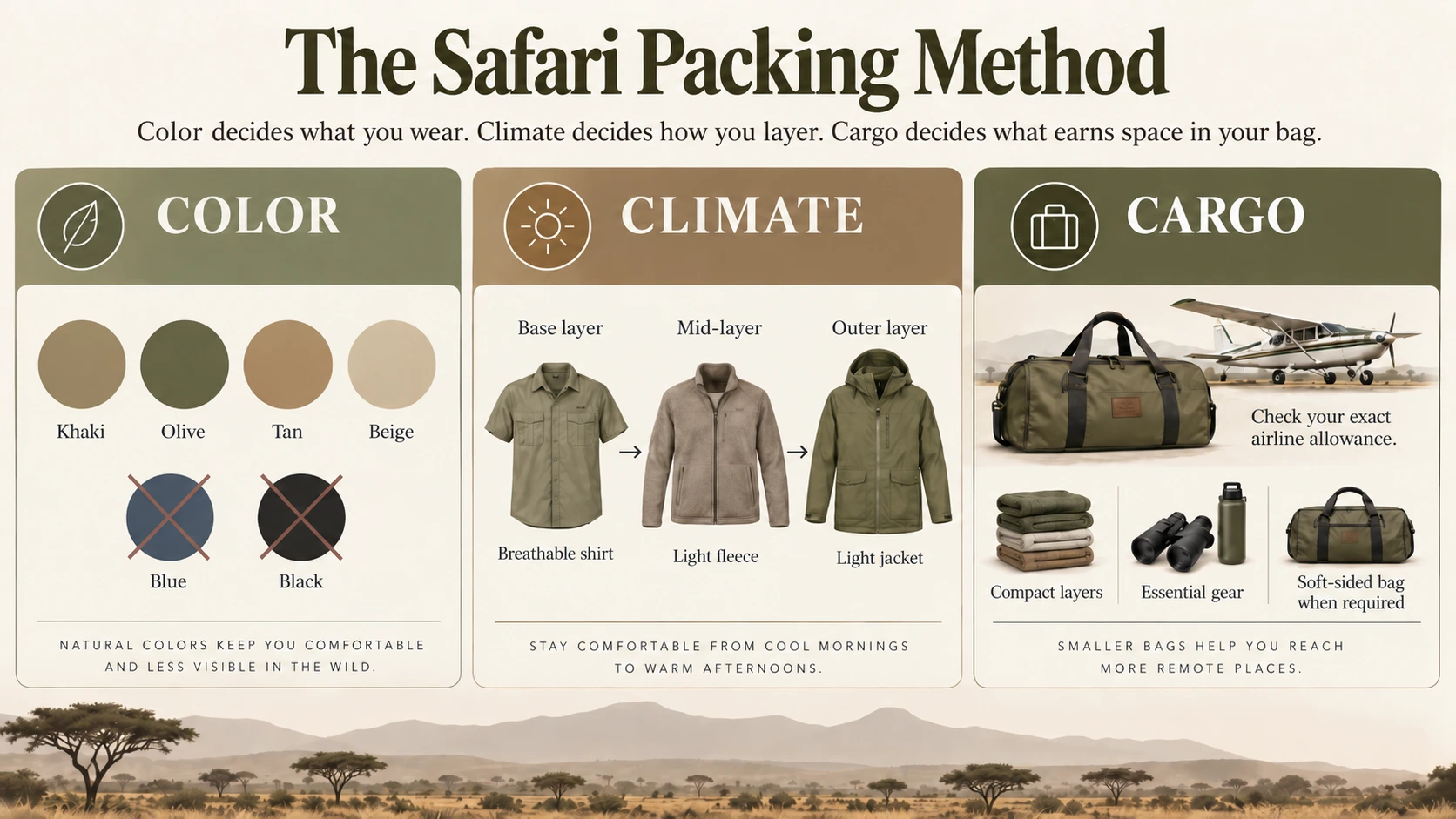
This African safari packing list uses three simple filters, Color, Climate, and Cargo, to help you decide what deserves space in your bag. Color guides what you wear. Climate determines how you layer. Cargo decides what you can realistically bring.
Still choosing where to go? Explore our guide to the best safari destinations in Africa for first-time travelers.
African Safari Packing List at a Glance
| Filter | What It Controls | Pack | Avoid or Limit |
|---|---|---|---|
| Color | Clothing choices | Khaki, olive, tan, beige, muted earth tones | Blue and black in tsetse areas; camouflage where restricted |
| Climate | Layers and protection | Breathable long sleeves, lightweight trousers, fleece, light jacket, hat, sunscreen | One bulky outfit expected to work in every temperature |
| Cargo | Luggage and quantity | Compact layers, essential safari gear, suitable duffel when required | Excess shoes, oversized toiletries, unnecessary equipment |
The Three-Filter Safari Packing Method
Before anything earns a place in your bag, ask three questions:
- Color: Is it practical for insects, dust, and the environment?
- Climate: Can I use or layer it as conditions change?
- Cargo: Does it fit within the baggage rules for every flight and transfer on my itinerary?
If something fails one of those tests, reconsider whether you really need it.
What to Wear on Safari
Pass the Color Filter: Choose Practical Safari Clothing
Khaki, olive, tan, beige, brown, and muted green are classic safari clothing colors for practical reasons, not because you need to dress like a safari guide.
Color matters most in regions where tsetse flies occur. The CDC advises travelers to wear neutral-colored long sleeves and trousers because tsetse flies are attracted to bright and dark colors, particularly blue and black. It also notes that the flies can bite through lightweight fabric, making medium-weight material more protective. CDC Yellow Book guidance on tsetse flies
That doesn’t mean every item has to be khaki. Aim for a small mix-and-match wardrobe such as:
- 3 to 4 neutral shirts
- 2 to 3 lightweight trousers
- One pair of shorts where appropriate
- Underwear and socks
- Comfortable camp or sleep clothes
Bright white isn’t forbidden, but safari dust quickly makes it less practical.
Pass the Climate Filter: Dress in Layers
Safari days rarely stay at one temperature.
An early-morning game drive in an open vehicle can feel chilly, while the same vehicle may be warm under the afternoon sun. Conditions also depend on your destination, altitude, and season.
Instead of packing a bulky coat, use three adaptable layers:
Base layer: Breathable T-shirt or long-sleeved shirt
Mid-layer: Lightweight fleece or sweater
Outer layer: Light windproof or weather-appropriate jacket
This gives you the flexibility to add or remove clothing throughout the day without carrying several heavy outfits.
Use the Climate Filter for Sun Protection Too
Climate isn’t only about temperature. Hours in an open safari vehicle can also mean significant UV exposure.
The CDC recommends broad-spectrum SPF 30 or higher, lightweight long-sleeved clothing with UPF above 30, UVA/UVB-protective sunglasses, and a wide-brimmed hat. CDC Yellow Book sun-exposure guidance
A practical safari outfit therefore includes:
- Breathable long sleeves
- Lightweight trousers
- Wide-brimmed hat
- Sunglasses
- SPF 30+ sunscreen
Choose Shoes That Pass the Climate and Comfort Test
For a typical vehicle-based safari, heavy hiking boots usually aren’t necessary.
Broken-in sneakers or light trail shoes work well for getting around camp, climbing in and out of safari vehicles, and taking short walks.
Bring more substantial hiking footwear if your itinerary includes walking safaris, trekking, or long hikes.
Most importantly, don’t bring brand-new shoes. Safari is not the place to discover that your boots start rubbing after an hour.
What to Pack for Safari
Pass the Cargo Filter: Check Your Safari Luggage Rules
The Cargo Filter is where many first-time safari travelers get caught out.
There is no universal safari luggage allowance. Small-aircraft rules vary by airline, aircraft, and route.
For example, AirKenya currently limits baggage to 15 kg (33 lb) in total and requires checked baggage to be soft-sided. Carry-on items form part of that allowance. AirKenya baggage policy
By comparison, Tanzania’s Auric Air currently allows 20 kg (44 lb) including hand luggage, cameras, and personal items. It accepts different bag types, although it recommends soft-sided luggage because it fits aircraft compartments more easily. Auric Air baggage policy
So don’t pack according to a generic “15 kg safari rule.”
| Check the baggage policy for every light-aircraft carrier on your exact itinerary. |
If soft luggage is required, a flexible duffel is generally more practical than a rigid suitcase.
Pack Clothes That Earn Their Cargo Space
Once you know your baggage allowance, avoid packing a separate outfit for every day.
Choose clothes that can be mixed, matched, and layered. For a week-long safari, a compact wardrobe of several shirts, two or three pairs of trousers, and a few layers can often be more useful than seven complete outfits.
Many safari camps offer laundry services, but availability, turnaround time, costs, and restrictions differ. Check your accommodation before depending on laundry to reduce your packing.
Cargo-Friendly Safari Essentials
After clothing, prioritize compact items that genuinely improve your trip.
- Binoculars: Guides often carry binoculars, but having your own means you won’t miss a distant animal while waiting to share.
- Small daypack: Keep water, binoculars, sunscreen, sunglasses, medication, a camera, and a light layer within reach during game drives.
- Headlamp: Useful when walking around remote camps after dark, particularly where lighting is intentionally limited.
- Power bank and travel adapter: Charging arrangements vary between camps, so check what your accommodation provides and what plug type your destination uses. Keep power banks and spare lithium batteries in your carry-on, including when your main bag is checked at the aircraft, and check your airline’s battery limits.
- Electronics protection: Fine dust reaches cameras, lenses, and chargers easily. A zipped packing cube, dry bag, or protective pouch can help keep electronics cleaner.
- Small travel health kit: Bring prescription medication, basic first-aid supplies, insect repellent, sunscreen, and any personal health essentials recommended for your destination.
What to Leave Behind on Safari
The easiest way to decide what stays home is to reverse the method:
| If it fails Color, Climate, or Cargo, it probably doesn’t belong in your bag. |
Fails the Color Filter
Blue and Black Clothing in Tsetse Areas
You don’t need to ban these colors from every African safari, but in areas where tsetse flies are present, neutral shades are the more practical choice because the CDC specifically identifies blue and black as attractive to the flies.
Camouflage Clothing
Camouflage is another easy item to leave at home.
Rules differ by country, and civilian camouflage clothing is restricted in some destinations. In Zimbabwe, for example, official UK government travel advice states that it is illegal for civilians to wear clothing made from camouflage material. UK government travel advice for Zimbabwe
Plain olive, tan, or khaki clothing gives you the practicality you need without the potential legal complication.
Fails the Climate Filter
One Bulky Jacket
A large jacket designed for one temperature takes up valuable space and may spend most of the day unused.
A light base layer, fleece, and outer layer are much more adaptable.
Brand-New Hiking Boots
Unless your itinerary specifically involves extensive walking or trekking, heavy new boots create more bulk than benefit, and new footwear comes with a blister risk.
Pack comfortable, tested shoes instead.
Clothing You Can’t Layer
A safari wardrobe works best when pieces can be worn together.
An item that is useful only in one narrow temperature range is less valuable than a shirt, fleece, or jacket you can combine with other layers.
Fails the Cargo Filter
A Suitcase Your Airline Doesn’t Accept
Don’t assume all safari airlines prohibit hard-shell luggage, because policies differ.
Instead, check your exact carrier. If it requires soft-sided bags, leave the rigid suitcase at home.
Too Many Shoes
Shoes are among the bulkiest items in your bag.
For most safaris, one practical pair for walking plus a lightweight camp option is enough. Add hiking boots only when your itinerary justifies them.
Full-Size Toiletries
Unless your trip is unusually long, travel-sized toiletries normally make more sense, particularly if you have a strict bush-flight weight allowance.
High-Wattage Appliances
Hair dryers, straighteners, and similar appliances can add unnecessary weight, and some remote camps have electrical systems that may not support them.
Check what your accommodation provides before packing.
Too Many “Just in Case” Items
This is how a light duffel becomes an overweight one.
An extra jacket, several backup shirts, another pair of shoes, and full-size toiletries may seem insignificant individually. Together, they can consume a large share of a small-aircraft baggage allowance.
When you’re unsure, ask:
Does this item pass Color, Climate, and Cargo?
If not, leave it behind.
Safari Packing Checklist Before You Leave
Before closing your bag, ask:
- Color: Have I chosen practical neutral clothing, especially if I’m visiting a tsetse area?
- Climate: Can I layer my clothes for cooler mornings and warmer afternoons?
- Cargo: Have I checked the luggage rules for every small-aircraft flight?
- Are my medications, documents, and essential electronics easy to access?
- Am I carrying anything bulky or heavy that I probably won’t use?
A good safari packing list isn’t about owning specialist safari clothing from head to toe. It’s about choosing versatile items that work together.
Remember the method:
Color decides what you wear.
Climate decides how you layer.
Cargo decides what earns space in your bag.
Pack with those three filters in mind, and you’ll arrive with less luggage, and far more of what you actually need.
FAQ
In areas with tsetse flies, minimize blue and black because these colors are particularly attractive to the flies. Neutral shades such as khaki, olive, tan, and beige are practical alternatives.
There is no universal weight limit. Your safari luggage allowance depends on the airline and aircraft. Some operators allow 15 kg, while others permit 20 kg or have different baggage rules. Always check your exact carrier before packing.
Not always. Some light-aircraft operators require soft-sided luggage, while others accept suitcases but recommend flexible bags. Follow your airline’s official policy rather than a generic safari rule.
Usually not for a vehicle-based game drive. Broken-in sneakers or light trail shoes are suitable for most standard safaris. Hiking boots are more useful for walking safaris, trekking, and longer hikes.
Choose a broad-spectrum sunscreen with SPF 30 or higher and combine it with protective clothing, sunglasses, and a wide-brimmed hat.