

Finding ethical wildlife sanctuaries takes more than searching for places with “rescue” in the name. Some facilities genuinely rehabilitate animals or provide lifelong care; others use sanctuary language while selling close-contact encounters.
This list focuses on places with clear rescue or conservation work, transparent visitor policies, and experiences that do not depend on rides, petting sessions, or forced photo opportunities. Visitor details were checked against official organization, government, or conservation sources in September 2026. Policies can change, so always recheck the official site before booking.
How I Chose These Ethical Wildlife Sanctuaries
I used five practical checks:
- Animals should come primarily through rescue, confiscation, rehabilitation, or legitimate conservation programs.
- Visits should minimize stress and avoid entertainment-style handling.
- The organization should explain its animal-care or release work.
- There should be credible oversight or partnerships where relevant.
- Conservation should extend beyond ticket sales.
The Global Federation of Animal Sanctuaries (GFAS) is a useful benchmark. Its eligibility rules prohibit direct public contact with wildlife, commercial animal trade, and breeding of lifetime-care animals except in legitimate release programs. GFAS also notes that absence from its directory does not automatically mean a facility is unethical. This list includes lifetime-care sanctuaries, rehabilitation centers, and conservation organizations with different operating models; inclusion does not mean that every facility is GFAS-accredited or meets all its standards.
Quick Comparison
| Sanctuary / Center | Location | Main focus | Visitor model |
| Sheldrick Trust | Kenya | Elephants & rhinos | Advance-booked hour |
| Elephant Nature Park | Thailand | Elephants | Hands-off SkyWalk |
| Agra Bear Rescue | India | Sloth bears | Pre-arranged visits |
| Luang Prabang | Laos | Bears & wildlife | Guided Bear Care Tour |
| Animals Asia | Vietnam | Rescued bears | Limited Open Days |
| Sepilok Orangutan Centre | Malaysia | Orangutans | Boardwalk viewing |
| Monkey World | England | Primates | Public rescue centre |
| Turpentine Creek | USA | Rescued big cats | Guided hands-off tours |
| Cheetah Conservation Fund | Namibia | Cheetahs | Day/overnight visits |
| Toucan Rescue Ranch | Costa Rica | Native wildlife | Hands-off tours |
1. Sheldrick Wildlife Trust: Nairobi, Kenya
Sheldrick Wildlife Trust is best known for rescuing and raising orphaned elephants and rhinos. Its Nairobi Nursery offers one public hour each day, except December 25, from 11 a.m. to noon, and advance booking is required. Visitors must pay the Nairobi National Park entry fee separately from the nursery’s admission donation. Visitors watch from designated areas while keepers explain the orphans’ stories; direct feeding and handling are reserved for staff. The long-term aim is reintegration, with elephants eventually moving to units that act as launchpads for a return to the wild.
2. Elephant Nature Park: Chiang Mai, Thailand
Elephant Nature Park has helped shift elephant tourism in northern Thailand away from riding and performances. For the clearest low-contact experience, choose its SkyWalk program, which is specifically promoted as a hands-off project. Visitors observe rescued elephants from elevated walkways and learn about their histories while the herds move, forage, socialize, and use mud or water areas on their own terms. Because the park offers several programs, check the exact itinerary before booking.
3. Agra Bear Rescue Facility: Uttar Pradesh, India
Run by Wildlife SOS with government partners, the Agra Bear Rescue Facility cares for sloth bears rescued from India’s former “dancing bear” trade and other harmful situations. Wildlife SOS also worked with Kalandar families on alternative livelihoods, tackling the human side of the trade rather than focusing only on the animals. The centre accepts conservation-education visitors by prior arrangement; it is not a casual petting attraction, and Wildlife SOS states that direct physical contact is not part of its visitor or volunteer program.
4. Luang Prabang Wildlife Sanctuary: Laos
Free the Bears operates Luang Prabang Wildlife Sanctuary for rescued sun bears, moon bears, and other wildlife affected by the illegal trade. Its three-hour Bear Care Tour is designed around education and enrichment rather than touching animals: guests learn rescue stories, help prepare enrichment, and then watch bears search for treats in their enclosures. For travelers who want a structured activity without turning wildlife into a photo prop, it is one of the strongest options in Southeast Asia.
5. Animals Asia Vietnam Bear Rescue Centre: Tam Dao, Vietnam
Animals Asia provides lifelong sanctuary to bears rescued from the bile industry. Its Tam Dao sanctuary is not open for unrestricted daily tourism; instead, it offers limited guided Open Days, with small group sizes and advance confirmation. Places are limited, and existing supporters receive priority. That restricted access is a positive sign: the sanctuary’s main purpose is bear care, not entertainment. Animals Asia’s bear sanctuaries have also been recognized through GFAS accreditation, adding an independent welfare benchmark.
6. Sepilok Orangutan Rehabilitation Centre: Sabah, Malaysia
Sepilok Orangutan Rehabilitation Centre was established to rehabilitate orphaned and displaced orangutans within the Kabili-Sepilok Forest Reserve. Visitors use boardwalks and viewing areas rather than handling the animals, and the official visitor guidance specifically asks people not to touch orangutans. Scheduled feeding platforms make sightings possible, but orangutans are free not to appear, especially when natural food is plentiful. That unpredictability is part of the rehabilitation model, not a flaw in the experience.
7. Monkey World Ape Rescue Centre: Dorset, England
Monkey World began in 1987 as a home for chimpanzees rescued from abuse as photographers’ props and has grown into a 65-acre centre for hundreds of rescued and rehomed primates. Its own visitor rules emphasize that it is a rescue and rehabilitation centre rather than a conventional zoo, with large social enclosures designed around the animals’ needs. Visitors can join guided talks or observe primates living in groups while learning about illegal wildlife trade, exploitation, and rehabilitation.
8. Turpentine Creek Wildlife Refuge: Arkansas, USA
Turpentine Creek Wildlife Refuge offers sanctuary to big cats and other animals rescued from private ownership, neglect, and the exotic-animal trade. It is a GFAS-accredited, explicitly hands-off facility: neither guests nor staff have routine physical contact with the animals, and the refuge states that it does not buy, sell, breed, or trade residents. Guided tours focus on individual rescue stories and the wider problems created by captive wildlife ownership.
9. Cheetah Conservation Fund: Otjiwarongo, Namibia
Cheetah Conservation Fund (CCF) combines animal care with field conservation, research, education, and conflict-reduction work with farmers. Its Namibia centre welcomes day visitors and overnight guests, with tours covering resident cheetahs, the livestock-guarding-dog program, research facilities, and predator-friendly farming. Its advertised activities also include a Cheetah Run with ambassador cheetahs, so check the specific itinerary and animal-welfare policies before booking. CCF is especially useful for travelers who want to understand conservation beyond rescue: the goal is not simply to house cheetahs, but to reduce the pressures that cause cheetahs to be killed in the wild.
10. Toucan Rescue Ranch: Heredia, Costa Rica
Toucan Rescue Ranch rescues and rehabilitates native Costa Rican wildlife, including toucans, sloths, owls, and monkeys. Its tours are reservation-based and explicitly hands-off: visitors may not touch or hold wildlife, and only trained staff handle animals when necessary. The ranch also supports the Stop Animal Selfies message and releases animals whenever rehabilitation makes a return to the wild possible. It is a good example of how a visitor experience can fund conservation without making physical contact the attraction.
How to Spot a Fake Sanctuary
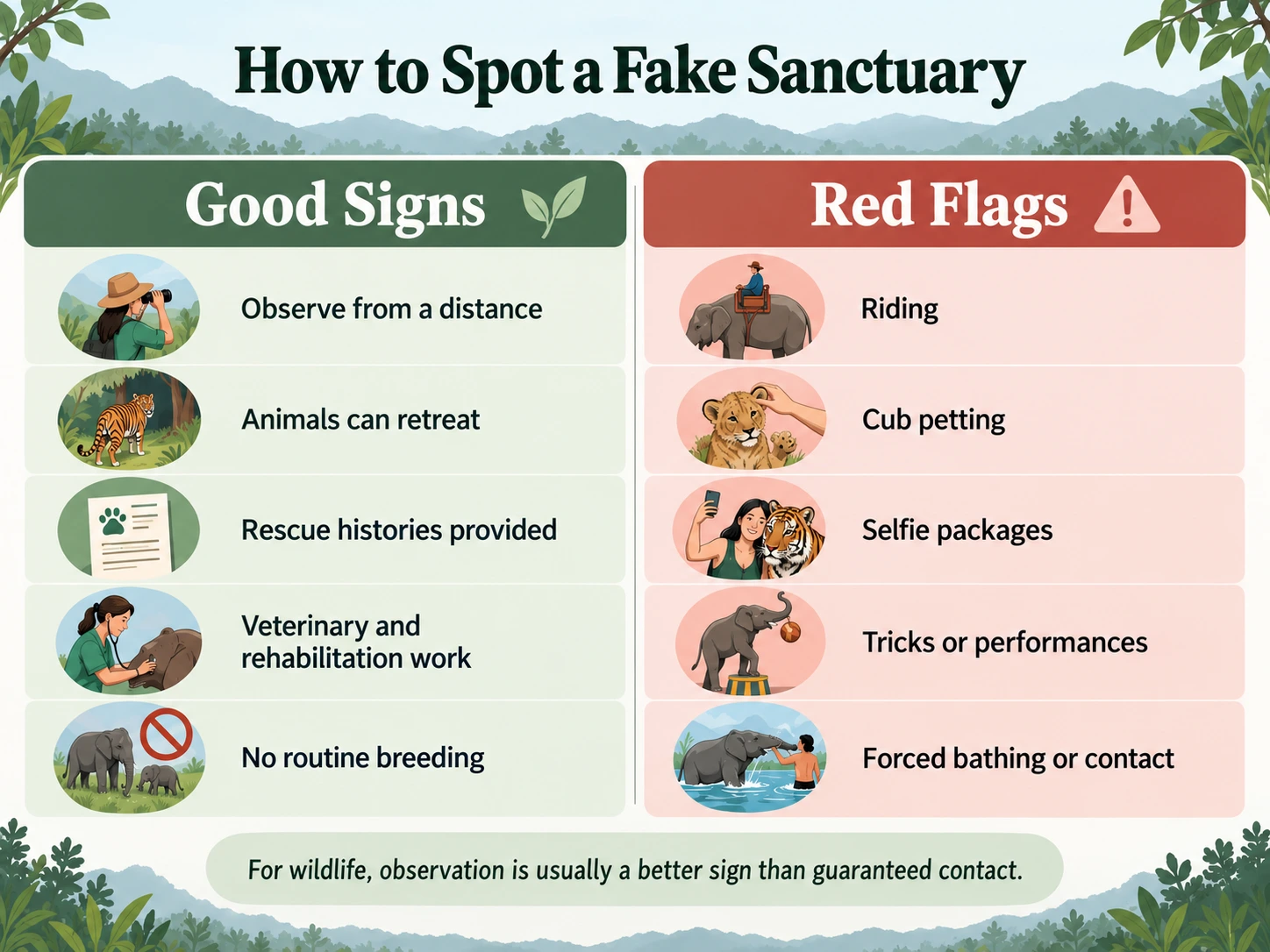
A “sanctuary” label is not enough. Be cautious if you see any of these signs:
- Riding, cub petting, forced bathing, or paid selfie packages with wild animals.
- Animals performing tricks, posing on command, or being brought out mainly for entertainment.
- Little or no information about where the animals came from, veterinary care, rehabilitation, or long-term outcomes.
- Routine breeding with no credible conservation or release purpose.
- Visitor access that seems designed around constant interaction rather than giving animals space to retreat.
One detail alone does not prove a facility is unethical, but repeated red flags should make you look elsewhere. For wildlife, observation is usually a better sign than guaranteed contact.
Planning a Bigger Trip
If Sheldrick Wildlife Trust or Cheetah Conservation Fund inspires a longer African itinerary, pair the sanctuary visit with responsible wildlife viewing in protected areas. For ideas, see our guide: 7 Best Safari Destinations in Africa for First-Time Travelers. For Sepilok, the Bornean Sun Bear Conservation Centre is next door, making it easy to build a full conservation-focused day without adding another long transfer.
Before You Visit
Before booking, check the exact visitor program and confirm any reservation requirements directly with the organization. During your visit, follow staff guidance and give animals space to retreat. A worthwhile sanctuary experience can be as simple as watching animals forage, socialize, or rest while learning how their care is supported.
FAQ
A credible sanctuary puts animal welfare before visitor entertainment. Look for rescue or rehabilitation work, transparent animal histories, appropriate veterinary care, limited or no public contact, and clear policies on breeding, acquisition, and long-term care.
As a general rule, avoid experiences built around touching, holding, riding, or posing with wild animals. Some legitimate rehabilitation work may require trained staff to handle animals, but that is very different from selling contact to tourists.
No. GFAS accreditation is a strong independent trust signal, but it is voluntary and not available or pursued by every credible organization. Use it as one indicator alongside official wildlife-authority partnerships, transparent policies, and evidence of genuine rescue or rehabilitation work.