


Cardboard, foil, and a sunny afternoon are all it takes to turn sunlight into cooking heat, no matches or electricity required. I’ll admit I was skeptical the first time I built a DIY solar oven out of a pizza box, but watching a s’more melt without a single flame changed my mind about what a scrap of cardboard and some kitchen foil can do. If you’ve ever wanted a hands-on way to understand solar energy or you just want a fun weekend project that ends in melted chocolate, this is the one to try.
This guide walks through the science, the build, and the small tweaks that separate a solar oven that sort of warms things up from one that reaches real cooking temperatures.
How a DIY Solar Oven Actually Works
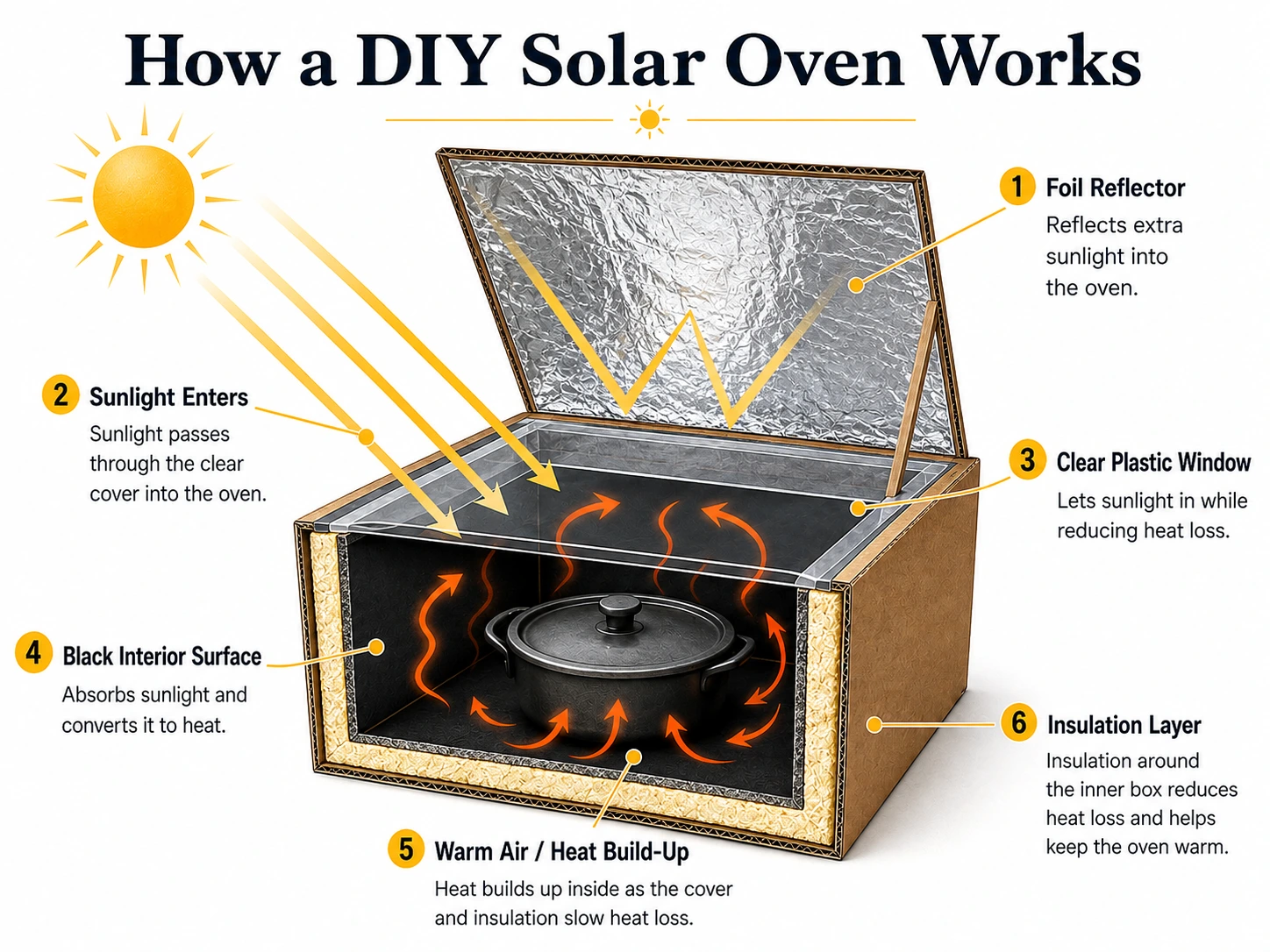
A solar oven isn’t magic; it’s the same physics that makes a parked car unbearably hot in July. Three things are doing the work together: reflection, absorption, and retention.
Foil panels bounce extra sunlight into the cooking chamber, while a dark interior surface absorbs that light and converts it into heat rather than reflecting it away. The real trick is what happens next: the clear cover lets sunlight enter while slowing the escape of warm air. Once the dark interior absorbs the sunlight and heats up, the sealed cover and insulation reduce heat loss through convection and conduction, allowing the temperature inside the box to rise.
| Did you know? Solar cooker designs can vary dramatically in power. In a peer-reviewed evaluation of household solar cookers, a panel cooker produced about 25 watts of standardized cooking power, compared with previously reported values of around 65 watts for a box cooker and 198 watts for a parabolic cooker. The exact performance of any solar cooker depends heavily on its size, design, sunlight, and operating conditions. |
What You’ll Need
- A cardboard box with a lid (a pizza box is the classic choice, but any similar hinged box works)
- A second, slightly smaller box, or extra cardboard to build an inner layer
- Aluminum foil
- Black construction paper or matte black paint
- Clear plastic wrap or a large ziplock bag
- Newspaper, wool scraps, or foam for insulation
- A ruler, box cutter, tape, and a wooden skewer or dowel to prop the reflector open
How to Build a DIY Solar Oven Step by Step
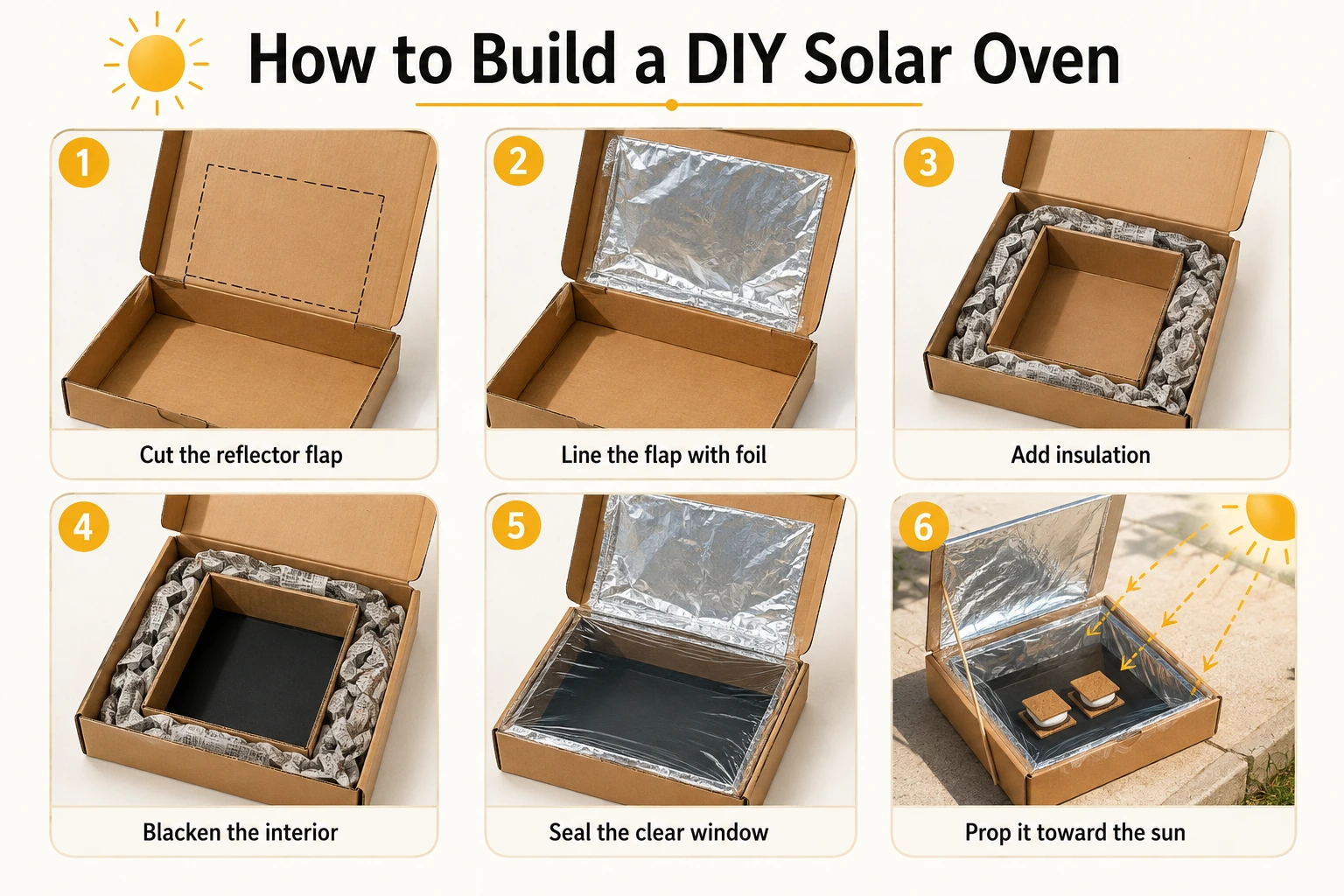
1. Cut your reflector flap. On the box lid, cut a flap that leaves about a one-inch border on three sides, so it stays hinged to the box. This becomes your reflector.
2. Line the flap with foil. Glue or tape aluminum foil to the inside of that flap, keeping it as smooth and wrinkle-free as possible; every crease scatters light that should be heading into your cooking chamber.
3. Insulate the base. If you’re using two boxes, nest the smaller one inside the larger and pack the gap with newspaper or foam. This layer slows down heat loss through the cardboard walls, the same way insulation works in a real building.
4. Blacken the interior. Line the bottom of the inner box with black construction paper or a coat of matte black paint. Dark surfaces absorb much more incoming visible light than light-colored surfaces instead of reflecting it away, which helps the cooking chamber heat up.
5. Seal the window. Stretch clear plastic wrap tightly over the box opening. For better insulation, use two layers with a small air gap between them to reduce heat loss from the cooking chamber. If you’re using a zip-lock bag, tape it snugly around the opening instead.
6. Prop the reflector. Use a skewer or dowel to angle the foil flap so it catches sunlight and directs it down into the box.
7. Preheat, then cook. Set the oven in direct sun and let it warm up for 20–30 minutes before adding food. In strong direct sunlight, a well-built pizza-box solar oven may reach roughly 150–200°F (65–93°C), although actual temperatures vary widely with sunlight, wind, insulation, reflector angle, and construction.
| Food-safety note: Treat a pizza-box solar oven primarily as a science project and low-temperature cooker. If you use it for perishable foods, check the food itself with a thermometer rather than relying on the oven temperature. |
Follow USDA safe minimum internal temperatures, and avoid cooking raw meat if your oven cannot heat food reliably.
| A useful tweak: Peak solar cooking hours run from about 11 a.m. to 3 p.m., when the sun sits highest in the sky. Reposition your oven every 20–30 minutes to keep the reflector angled directly at the sun; it makes a bigger difference than almost any other adjustment. |
Does Solar Cooking Affect Nutrients?
In 2023, research published in the journal Molecules compared a direct solar oven with an electric oven and found that solar cooking preserved some nutrients and increased total phenolic content in certain vegetables. Solar-cooked eggplant, for example, showed 38% higher total phenolic content than the electric-oven sample. However, direct solar exposure also increased the degradation of some carotenoids, and the researchers found that adding a UV filter helped reduce those losses. Because the study used a purpose-built direct solar oven rather than a pizza-box cooker, its results shouldn’t be assumed to apply equally to every homemade design.
Beyond the kitchen, solar cooking has a track record worth knowing about. Solar Cookers International, a nonprofit that’s been promoting the technology since the 1980s, has pushed for solar cooking’s inclusion in national climate plans precisely because it touches on environmental, health, and equity issues all at once. Around 2.1 billion people worldwide still rely primarily on polluting fuels and technologies for cooking, including biomass, charcoal, coal, and kerosene, according to the World Health Organization.
FAQ
It’ll still generate some heat, since sunlight passes through thin cloud cover, but it’ll take considerably longer and won’t reach the same peak temperature as a clear, sunny day.
In strong direct sunlight, a well-built pizza-box cooker may reach roughly 150–200°F (65–93°C), although actual temperatures vary widely with sunlight, wind, insulation, reflector angle, and construction.
No — panel and box cookers are the easiest to build at home, but parabolic and Fresnel-lens designs concentrate far more sunlight and reach higher temperatures. They’re just more complex to construct.
Anything that benefits from slow, gentle heat: melted s’mores, warmed leftovers, and soft cookies, all do well. Anything needing a hard sear or crisp crust is a poor match.
Troubleshooting: Why Your Oven Isn’t Getting Hot Enough
- Wrinkled foil. Smooth it out; every crease scatters light instead of reflecting it into the box.
- Gaps in the plastic seal. Any opening lets your trapped heat leak straight back out. Tape it down tight.
- Wrong angle. If the reflector isn’t aimed at the sun, you’re losing most of your potential heat. Adjust every 20–30 minutes.
- Not enough insulation. A thin single-wall box loses heat fast. Double up the cardboard or pack in more newspaper.
- Cooking outside peak hours. Early morning or late afternoon sun just doesn’t carry the same punch as midday sun.
Got your solar oven up and running? Pair it with our “Easy Camping Food Ideas” for more no-fuss ways to eat well outdoors.