

Few nights on the astronomical calendar reward patience like the Geminids meteor shower 2026. Every December, Earth drifts through a wide, dusty trail left behind by a strange rocky object, and for a few nights the sky answers back with some of the brightest and most colorful shooting stars of the year. Grab a blanket and a thermos, because this year’s show comes with genuinely good viewing conditions.
When to Watch the Geminids in 2026
The shower runs from December 4 through December 17, but the real spectacle arrives on the night of December 13 into the early morning of December 14, 2026, when Earth passes through the densest part of the debris stream. Under ideal conditions, the Geminids can reach a zenithal hourly rate (ZHR) of about 150, although the number an individual observer actually sees will usually be lower.
The best viewing generally comes from late evening through the predawn hours. From many Northern Hemisphere locations, conditions improve after midnight as Gemini climbs higher in the sky, with the radiant reaching its highest point around the middle of the night. If you can only watch for an hour or two, the post-midnight period is usually a good choice.
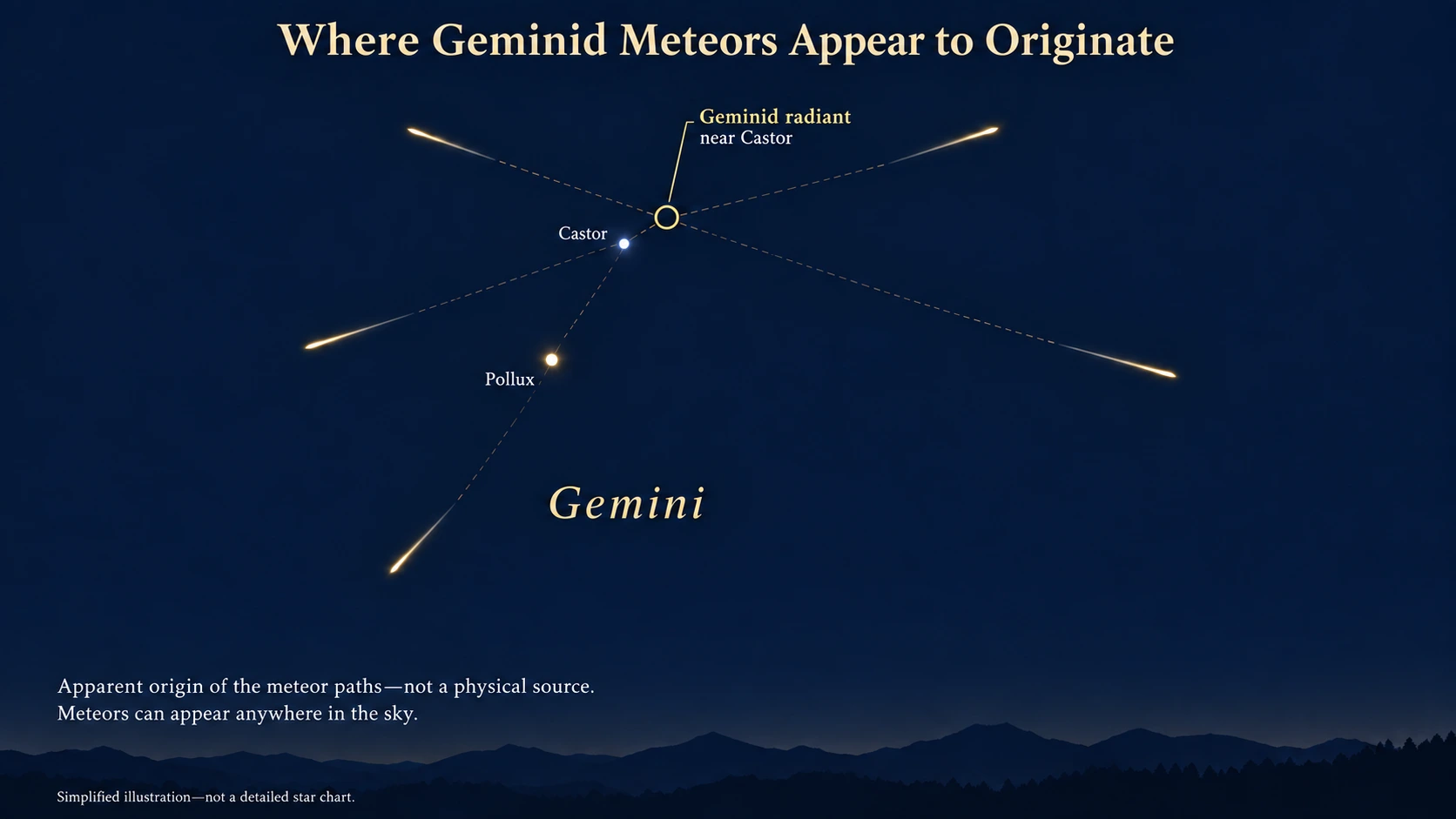
| Did you know? The Geminids’ radiant lies near Castor in Gemini. It’s a chance alignment; Castor is roughly 52 light-years away and has nothing to do with the meteors, but it makes the shower easy to locate even for casual stargazers. |
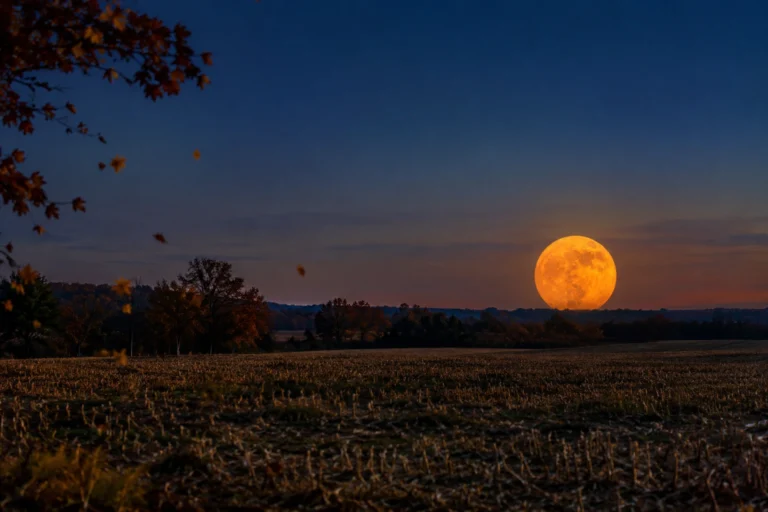
Moon conditions matter more than most people realize when they’re planning a meteor watch, and 2026 happens to cooperate. A waxing crescent Moon, roughly 20% illuminated around the peak, will set relatively early from many locations, leaving much of the prime late-night viewing period dark.
What Makes the Geminids Different
Most meteor showers trace back to comets: icy wanderers that shed dust and debris as they swing past the sun. The Geminids break that pattern entirely. Their parent object is 3200 Phaethon, a roughly three-mile-wide rocky asteroid discovered in 1983 that passes about 13 million miles from the Sun at its closest approach. Recent observations have complicated the mystery further: Phaethon’s comet-like tail appears to be made largely of sodium gas rather than dust, so its present-day activity may not explain how the enormous Geminid stream originally formed.
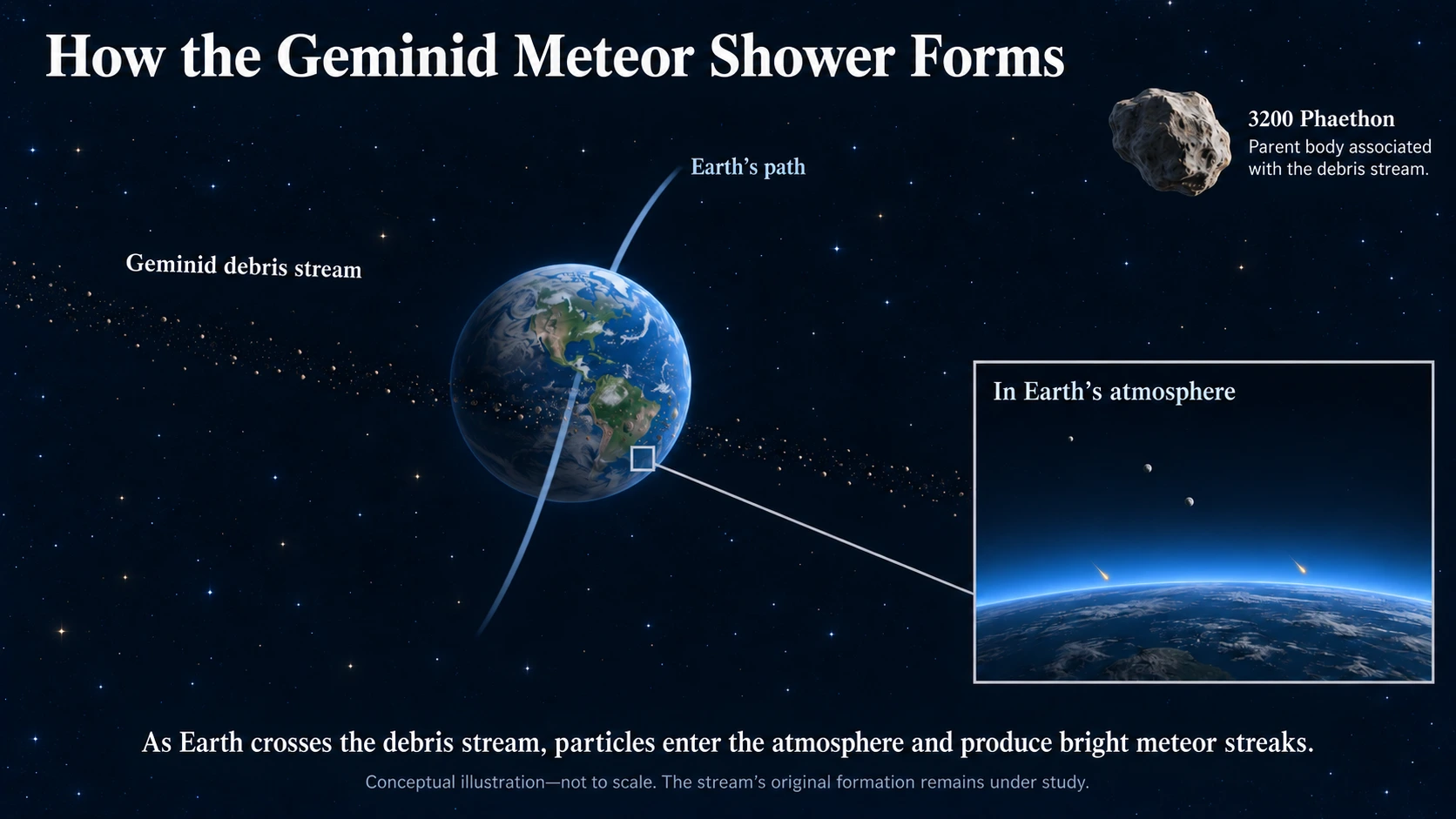
That asteroid origin also explains why Geminid meteors look and behave differently from what you might have seen during August’s Perseids. They travel at a relatively modest 22 miles per second, considerably slower than Perseid meteors, which gives them slower streaks rather than the quick flash-and-gone trails typical of faster showers. Geminids also tend to be bright and can produce colorful fireballs—exceptionally bright meteors that may rival or exceed Venus in brightness.
How to Watch: No Equipment Required
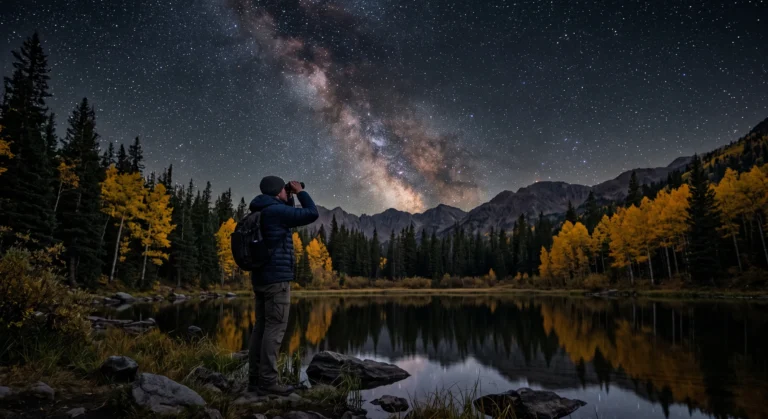
The single best piece of gear for a meteor shower is the one you were born with. Binoculars and telescopes narrow your field of view so much that you’ll miss far more meteors than you catch; naked-eye viewing wins every time. If you’ve been using a red light headlamp to protect your night vision on other stargazing trips, bring it along here too; it’ll let you check a star chart or pour a cup of coffee without blowing out the dark adaptation you just spent twenty minutes building.
A few practical notes for a comfortable night out:
- Get away from light pollution. Even a modest move away from bright city and street lights can reveal fainter meteors that would otherwise disappear into the skyglow.
- Give your eyes time to adjust. Dark adaptation takes roughly 20–30 minutes, and looking at a bright phone screen can significantly disrupt your night vision
- Look up, not just toward Gemini. Meteors can streak across any part of the sky, though tracing a trail backward will usually lead you toward the radiant near Castor.
- Dress for it. December nights get cold fast once you’re lying still for an hour. If you’re planning a longer session, our guide to easy camping food ideas has some warm, low-effort options that travel well in a thermos.
If this is your first time watching a meteor shower, or you want a broader primer on reading the night sky, our beginner’s guide to stargazing covers the basics of dark adaptation, star charts, and what to expect before your first session.
What Makes 2026 Worth the Late Night
At peak, the Geminids have a theoretical ZHR of around 150 under ideal conditions. Actual observers usually see considerably fewer; NASA estimates roughly 40–50 meteors per hour under dark skies for the 2026 shower. Models suggest that the densest part of the Geminid stream has gradually shifted closer to Earth’s orbit, helping explain why the shower’s activity has increased over time.
Combine the Geminids’ naturally high activity with the favorable Moon phase, and 2026 offers particularly good conditions for watching the shower.
FAQ: Geminids Meteor Shower 2026
The International Meteor Organization predicts a broad maximum centered on December 14 at 14:00 UTC. For US observers, the night of December 13 into the morning of December 14 is the main viewing night, with good viewing opportunities after midnight when the radiant is high.
Meteors become visible in mid-evening, but rates climb substantially after 9 or 10 p.m. and keep improving until the radiant is highest, well after midnight.
No, the naked eye is actually the best tool for meteor watching. Binoculars and telescopes narrow your view too much to catch fast-moving streaks across the sky.
Not much. Around the peak, the Moon will be a waxing crescent, roughly 20% illuminated. It sets during the evening in many locations, leaving the main late-night viewing hours largely free of moonlight.
Meteors can appear anywhere in the sky, but they’ll trace back toward the constellation Gemini, near the bright stars Castor and Pollux, which rise in the east during the evening.
Yes, though at reduced rates compared to the Northern Hemisphere, since the radiant doesn’t climb as high above the horizon.
The shower stays active from December 4 through December 17, so nights on either side of the peak, especially December 12 or 15, can still deliver a solid, if less dramatic, showing.