

Fireflies turn darkness into a language. One flash appears in the grass, another answers from across the meadow, and soon the night seems to be filled with tiny signals blinking back and forth. What looks like a simple summer spectacle is actually a remarkably precise biological system, shaped by chemistry, communication, and evolution.
The light itself is produced through bioluminescence, a chemical reaction inside the firefly’s body that generates visible light with almost no heat. But the glow is only part of the story. Different species use their flashes to find mates, warn predators, and, in some cases, even lure other fireflies to their deaths.
So how do fireflies glow, and why do they flash in the first place? This is the science behind one of nature’s most fascinating nighttime displays and a few thoughts on how to watch it responsibly.
What Are Fireflies?
First, a small correction that surprises a lot of people: fireflies aren’t flies at all. They’re beetles, belonging to the family Lampyridae, with more than 2,400 described species known worldwide. “Lightning bug” is just as accurate a name as “firefly” — neither is scientifically precise, and both are fine to use.
Like all beetles, fireflies go through complete metamorphosis: egg, larva, pupa, adult. What most people don’t realize is that the larvae glow too.
Did you know?
Firefly larvae are sometimes called “glowworms.” They spend one to two years living in soil, leaf litter, or rotting wood before emerging as the winged adults we associate with summer evenings.
How Do Fireflies Glow? The Chemistry of Bioluminescence
Here’s where it gets genuinely remarkable. The light a firefly produces comes from a chemical reaction called bioluminescence, and it happens inside a specialized organ near the tip of the abdomen called the lantern.
Three ingredients make it happen:
- Luciferin — a light-emitting compound the firefly’s body produces
- Luciferase — an enzyme that catalyzes the reaction
- Oxygen and ATP — oxygen triggers the reaction, and ATP (the cell’s energy currency) fuels it
When these combine inside the lantern cells, the luciferin is oxidized and briefly enters an excited energy state. As it settles back down, it releases that energy as a photon of light rather than as heat.
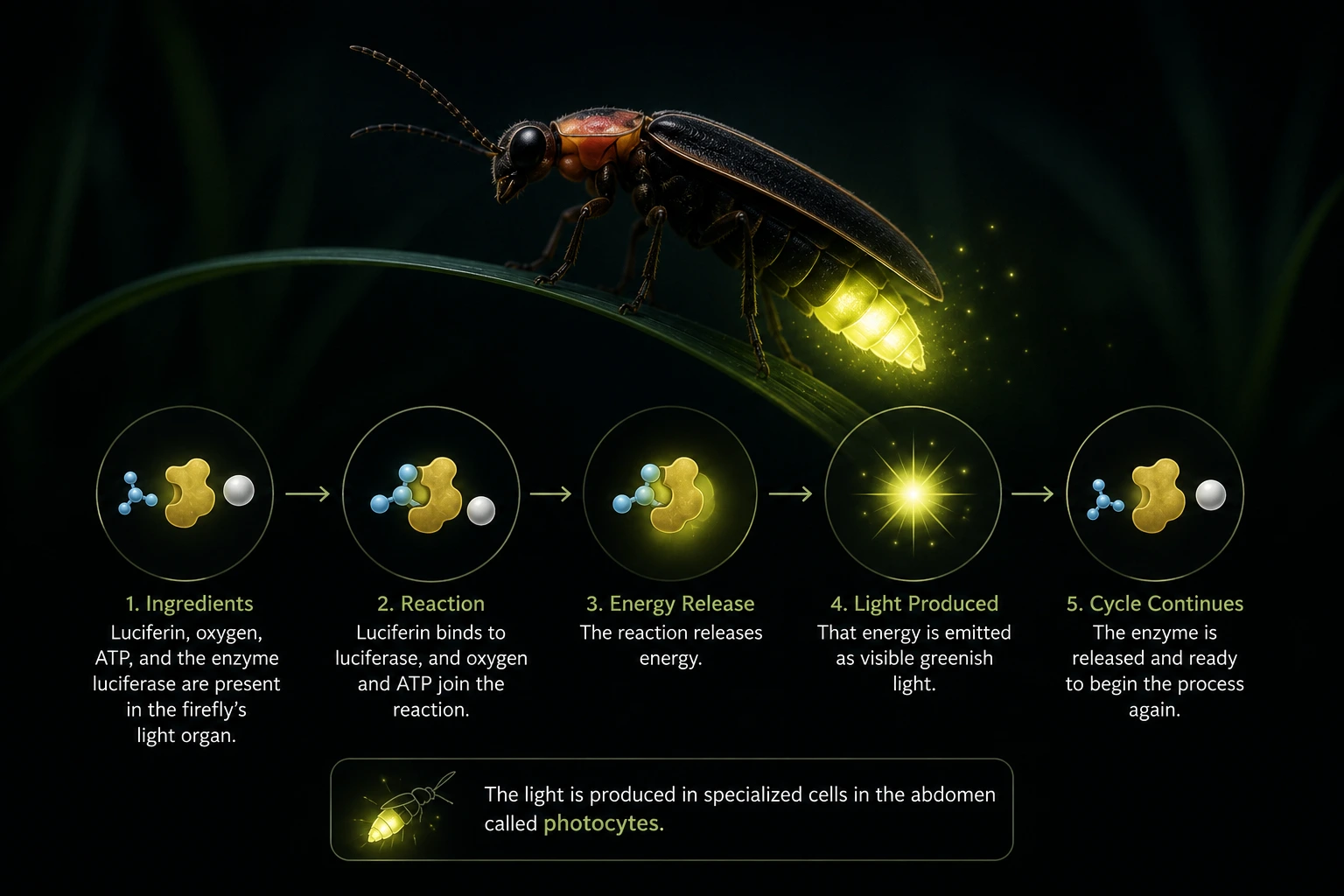
For more detail on the biochemical mechanism of firefly bioluminescence;
This is what scientists call “cold light” because this reaction is remarkably efficient, converting chemical energy into light while producing very little heat, compared to a standard incandescent bulb, which wastes most of its energy as heat and converts only a small fraction into visible light.
A useful glow:
Firefly luciferase hasn’t just fascinated naturalists; it’s become a genuine research tool. Scientists have studied and adapted the enzyme for decades, including its use in medical and genetic research, where it helps make certain biological processes visible.
Fireflies control their flashes by regulating the biochemical conditions inside the lantern, with oxygen availability playing an important role. The detailed mechanism involves nitric oxide signaling and is more complex than a simple on-and-off valve.
💡 Bottom Line
Fireflies make light through a biochemical reaction involving luciferin, luciferase, ATP, and oxygen. Unlike a flame or incandescent bulb, the process produces very little heat.
The Language of Light: Why Do Fireflies Flash?
Firefly behavior varies considerably among species, so the patterns described here are broad examples rather than rules that apply to every firefly.
1. Finding a Mate
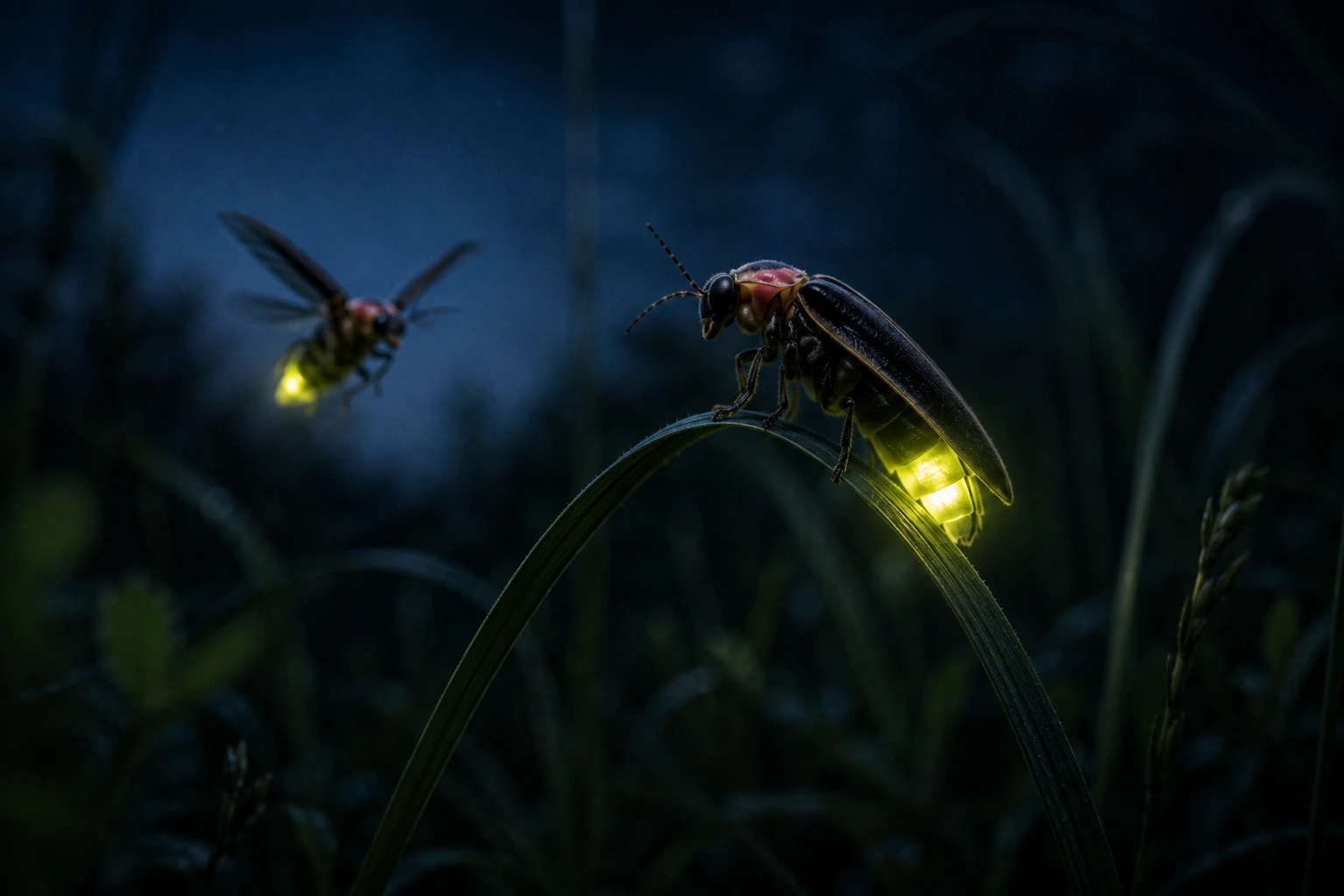
The primary reason fireflies flash is courtship. Each species has its own unique flash pattern: a specific rhythm, color, duration, and number of pulses. Males fly around flashing their species-specific pattern, while females typically perch on vegetation and watch. When a female spots a pattern she recognizes, she’ll flash back in response, essentially saying “I’m here, and I’m interested.” This back-and-forth exchange can continue as the male homes in on her location.
This species-specific coding is crucial because it prevents fireflies from wasting energy courting the wrong species and in a field with multiple species flashing at once, it keeps the signals from turning into chaos.
2. A Warning to Predators
Many firefly species produce defensive chemicals, including cardiotonic steroids known as lucibufagins, which can deter predators. Some Photuris females acquire these defensive chemicals by consuming other fireflies. Their glow doubles as a warning signal similar to the way a wasp’s yellow-and-black stripes tell predators “don’t eat me.” Predators that learn to associate the flashing light with a bad experience tend to avoid fireflies in the future.
3. A Deadly Trap
Not all firefly flashing is friendly. Females of the genus Photuris have evolved a predatory trick: they mimic the flash patterns of other firefly species to lure in unsuspecting males, who arrive expecting a mate and instead become dinner. This behavior has earned Photuris females the nickname “femme fatale fireflies.”
💡 Bottom Line
Firefly flashes are primarily signals used in courtship, but some species also use light to warn predators or deceive other fireflies.
Where and When to See Them
If you’d like to witness this yourself, timing and location matter more than most people expect.
Season
In most of the temperate Northern Hemisphere, firefly activity peaks in late spring through mid-summer, roughly late May through July, though this shifts with latitude and elevation. Warm, humid conditions can favor firefly activity in many species, particularly where moisture supports suitable larval habitat.
Time of night
Many fireflies become active around dusk, although the timing and duration of activity vary considerably among species. Patience matters here: arrive before it feels dark enough, and let your eyes adjust.
Habitat
Fireflies favor damp, undisturbed places, forest edges, tall grass meadows, marshes, and areas near slow-moving water. Larvae need moist soil and leaf litter to develop, so fireflies can be a useful sign that suitable moist, relatively undisturbed habitat is still present. Manicured lawns treated with pesticides are rarely good firefly habitat, which is worth sitting with for a moment.
💡 Bottom Line
Your best chance of seeing fireflies is usually in warm, suitable habitats around dusk, but the exact timing depends on the species and local conditions.
Watching Responsibly
Fireflies are facing increasing conservation concerns in many regions, although population trends are not equally well documented for every species, and the causes trace back to a few very human pressures: habitat loss, pesticide use, and notably for anyone who loves dark skies, light pollution. Artificial light at night appears to interfere with fireflies’ ability to see and respond to each other’s flashes, essentially drowning out their conversation before it can happen.
If you’ve spent time chasing dark sky spots for stargazing, this will sound familiar: the same unhurried darkness that reveals the Milky Way is often what fireflies need to find each other.
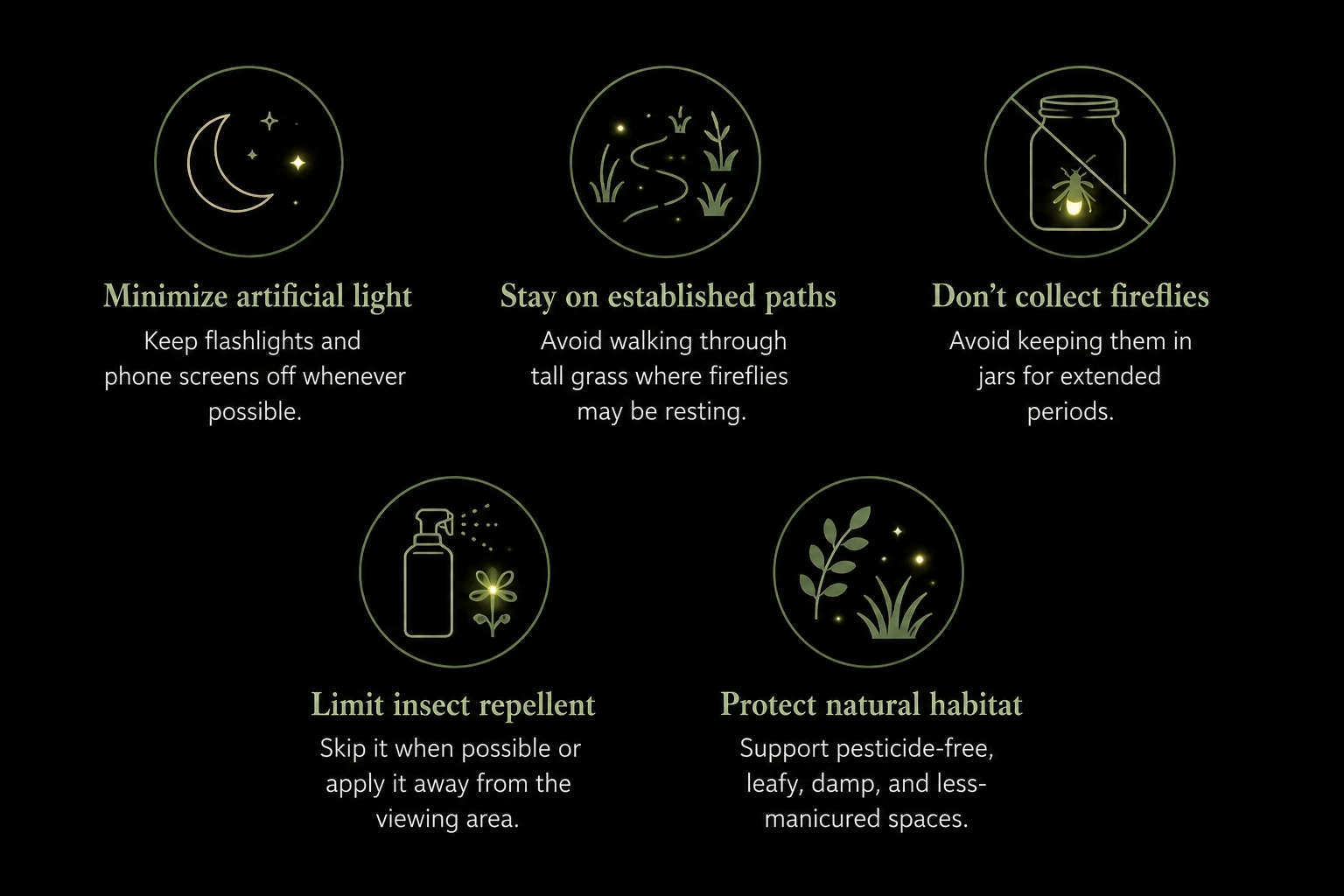
A few small practices go a long way if you’re heading out to watch:
- Leave flashlights and phone screens off whenever possible. If a light is necessary for safety, use the dimmest practical setting and avoid shining it directly toward fireflies.
- Stay on trails or established paths rather than walking through tall grass, where larvae and low-perched females may be resting.
- Avoid catching fireflies in jars for extended periods. A quick, gentle look is one thing; keeping them captive disrupts their brief mating window.
- Skip the bug spray if you can, or apply it well away from the area you’re observing.
- Support pesticide-free green spaces where you live. Firefly-friendly yards are usually the same yards that are friendlier to fireflies’ whole ecosystem: leaf litter left in place, minimal chemical use, a few damp, unmanicured corners.
To learn more about the environmental pressures these creatures face and the initiatives to protect them, you can explore the information on Firefly Threats and Conservation Efforts.
💡 Bottom Line
The best way to watch fireflies is to disturb them as little as possible: keep artificial light low, stay on established paths, and protect the moist habitats they depend on.
A Small, Bright Reminder
There’s something fitting about the fact that fireflies are most visible in the dark — that their entire language depends on the absence of other light. In a world that keeps getting brighter at night, that feels worth protecting, not just for the sake of a pretty summer evening, but because the flash you’re watching is one half of an actual conversation, thousands of years in the making, playing out in the grass at your feet.
Next time you see that first blink of the season, it’s worth pausing a little longer than usual. You’re not just watching an insect. You’re watching chemistry, courtship, and a small act of trust between two creatures finding each other in the dark.
Planning a dark sky evening to catch both fireflies and stars? The same conditions that make for good stargazing- clear nights, minimal light pollution, a little patience tend to make for excellent firefly watching too.
Frequently Asked Questions
Fireflies glow through bioluminescence, a biochemical process that produces light inside a specialized organ called the lantern. Luciferin, luciferase, ATP, and oxygen work together in this reaction, producing light with very little heat.
Fireflies primarily flash as a form of communication during courtship. Different species use characteristic patterns of color, timing, duration, and pulses to help individuals recognize potential mates. Some fireflies also use their flashes to warn predators or, in certain species, deceive other fireflies.
No. Fireflies are actually beetles belonging to the family Lampyridae. Like other beetles, they undergo complete metamorphosis through the egg, larva, pupa, and adult stages.
Yes. Firefly larvae can produce light and are sometimes called glowworms. They typically live in soil, leaf litter, or other moist habitats while developing before eventually becoming winged adults.
No. Firefly species differ considerably in how they produce and use light. While bioluminescence is widespread among fireflies, not every species uses visible flashing in the same way, and some adults may communicate through other signals.
Firefly light is often described as cold light because the bioluminescent reaction produces very little heat compared with incandescent lighting. It is an exceptionally efficient natural system for producing visible light.
In many temperate regions, firefly activity peaks from late spring through mid-summer, although timing varies with species, latitude, elevation, and local weather. Many species become active around dusk, while others are active later at night.
Fireflies are commonly associated with moist, relatively undisturbed habitats, including forest edges, meadows, marshes, and areas near slow-moving water. Their larvae often depend on suitable soil moisture, leaf litter, and other organic material.