

You’ve felt it a hundred times: you sit down at a campfire, and within minutes smoke is drifting straight into your eyes. Why does campfire smoke always follow you, no matter which side of the fire you move to? It isn’t bad luck, and it definitely isn’t the fire holding a grudge; it’s physics, and once you understand the mechanics behind it, the “curse” makes a lot more sense.
It Isn’t Personal: It’s Buoyancy
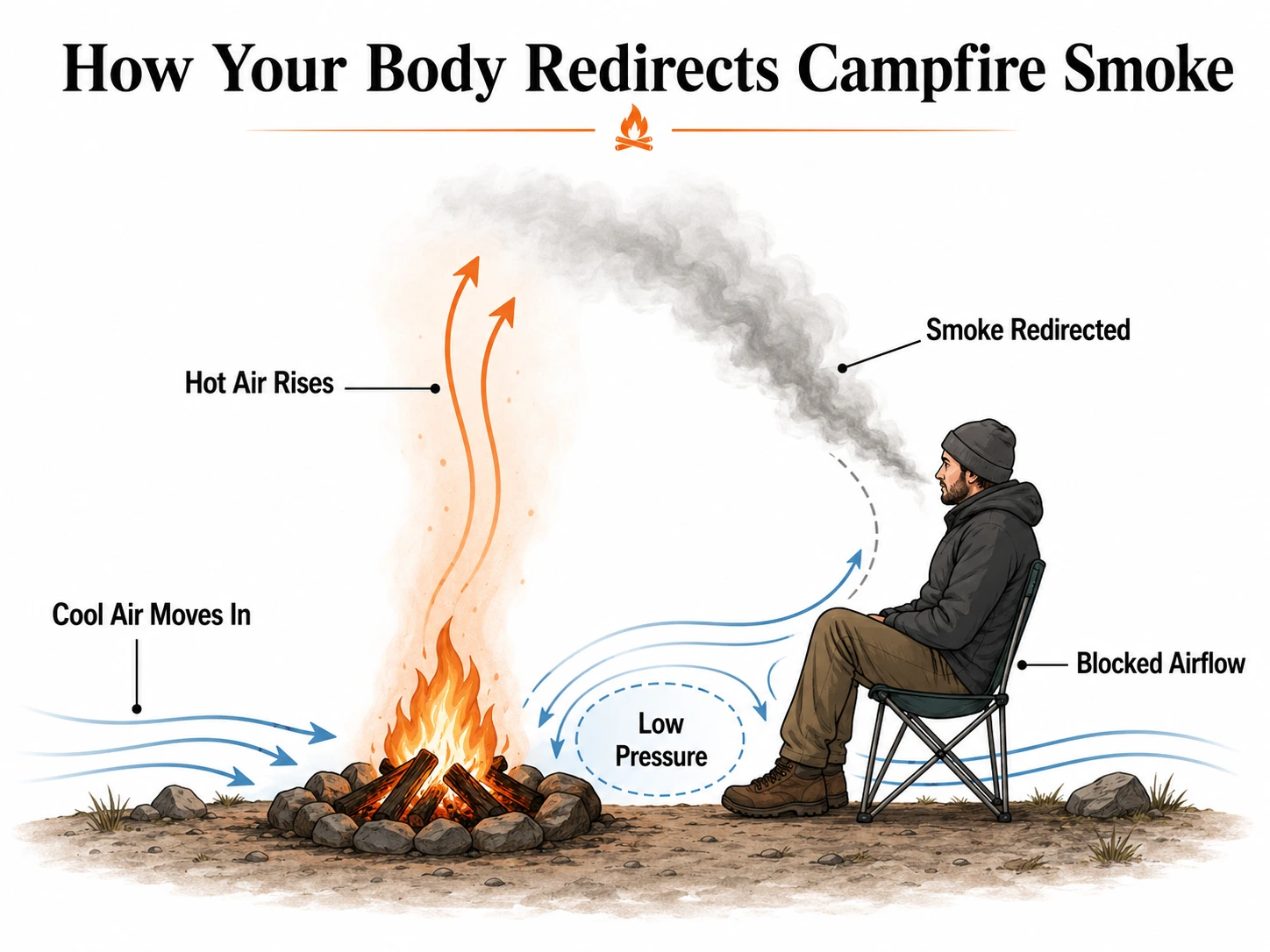
Every campfire runs on the same basic engine: heat rises, and cooler air rushes in to take its place. As wood burns, the air directly above the flames heats up, and its molecules spread further apart as they absorb that energy. Spread-out molecules mean lower density, and lower density means the hot air becomes buoyant relative to the cooler air surrounding it. According to OpenStax College Physics, natural convection is driven by exactly this kind of buoyant force: hot air rises simply because it’s less dense than the air around it, not because heat is somehow drawn upward on its own.
That rising column of hot air and smoke is called a thermal, and it’s the same phenomenon that lets birds and glider pilots ride columns of warm air for miles without flapping a wing. Around a campfire, though, that thermal rarely stays perfectly vertical, and that’s where things start to go wrong for whoever’s sitting nearby.
How You Become the Problem
Here’s the part that feels unfair: your own body is often the reason smoke finds you. As hot air rises off the fire, it leaves a gap behind it, and cooler air rushes in low to the ground to fill that space and feed the flames with fresh oxygen. When you’re sitting or standing near the fire, you physically block some of that incoming air, which creates a small low-pressure pocket right between you and the flames.
A research scientist who has spent decades modeling wildfire smoke for Environment Canada put it simply in an interview with CTV News: rising hot air creates a low-pressure zone that pulls surrounding air in to fill the gap, and a person standing nearby essentially becomes a barrier that creates a second low-pressure zone of their own. The surrounding airflow is redirected toward that lower-pressure region, carrying some of the smoke with it.
Why Moving Around the Fire Often Doesn’t Help
This is the maddening part. When you get up and move to what looks like the clear side of the fire, you don’t remove yourself from the equation; you just relocate the obstruction. Your body creates the same low-pressure pocket in the new spot, and the smoke bends toward you there too. It’s less a fire chasing you and more a pattern repeating itself wherever you happen to stand, similar to how water swirls into eddies just downstream of a rock in a fast-moving creek.
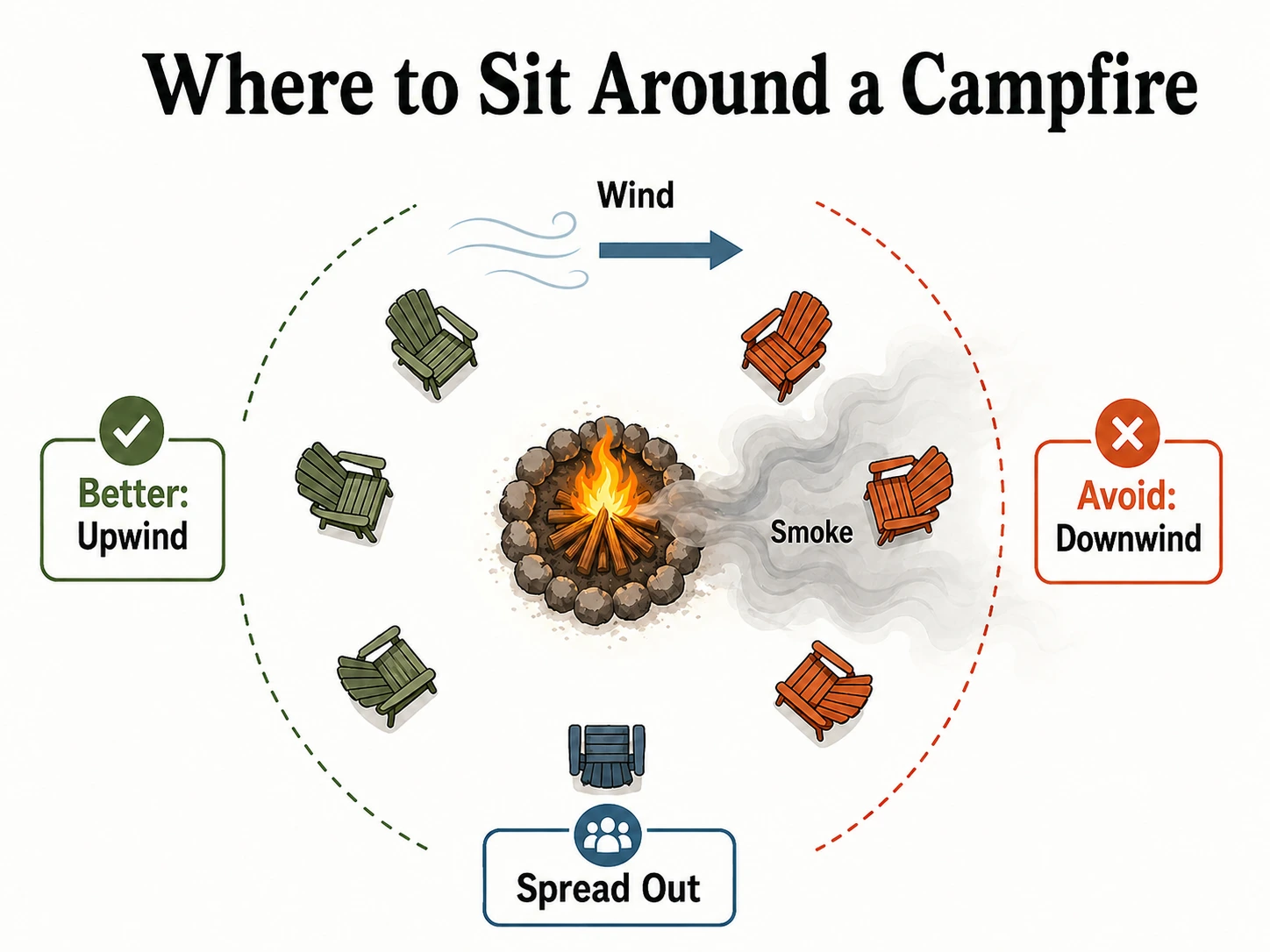
The effect gets stronger with a bigger group. More people sitting shoulder to shoulder around a fire create a longer, more continuous wall blocking incoming air, which deepens the low-pressure pocket and pulls smoke in more aggressively than if everyone were spread out.
Wind, Terrain, and Other Variables
Buoyancy and body-blocking explain most of the effect on a still night, but real campfires rarely burn in perfectly calm conditions. Even a light breeze can override the subtle low-pressure pull entirely, pushing smoke steadily in one direction regardless of where anyone sits. Slopes, tree lines, and nearby rock walls can also funnel or redirect airflow in ways that have nothing to do with convection at all, which is part of why the same campsite can smoke you out on one trip and stay clear on the next.
| Did you know? Even one person can disrupt the airflow feeding a fire and cause the rising smoke plume to tilt toward them. It’s purely a matter of blocking airflow, proof that in fluid dynamics, being in the way matters just as much as being hot. |
How to Keep Campfire Smoke Out of Your Face
Since you can’t out-walk a low-pressure pocket, the better move is to change the conditions that create it in the first place. Spreading people out evenly around the fire, rather than clustering on one side, keeps any single low-pressure zone from growing too strong. Sitting a little further back, staying upright instead of crouching, and avoiding bulky blankets or jackets that widen your silhouette all shrink the size of the “shadow” you cast in the airflow. And on nights with any wind at all, checking which direction it’s blowing before you set up your chair does more good than any amount of seat-hopping once the fire’s already going.
Even with the best positioning, a little smoke tends to find its way onto your clothes and into your hair by the end of the night. If it does, our guide to getting campfire smoke smell out of clothes and hair will take care of the rest.
FAQ
Indirectly, yes. Wet or green wood generally burns less efficiently and produces more smoke than dry, seasoned wood. Whether that smoke remains near the ground depends largely on wind and atmospheric conditions.
Not a permanent one, but the safest bet is usually upwind, since even a mild breeze tends to overpower the low-pressure effect and push smoke consistently away from you rather than toward you.
Adding a new log can briefly lower temperatures in the flame zone and change airflow around the fire. While the wood heats and ignites, combustion may be less complete, causing a temporary increase in visible smoke.