

The Cold Moon 2026 arrives right on the heels of the winter solstice, lighting up some of the longest, darkest nights of the year in the Northern Hemisphere. Here’s when to look up, what the Cold Moon means, and how to get the best possible view of it.
When Does the Cold Moon Peak in 2026?
The Cold Moon reaches peak fullness on Wednesday, December 23, 2026, at 8:28 p.m. EST (01:28 UTC on December 24), according to the U.S. Naval Observatory’s lunar phase data. To the eye, the moon will look completely round for about a day on either side of that moment, so both December 23 and December 24 offer good viewing regardless of your time zone.
This is also the closest, brightest supermoon of the year. The moon’s orbit around Earth isn’t a perfect circle, and December’s full moon lines up almost exactly with perigee, the point in that orbit where the moon sits nearest to Earth. By a commonly used definition, December’s Cold Moon is the third supermoon of 2026, following January’s Wolf Moon and November’s Beaver Moon. It’s also the closest and brightest full moon of the year.
Why Is It Called the “Cold Moon”?
The name “Cold Moon” is commonly associated with Indigenous seasonal moon-naming traditions in North America. The Old Farmer’s Almanac specifically attributes the name to the Mohawk, reflecting the cold conditions of this time of year. Other Indigenous nations used their own seasonal names for December’s full moon, so there was no single universal Native American name for it.
European and Celtic traditions gave it different names for the same reason. Some called it the Moon Before Yule, tied to the midwinter festival that later blended into Christmas. Others knew it as the Oak Moon or the Long Night Moon, a nod to how close it falls to the year’s longest night.
| Did you know? Because the Cold Moon rises so close to the winter solstice, it climbs unusually high across the sky for a full moon as seen from the Northern Hemisphere. The higher a full moon rises, the longer it stays above the horizon, so the Cold Moon often lights the sky longer than any other full moon of the year. |
The Science Behind December’s Supermoon
“Supermoon” is an informal term rather than an official astronomical classification, generally used for a full moon that occurs near its closest approach to Earth.
A supermoon isn’t a different kind of moon; it’s a matter of timing. The moon’s path around Earth is elliptical, so its distance from us shifts throughout the month. At apogee, the far point of that orbit, the moon sits roughly 252,000 miles away. At perigee, the near point, that gap can shrink to about 221,000 miles. NASA’s Jet Propulsion Laboratory explains that when a full moon happens to land near perigee, it can look up to 14% larger and 30% brighter than a full moon at apogee. That’s the entire supermoon effect: real, but modest enough that most people wouldn’t notice the difference without a side-by-side comparison.

The Cold Moon’s 3-Window Watch
Rather than one single “best moment” to see the Cold Moon, think of the night in three separate windows. Each one shows you something a little different.
1. The Rise Window (Around Moonrise on December 23)
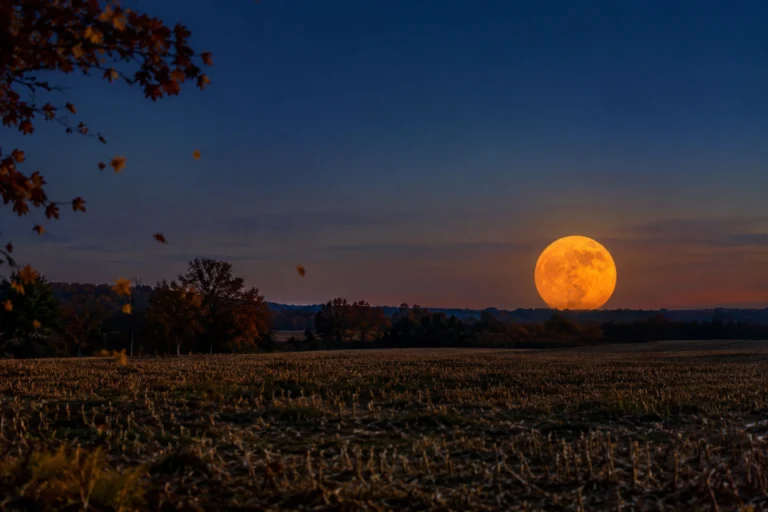
Catch the moon low on the horizon, right as it clears the treeline or skyline. This is when the famous moon illusion kicks in, the same moon can look dramatically larger near the horizon than it does later overhead, even though its actual size never changes. The exact cause of the moon illusion is still debated, but researchers think perceived distance, foreground objects, and effects similar to the Ponzo illusion may all contribute to why the Moon appears much larger near the horizon. Pair it with the supermoon’s genuine extra brightness and you get the most dramatic-looking Cold Moon of the night.
2. The Peak Window (8:28 p.m. EST / 01:28 UTC December 24)
This is the astronomically exact moment of “full,” when the Earth, moon, and sun line up as closely as they will all month. It’s a satisfying detail for the astronomy-minded, but visually indistinguishable from the hours around it.
3. The Afterglow Window (December 24 into the following nights)
The Moon will still look nearly full to the naked eye on December 24, so an overcast December 23 doesn’t mean you’ve missed it. If the skies clear the following evening, you’ll still have a beautiful view.

Best Time and Place to See the Cold Moon
You don’t need a telescope or binoculars to enjoy the Cold Moon 2026; it’s bright enough and big enough to be a rewarding sight with the naked eye alone. A few things will make the difference between a good view and a great one:
- Time it around moonrise. Check your local moonrise time and get outside a few minutes before, so you catch the moon as it clears the horizon rather than after it’s already climbed into a plain white disk overhead.
- Find an open eastern view. A field, a hilltop, or even a parking lot with a clear sightline works better than a spot boxed in by trees or buildings.
- Dress for the cold. Clear winter nights can cool quickly because the absence of cloud cover allows stronger radiational heat loss from the surface. Lower humidity can also mean less haze, which may improve visibility.
- Skip the light-pollution worry. A full moon this bright washes out most of the sky’s detail anyway, so a backyard view works nearly as well as a drive out to darker skies.
FAQ
The Cold Moon reaches peak fullness on Wednesday, December 23, 2026, at 8:28 p.m. EST (01:28 UTC on December 24), per the U.S. Naval Observatory. It looks completely full to the naked eye for about a day on either side of that moment.
The name “Cold Moon” is traditionally attributed to the Mohawk people, reflecting the colder weather that arrives in December. Other Indigenous communities have their own seasonal names for this full moon, while European traditions include names such as Moon Before Yule.
Yes. It’s the closest and brightest of three supermoons in 2026, alongside January’s Wolf Moon and November’s Beaver Moon. It happens because the moon’s full phase lines up almost exactly with perigee, its nearest point to Earth in orbit.
No. The Cold Moon is bright and large enough to enjoy with the naked eye. Binoculars can bring out surface detail like craters and maria, but they’re optional.
Around moonrise on December 23, when the Cold Moon appears low on the eastern horizon. The moon illusion can make it look especially large against trees, buildings, or distant landscapes. Check your local moonrise time so you don’t miss the view.
They’re close but separate events. The 2026 winter solstice falls on December 21, and the Cold Moon peaks two days later. Because it’s so close to the solstice, the Cold Moon climbs unusually high across the sky and stays visible longer than most full moons.
What Else to Watch in the Sky This December
December 2026 is a busy month for skywatchers on either side of the Cold Moon. The Geminids Meteor Shower 2026 peaks earlier in the month, on the night of December 13-14, and is widely considered the most reliable meteor shower of the year. The winter solstice follows on December 21, marking the official start of astronomical winter and the shortest day of the year in the Northern Hemisphere; NASA and NOAA’s SciJinks project breaks down the science behind it in plain terms.
If you caught last month’s supermoon, the Beaver Moon 2026 was the Cold Moon’s warm-up act, the second of the year’s three-supermoon run. Together, the two make a good bookend to autumn’s close and winter’s start.
However you catch it, the Cold Moon is a fitting way to close out the year’s skywatching. Step outside on the longest, coldest nights in the Northern Hemisphere, let your eyes adjust, and watch the year’s biggest, brightest full moon climb into a clear winter sky.