

Biodegradable camping soap may be easier on the environment than some conventional cleaners, but it still does not belong in a lake or stream. A “biodegradable” label describes what eventually happens to a soap after it leaves your hands, not whether it’s safe to use directly in the water beside your campsite.
This guide covers what biodegradable actually means, how a few practical camp dish soap options compare, and how to wash dishes and yourself without leaving a mark behind, using the Leave No Trace approach to camping greywater disposal.
Does Biodegradable Camping Soap Really Protect the Environment?
“Biodegradable” means a product’s ingredients can be broken down by naturally occurring microorganisms into water, carbon dioxide, and biomass. That breakdown happens far more effectively in soil than in open water, so the label says little about how a soap behaves in the minutes before it degrades.
Here’s a distinction that gets lost in a lot of eco-friendly camping soap marketing: every soap and detergent, biodegradable or not, cleans through surfactant action, molecules with one end that binds to grease and one that binds to water. That mechanism doesn’t disappear because a soap is plant-based. What changes is the specific surfactant, its concentration, and how it behaves once diluted into a lake or stream: some formulations break down quickly in soil and pose limited risk in small amounts, while others linger longer or shift water chemistry more noticeably in concentrated form or in heavily used water.
Surfactants introduced directly into water can affect the protective mucus layer on fish gills and reduce how efficiently oxygen dissolves at the surface, effects that scale with concentration and the ecosystem’s sensitivity rather than occurring identically every time. Soil filters what open water can’t, breaking residue down and diluting it before it ever reaches a water source. Food residue, grease, and fragrance in wash water can also draw wildlife toward camp. Using less soap, whatever the brand, usually does more for a site than switching to the most aggressively marketed “green” option on the shelf.
💡 Bottom Line: Biodegradable soap is a lower-impact option only when it’s used sparingly and kept out of natural water sources.
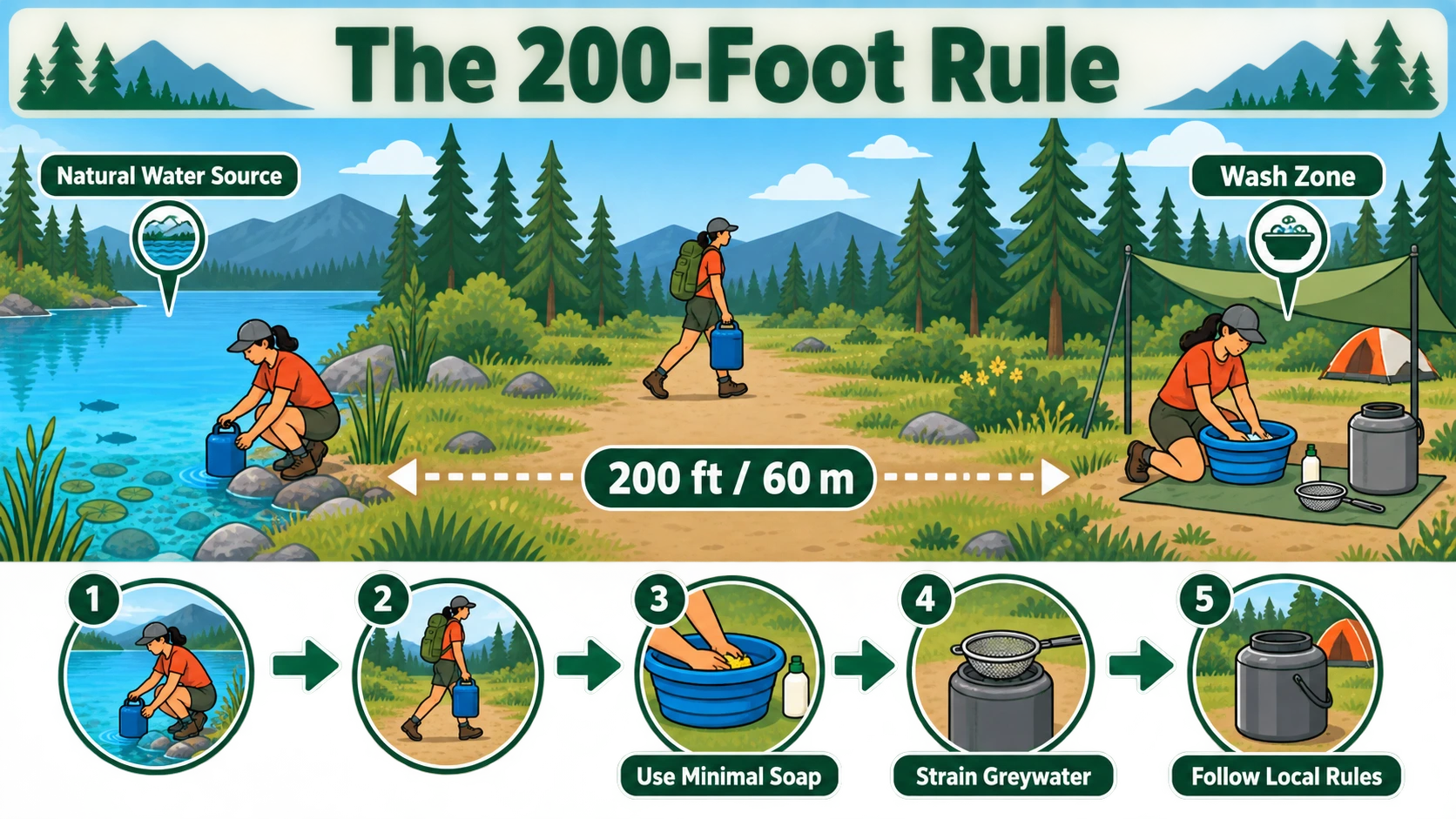
The 200-Foot Rule for Washing at Camp
Leave No Trace and the National Park Service both advise carrying water away from its source rather than carrying soap down to the shoreline. Fill a pot or wash basin at the water’s edge, then walk it out at least 200 feet, or about 60 meters, before adding any soap. As a rough secondary guide, that’s roughly 70 large adult steps, though stride length varies enough to make erring generous the safer habit.
A few practices help:
- Wash in a dedicated basin rather than the container also used for drinking water.
- Measure soap by the drop; concentrated camping soap for backpacking needs far less than first-timers expect.
- Check the rules for the specific park, forest, or campground, since some set stricter distances.
- Use a designated dishwashing station or greywater system whenever one is provided.
The Leave No Trace waste disposal guidelines cover this in more detail, including how the same distance applies to bathing and human waste.
💡 Bottom Line: Carry water away from the source, wash at least 200 feet away, and use as little soap as you can get away with.
How to Choose a Biodegradable Camping Soap
A biodegradable label is a reasonable starting filter, but a few practical questions matter more:
- Concentration: fewer drops per basin means less to carry and less entering the environment overall.
- Scent: fragrance can attract insects and wildlife; unscented formulas are also gentler for sensitive skin.
- Multipurpose vs. dish-specific: some products handle dishes, laundry, and body washing from one bottle; others suit a single job.
- Liquid vs. dry leaves: liquid is easy to dose but can leak in a pack; dry sheets avoid that but dissolve if they get wet early.
- Labeling clarity: favor products that state ingredients and dilution over vague “eco” language.
- Packaging: smaller, refillable, or concentrated packaging usually means less waste per wash.
None of this changes the core point: “plant-based,” “natural,” and “biodegradable” describe a product’s ingredients, not whether it’s fine to pour into a stream. That comes down to how it’s used.
Biodegradable Camping Soap Comparison
| Product | Best for | Format | Notable strengths | Important caveat |
|---|---|---|---|---|
| Dr. Bronner’s Baby Unscented Pure-Castile Liquid Soap | Multipurpose: skin, hair, dishes, gear | Concentrated liquid castile soap | Plant-oil based, no added fragrance, per the manufacturer | Needs proper dilution and small amounts; not for direct use in water |
| Sierra Dawn Campsuds | Cleaning across variable water conditions | Concentrated liquid, essential-oil scented | Manufacturer states it works in hot, cold, fresh, and salt water | Contains fragrance; some retail listings overstate its water safety |
| Sea to Summit Wilderness Wash | One bottle for dishes, laundry, and personal washing | Concentrated liquid, fragrance-free | Manufacturer states it’s phosphate- and paraben-free | Some spill risk in a pack; the 200-foot rule still applies |
| Sea to Summit Wilderness Wash Pocket Soap | Ultralight backpacking and air travel | Dry soap leaves, 50 per pack | No liquid to leak; TSA carry-on friendly | Leaves must stay dry until used |
Recommended Camping Soaps by Use
Dr. Bronner’s Baby Unscented Pure-Castile Soap
A concentrated, plant-oil-based castile soap with no added fragrance, suited to campers wanting one bottle for skin, hair, dishes, and gear. It’s versatile rather than objectively superior; other concentrated soaps handle the same jobs. It still needs proper dilution, small amounts, and distance from natural water.
Sierra Dawn Campsuds
A concentrated, multipurpose cleanser sold to backpackers since the 1960s. The manufacturer states it works in hot, cold, fresh, and salt water, a claim rather than independent testing by Earthshinejournal. Its formula includes surfactants and an essential-oil fragrance; reaching water doesn’t make it harmless, despite how some retail listings phrase it.
Sea to Summit Wilderness Wash
A single liquid for personal washing, dishes, clothing, and gear, useful for backpackers carrying fewer bottles. The manufacturer describes it as concentrated and fragrance-free.
Sea to Summit Wilderness Wash Pocket Soap
The dry-leaf version solves a real problem: liquid soap leaking in a pack or getting flagged at airport security. Fifty thin leaves ship in a palm-sized pack, letting you use one at a time, though the packet has to stay dry until needed.
How to Wash Camp Dishes Without Polluting
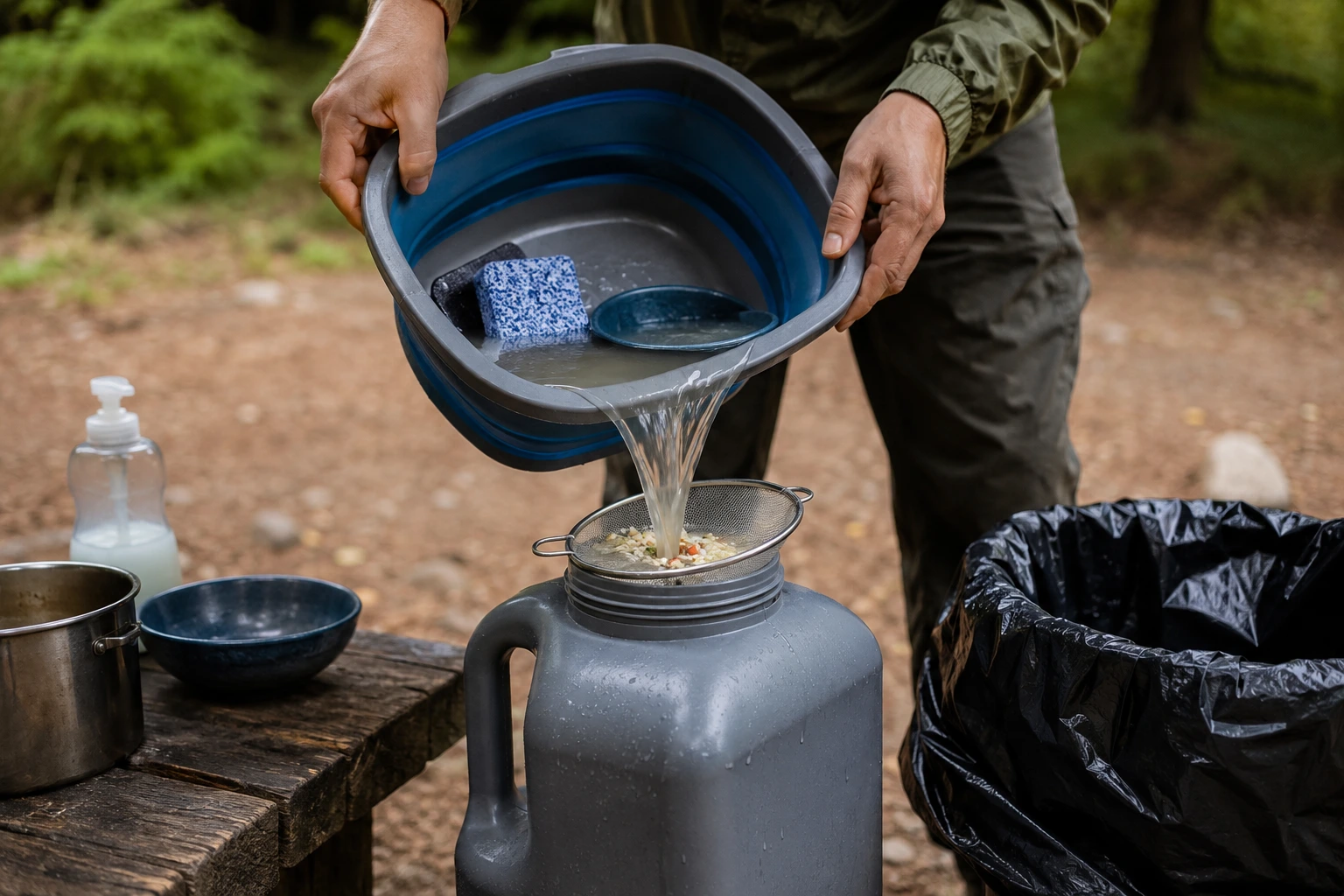
- Carry washing water and equipment at least 200 feet from any natural water source.
- Scrape or eat as much leftover food as possible first.
- Wipe out greasy pots and pans when practical, and pack out whatever gets wiped away.
- Wash in a basin using the smallest effective amount of soap.
- Strain the dishwater through a fine mesh strainer or bandana.
- Pack out the strained particles with the trash.
- Use a designated greywater disposal facility if the campground provides one.
- If there’s no facility and local rules allow it, scatter the strained water widely over durable soil, 200 feet from water and camp.
If you are still planning your menu, these easy camping food ideas prioritize simple preparation and minimal cleanup.
Scattering widely, rather than dumping in one spot, gives the water more soil to filter through and keeps residue from concentrating. How quickly it breaks down depends on climate and soil, so it’s not something to count on happening fast everywhere.
💡 Bottom Line: Remove every food particle, use a designated disposal point when one exists, and scatter strained greywater only where local rules allow it.
Using Camping Soap for Your Body and Hair
The same principles apply to washing yourself. Sponge bathing from a basin of carried water beats rinsing off in a stream, even with a soap labeled biodegradable.
- Follow the same 200-foot distance from any water source.
- Collect and carry wash water rather than bathing at the shoreline.
- Use small amounts; concentrated soap goes further than most first-timers expect.
- Store soap and other scented toiletries with your food in bear country. Our night camping safety guide explains how to manage scented attractants around camp.
- Remember that “multipurpose” doesn’t guarantee a formula suits every skin or hair type. What lathers well for one person can feel drying or waxy for another.
FAQ
No. Biodegradability describes how a product eventually breaks down, not whether it’s harmless to fish, amphibians, or other aquatic life in the meantime. Even biodegradable soap for backpacking should be used at least 200 feet from any natural water source, with wash water carried out rather than soap carried down to the shoreline.
It can be a practical camping option, particularly in the unscented version, because it is concentrated and handles multiple jobs with one bottle. That doesn’t make it objectively superior to other concentrated camping soaps. It still needs to be used sparingly, diluted properly, and kept well away from lakes and streams like any other soap.
Not usually. Most camping soaps lather and clean fine in cool water, though warm water often cuts through grease more easily. Getting dishes visibly clean and getting them sanitized are different things; soap alone doesn’t sanitize, which typically requires a hot rinse or a diluted bleach solution. For a complete wash, rinse, and sanitizing process, follow Leave No Trace’s frontcountry dishwashing method.
It depends on where you are. Use a designated greywater facility first if the campsite has one, and check local land-management rules either way. When no facility exists and regulations permit it, strain out food particles, then scatter the water widely over durable soil at least 200 feet from water and camp.
Final Thoughts
The right soap can make camp cleanup easier, but responsible use matters more than any label. Use the smallest effective amount, wash well away from natural water, strain dishwater, and follow local disposal rules.
Those few extra steps take little effort, and they help protect the campsites, lakes, streams, and wildlife that make spending time outdoors worthwhile.