

The exact moment of the winter solstice 2026 is 20:50 UTC on Monday, December 21, according to the US Naval Observatory’s seasons data. That is 3:50 p.m. EST and 12:50 p.m. PST. North of the equator it brings the shortest day of the year. South of the equator, where the same instant is the summer solstice, it brings the longest.
What it does not bring, for most of the United States, is the earliest sunset. In New York the evenings bottomed out around December 8, at about 4:28 p.m., and by the solstice the Sun is already setting more than three minutes later. The mornings run the other way: sunrise keeps creeping later until early January. Both quirks have one cause, and it explains why late December feels darker in the morning than the calendar says it should.
Winter solstice 2026: one moment, two calendar dates
The solstice is an instant, not a day, so the date on your calendar depends on where you are. At 20:50 UTC on December 21 it is Monday afternoon across the Americas and Monday evening in Europe and Africa. Across most of Asia and Australia it is already Tuesday morning, December 22.
| Where you are | Local time of the solstice |
|---|---|
| Hawaii (HST, UTC-10) | 10:50 a.m., Monday, Dec 21 |
| Alaska (AKST, UTC-9) | 11:50 a.m., Monday, Dec 21 |
| US Pacific (PST, UTC-8) | 12:50 p.m., Monday, Dec 21 |
| US Mountain (MST, UTC-7) | 1:50 p.m., Monday, Dec 21 |
| US Central (CST, UTC-6) | 2:50 p.m., Monday, Dec 21 |
| US Eastern (EST, UTC-5) | 3:50 p.m., Monday, Dec 21 |
| Brasília and Buenos Aires (UTC-3) | 5:50 p.m., Monday, Dec 21 |
| UK and Ireland (GMT, UTC+0) | 8:50 p.m., Monday, Dec 21 |
| Central Europe (CET, UTC+1) | 9:50 p.m., Monday, Dec 21 |
| South Africa (SAST, UTC+2) | 10:50 p.m., Monday, Dec 21 |
| India (IST, UTC+5:30) | 2:20 a.m., Tuesday, Dec 22 |
| China, Singapore and Perth (UTC+8) | 4:50 a.m., Tuesday, Dec 22 |
| Japan and South Korea (UTC+9) | 5:50 a.m., Tuesday, Dec 22 |
| Sydney and Melbourne (AEDT, UTC+11) | 7:50 a.m., Tuesday, Dec 22 |
| New Zealand (NZDT, UTC+13) | 9:50 a.m., Tuesday, Dec 22 |
For a zone that is not listed, start from 20:50 UTC and apply your offset: subtract 5 hours for UTC-5, add 8 hours for UTC+8. If the result passes midnight, your date is December 22. The dividing line sits just east of UTC+3. Moscow, Istanbul and Nairobi get the solstice at 11:50 p.m. on the 21st, while Iran (UTC+3:30) gets it at 12:20 a.m. on the 22nd.
You may see 20:30 UTC quoted on at least one well-known astronomy site. The Naval Observatory gives 20:50. The Old Farmer’s Almanac and the Farmers’ Almanac both list 3:50 p.m. EST, the same instant, and an independent ephemeris calculation made for this article lands on the same minute. Use 20:50 UTC for the winter solstice 2026. If you are reading after the event, the next December solstice falls at 02:42 UTC on December 22, 2027, which is 9:42 p.m. EST on December 21.
The Sun stops moving south, and that is the entire event
Nothing happens at 20:50 UTC that you could watch. The solstice marks the moment the Sun reaches the southern end of its yearly swing. Seen from Earth, the Sun has drifted a little farther south each day since late June; on December 21 that drift reaches its limit and reverses.
Picture a globe on a desk with its axis tilted, carried in a slow circle around a lamp without ever changing the direction of the tilt. On one side of the circle the top of the globe leans toward the lamp; on the opposite side it leans away. Earth does exactly this. Its axis is tilted about 23.4 degrees and keeps pointing the same way in space all year, as the Naval Observatory’s page on the seasons and Earth’s orbit explains. In December the north end leans away from the Sun, and at the solstice the lean is at its greatest.
At that moment the Sun stands directly overhead at noon along the Tropic of Capricorn, about 23.4 degrees south of the equator. NOAA notes that the word “tropic” comes from a Greek word meaning “turn”, because this is where the Sun appears to turn back.
Two common beliefs need correcting here. The first is that winter happens because Earth is farther from the Sun. It is the reverse. Earth is closest to the Sun in early January (on January 3 in 2026, per the Naval Observatory), about two weeks after the December solstice. The Observatory calls the distance effect too weak to cause the seasons. The second is that the solstice is the “first day of winter” for everyone. That is the astronomical convention. Meteorologists count winter as December, January and February, according to NOAA’s climate data center, so on their calendar winter is three weeks old by December 21.
The part you can see is the height of the noon Sun. In the mid-northern latitudes, subtract your latitude and 23.4 from 90. In New York (40.7°N) the noon Sun on December 21 stands only about 26° above the horizon; in London (51.5°N), about 15°. A 1.8 m (6 ft) person in New York casts a noon shadow about 3.7 m (12 ft) long that day. In London the same shadow stretches to about 6.7 m (22 ft).
How much daylight you get depends almost entirely on latitude
On December 21 daylight runs from about 12 hours at the equator down to none at all north of roughly 67°N. South of the equator the spread runs the other way. Longitude and time zone change when your sunrise and sunset happen by the clock, but latitude decides how long the Sun stays up.
| City (latitude) | Sunrise | Sunset | Daylight on Dec 21 | Change by Jan 21 |
|---|---|---|---|---|
| Singapore (1.4°N) | 7:01 a.m. | 7:04 p.m. | 12 h 3 min | none |
| Honolulu (21.3°N) | 7:05 a.m. | 5:55 p.m. | 10 h 50 min | +13 min |
| Miami (25.8°N) | 7:03 a.m. | 5:35 p.m. | 10 h 32 min | +16 min |
| Los Angeles (34.1°N) | 6:55 a.m. | 4:48 p.m. | 9 h 53 min | +23 min |
| New York (40.7°N) | 7:17 a.m. | 4:32 p.m. | 9 h 15 min | +30 min |
| Chicago (41.9°N) | 7:15 a.m. | 4:23 p.m. | 9 h 8 min | +31 min |
| Seattle (47.6°N) | 7:55 a.m. | 4:20 p.m. | 8 h 25 min | +40 min |
| London (51.5°N) | 8:04 a.m. | 3:53 p.m. | 7 h 50 min | +47 min |
| Anchorage (61.2°N) | 10:14 a.m. | 3:41 p.m. | 5 h 27 min | +1 h 25 min |
| Fairbanks (64.8°N) | 10:58 a.m. | 2:40 p.m. | 3 h 41 min | +2 h 4 min |
| Utqiagvik, Alaska (71.3°N) | no sunrise | no sunset | 0 | Sun returns Jan 23 |
| Sydney (33.9°S) | 5:41 a.m. | 8:05 p.m. | 14 h 25 min | -23 min |
| Buenos Aires (34.6°S) | 5:37 a.m. | 8:06 p.m. | 14 h 29 min | -24 min |
| Melbourne (37.8°S) | 5:54 a.m. | 8:42 p.m. | 14 h 47 min | -27 min |
| Ushuaia, Argentina (54.8°S) | 4:51 a.m. | 10:11 p.m. | 17 h 20 min | -59 min |
Times are local standard time, except Sydney and Melbourne, which are on daylight time in December. They were calculated for each city center with the Naval Observatory’s definition of sunrise and sunset: the moment the top edge of the Sun meets a level horizon, with average atmospheric refraction. Checked against timeanddate.com’s tables for New York, London, Sydney and Fairbanks, the day lengths agreed to within a few seconds. Hills, tall buildings and elevation can move your own times by several minutes, and NOAA’s solar calculator will give the figures for any point you click on its map.
Utqiagvik shows what lies past the Arctic Circle. The Sun set there on November 18, 2026, and does not rise again until January 23, 2027. At the other end of the planet, Ushuaia gets more than 17 hours of daylight, and south of about 67°S the Sun does not set at all.
The “shortest day” is really the shortest fortnight. In New York, December 14 and December 28 each have less than two minutes more daylight than December 21, and December 20 and 22 differ from it by only seconds. The change that you will actually notice builds through January.
Why does the earliest sunset come two weeks before the solstice?
Because in December the Sun runs slow against your clock. Measured from one solar noon to the next, each day in late December lasts almost half a minute longer than 24 hours, according to the Naval Observatory’s explanation of the equation of time. Clocks keep every day at exactly 24 hours, so sunrise, solar noon and sunset all slide a little later by the clock each day.
Two separate things move your sunset. One is the length of the day, which shrinks from both ends until the solstice. The other is the position of the middle of the day. Solar noon, the moment the Sun stands due south and highest, falls at about 11:45 a.m. EST in New York on December 1, 11:54 a.m. on the solstice and 12:01 p.m. on January 4. A day centered on a noon that keeps moving later drags both ends along with it.
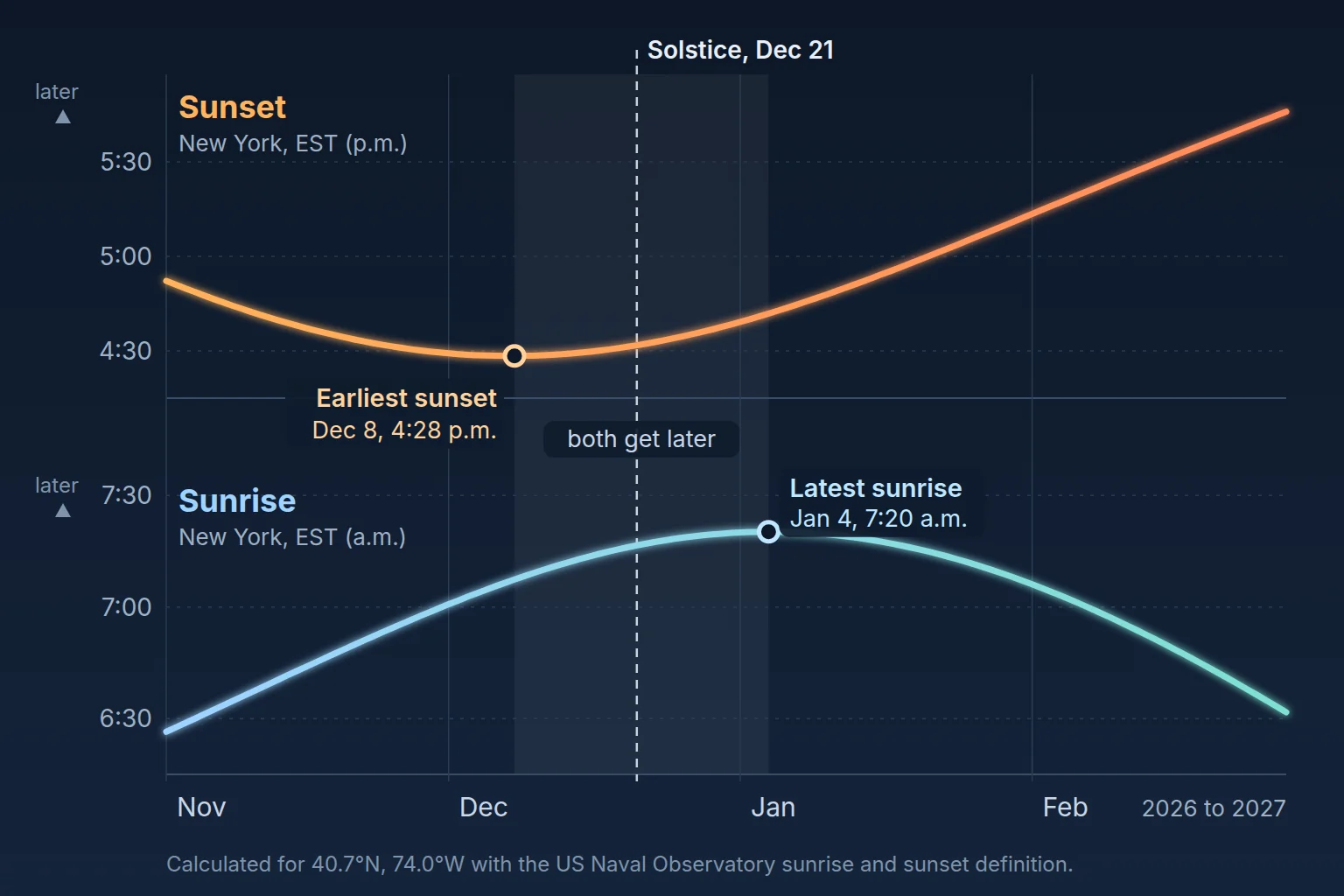 New York, local standard time. Sunsets start getting later on December 8, nearly two weeks before the shortest day; sunrises keep getting later until January 4.
The Naval Observatory’s page on sunrise and sunset near the solstices calls these the geometric effect and the clock effect. In early December the geometric effect still wins: New York’s day is shrinking by about a minute a day, so each end moves in by roughly half a minute. By about December 8 the shrinking has slowed enough that the daily noon drift outweighs it at the sunset end, so sunsets start getting later. After the solstice the day starts to grow, which pulls sunrise earlier, but at first by only seconds a day. The clock effect keeps pushing sunrise later until early January, when the lengthening finally catches up.
Why is the solar day long in December? The Observatory gives two reasons of similar size. Earth is near its closest point to the Sun and moving fastest along its orbit. That means it has to turn a little extra each day to bring the Sun back to the same spot in the sky. And near the solstice the Sun’s yearly path runs parallel to the equator, so all of its slow eastward drift against the stars counts toward that delay. Added up over weeks, the gap between sundial time and clock time is the equation of time, and over a year it can reach about 16 minutes.
| City (latitude) | Earliest sunset, around | Latest sunrise, around |
|---|---|---|
| Honolulu (21.3°N) | Nov 26, 5:48 p.m. | Jan 15, 7:12 a.m. |
| Miami (25.8°N) | Nov 29, 5:29 p.m. | Jan 12, 7:09 a.m. |
| Los Angeles (34.1°N) | Dec 4, 4:43 p.m. | Jan 7, 6:59 a.m. |
| New York (40.7°N) | Dec 8, 4:28 p.m. | Jan 4, 7:20 a.m. |
| Seattle (47.6°N) | Dec 10, 4:18 p.m. | Jan 1, 7:58 a.m. |
| London (51.5°N) | Dec 12, 3:51 p.m. | Dec 30, 8:06 a.m. |
| Fairbanks (64.8°N) | Dec 18, 2:39 p.m. | Dec 24, 10:59 a.m. |
Each date is the middle of a plateau. New York’s sunset stays at 4:28 or 4:29 p.m. from about December 1 to December 15. That is why the Naval Observatory describes these dates as “around” December 8 and January 5 for latitude 40°N. The pattern is the useful part. The farther you are from the equator, the closer the two dates squeeze toward the solstice, because the day length changes faster there and overpowers the clock effect sooner. At the equator, where the day length barely changes at all, the Observatory puts the earliest sunset around November 2 and the latest sunrise around February 11.
South of the equator the same drift produces a mirror image. In Sydney the earliest sunrise comes around December 6 (5:37 a.m. daylight time) and the latest sunset around January 7 (8:10 p.m.), so the longest evenings arrive after the longest day.
The extra daylight comes back in the evenings first
Almost all of January’s new daylight lands at the end of the day. By January 21, New York gains 30 minutes of daylight over the solstice. Sunset moves from 4:32 to 5:00 p.m., a gain of 28 minutes, while sunrise moves only from 7:17 to 7:15 a.m.
The split holds farther north, with bigger numbers. London gains 47 minutes by January 21: 37 of them in the afternoon, as sunset moves from 3:53 to 4:30 p.m., and 10 in the morning. Fairbanks gains 2 hours 4 minutes, with sunset about 75 minutes later and sunrise about 48 minutes earlier. Closer to the tropics the mornings keep getting darker well into January. Miami’s sunrise on January 21 is 7:08 a.m., five minutes later than on the solstice, even though the day is 16 minutes longer.
For a change that feels real, look to late February. By February 21 New York has gained an hour and 41 minutes of daylight, and London more than two and a half hours.
In the Southern Hemisphere the shrinking days lose their light at the start of the day. Sydney gives up 23 minutes by January 21, and nearly all of it comes off the morning. Sunrise slips from 5:41 to 6:05 a.m., while sunset barely moves, staying between 8:05 and 8:10 p.m.
Watch the sunset point stand still
The solstice is easiest to see where the Sun meets your horizon. The point where the Sun goes down slides south along the horizon through November, stalls for about two weeks around December 21, then starts back north.
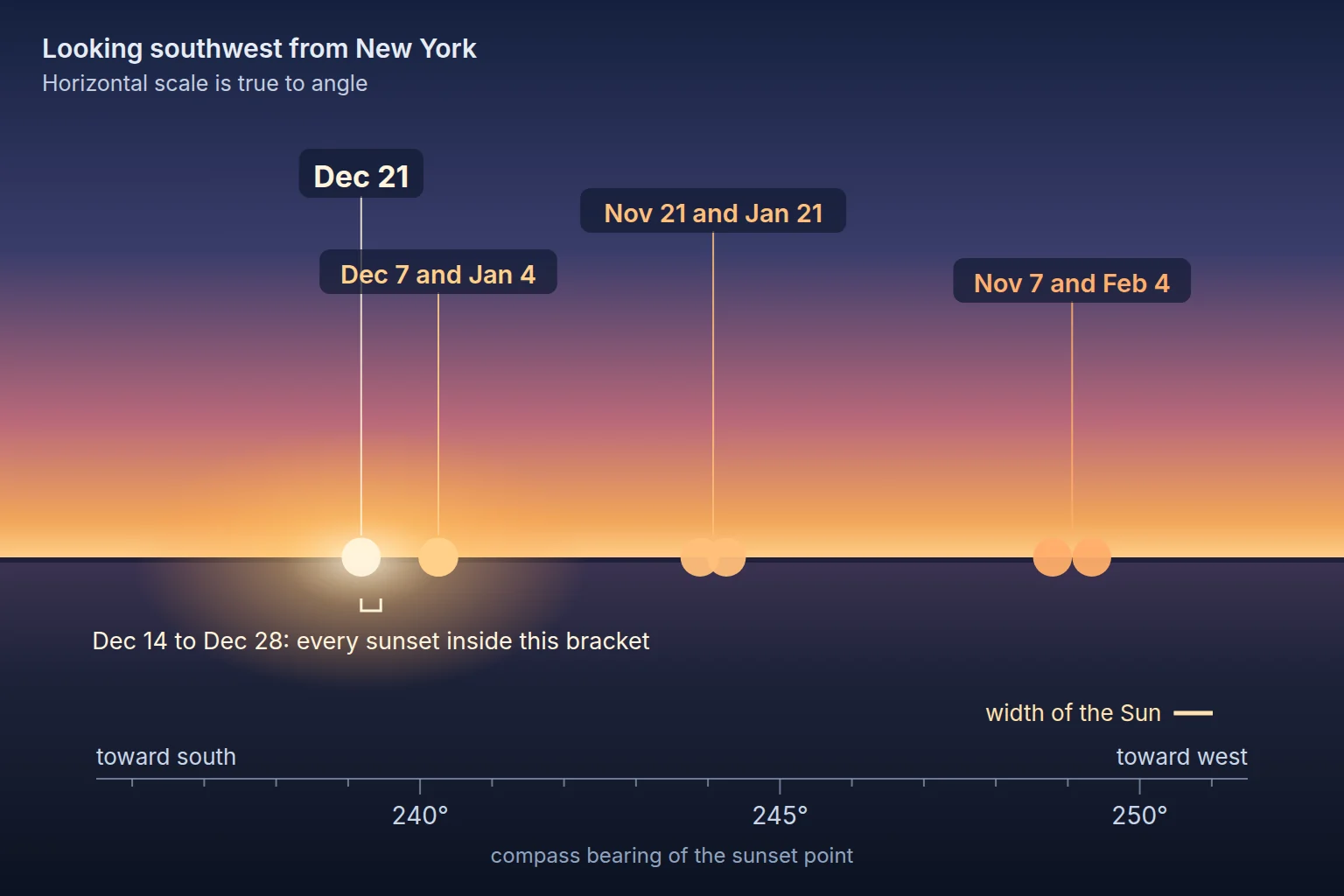 Sunset positions for New York. From December 14 to December 28 the setting point stays within about a quarter of a degree, roughly half the width of the Sun.
From New York on the solstice, the Sun sets about 31° south of due west (compass bearing 239°) and rises about 31° south of due east (121°). In London the angles are wider: about 38° south of west and south of east. Between November 7 and November 21 the New York sunset point moved about 5°, roughly nine times the Sun’s own width. Between December 14 and December 28 it never strays more than about a quarter of a degree. That near-pause is the “turn” the Tropic of Capricorn is named for, and you can watch it with no equipment:
- Choose a spot you can return to, with a clear view of the southwestern horizon and a fixed skyline: a ridge, a water tower, a row of rooftops.
- At sunset, take a phone photo from the same place at the same zoom, framing the stretch of skyline where the Sun goes down.
- Repeat on about December 7, December 21 and January 4, then once more in late January when the point is clearly moving north again.
Do not look directly at the Sun, and never point binoculars, a telescope or a camera’s optical viewfinder at it. NASA’s guidance is that it is not safe to look at the Sun without specialized solar eye protection, and that viewing any part of the bright Sun through a camera lens, binoculars or a telescope without a special-purpose solar filter can cause severe eye injury. Compare your photos on the phone’s screen; the skyline in them tells you where the Sun went down.
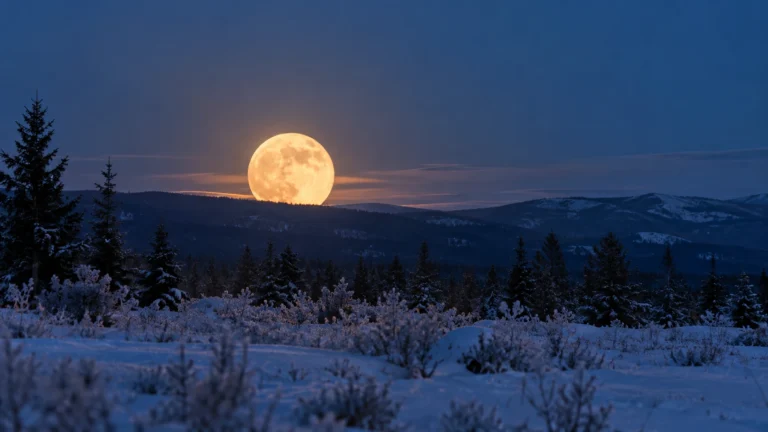
The night after the solstice is the longest of the year north of the equator: about 14 hours 45 minutes from sunset to sunrise in New York. This year it is not a dark one. On the evening of December 21 a waxing gibbous Moon, more than 90 percent lit, is already well up in the east by nightfall. It turns full at 01:28 UTC on December 24 (8:28 p.m. EST on December 23), per the Naval Observatory’s Moon phase data.
A full Moon sits opposite the Sun, so in midwinter it takes the high, long path the Sun has given up. In New York the December full Moon stays above the horizon for about 16 hours. The Cold Moon 2026 viewing windows cover when to catch it rising.
Pick your spot before December 14, photograph where the Sun goes down, and go back on December 21. If it sets behind the same rooftop a week later, you have watched the winter solstice 2026 happen.
How this was checked: the solstice time and Moon phases come from the US Naval Observatory. Sunrise, sunset, solar noon and Sun directions for each city were calculated with the PyEphem astronomy library using the Observatory’s rise and set definitions, then compared with timeanddate.com’s published tables. Earliest-sunset and latest-sunrise dates mark the middle of plateaus several days wide. Nothing here was observed on site. Last verified November 13, 2026.