

The Orionid meteor shower 2026 offers a shrinking window of moon-free darkness before dawn around its October peak. Knowing the peak is the easy part. The useful question this year is which hours are actually dark, because the moon reaches first quarter on October 18 and full on October 26. That puts a bright waxing gibbous in the sky across all of the best Orionid nights.
Your observing window opens when the moon sets and closes at astronomical dawn, and it loses roughly an hour every night as the peak approaches. From the mid-northern latitudes you get around three and a half usable hours on the morning of October 21, about two and a half on the morning of October 22, and less than two by the morning of October 23. By October 24, only a brief moon-free interval remains in the cities listed below.
How much moonlight, and when
Timeanddate’s 2026 lunar calendar lists new moon on October 10, first quarter on October 18, full moon on October 26 and last quarter on November 1. On the morning of October 21 the moon is about 74 percent lit. By the morning of October 22 it is 83 percent, and by the morning of October 23 it is 90 percent.
There is one piece of luck in that arrangement. A waxing moon sets during the night rather than rising during it, so the moonlight clears out of the way at the end of the night instead of arriving partway through. That matters, because the Orionid radiant is also highest at the end of the night. The dark hours you get are the good hours, not the leftovers.
The cost is that those hours are few, and they get fewer fast.
Your dark window, morning by morning
The table below gives the span when three conditions hold at once: the moon is below the horizon, the sun is more than 18 degrees below the horizon, and the Orionid radiant is at least 30 degrees up. Below about 30 degrees, the radiant is low enough that most of the shower’s meteors are cut off by the horizon, so the time is worth little even if the sky is dark.
| Morning of | New York (EDT) | London (BST) | Los Angeles (PDT) |
|---|---|---|---|
| Oct 19 | 1:10 to 5:40 (4.5 h) | 1:25 to 5:40 (4.2 h) | 1:05 to 5:40 (4.5 h) |
| Oct 20 | 1:10 to 5:40 (4.6 h) | 1:20 to 5:40 (4.3 h) | 1:20 to 5:40 (4.3 h) |
| Oct 21 | 2:05 to 5:40 (3.6 h) | 1:30 to 5:45 (4.2 h) | 2:20 to 5:40 (3.3 h) |
| Oct 22 | 3:10 to 5:45 (2.5 h) | 2:50 to 5:45 (3.0 h) | 3:20 to 5:40 (2.3 h) |
| Oct 23 | 4:20 to 5:45 (1.4 h) | 4:05 to 5:45 (1.7 h) | 4:25 to 5:40 (1.3 h) |
| Oct 24 | 5:25 to 5:45 (0.3 h) | 5:25 to 5:50 (0.4 h) | 5:30 to 5:40 (0.2 h) |
These are calculated positions for the city centers, rounded to five minutes. Moonset shifts by several minutes across a single time zone and more across a large state or country, so check the moonset time for your own location before you set an alarm. The pattern, though, holds anywhere in the mid-northern latitudes: an hour lost per night, and nothing left by October 24.
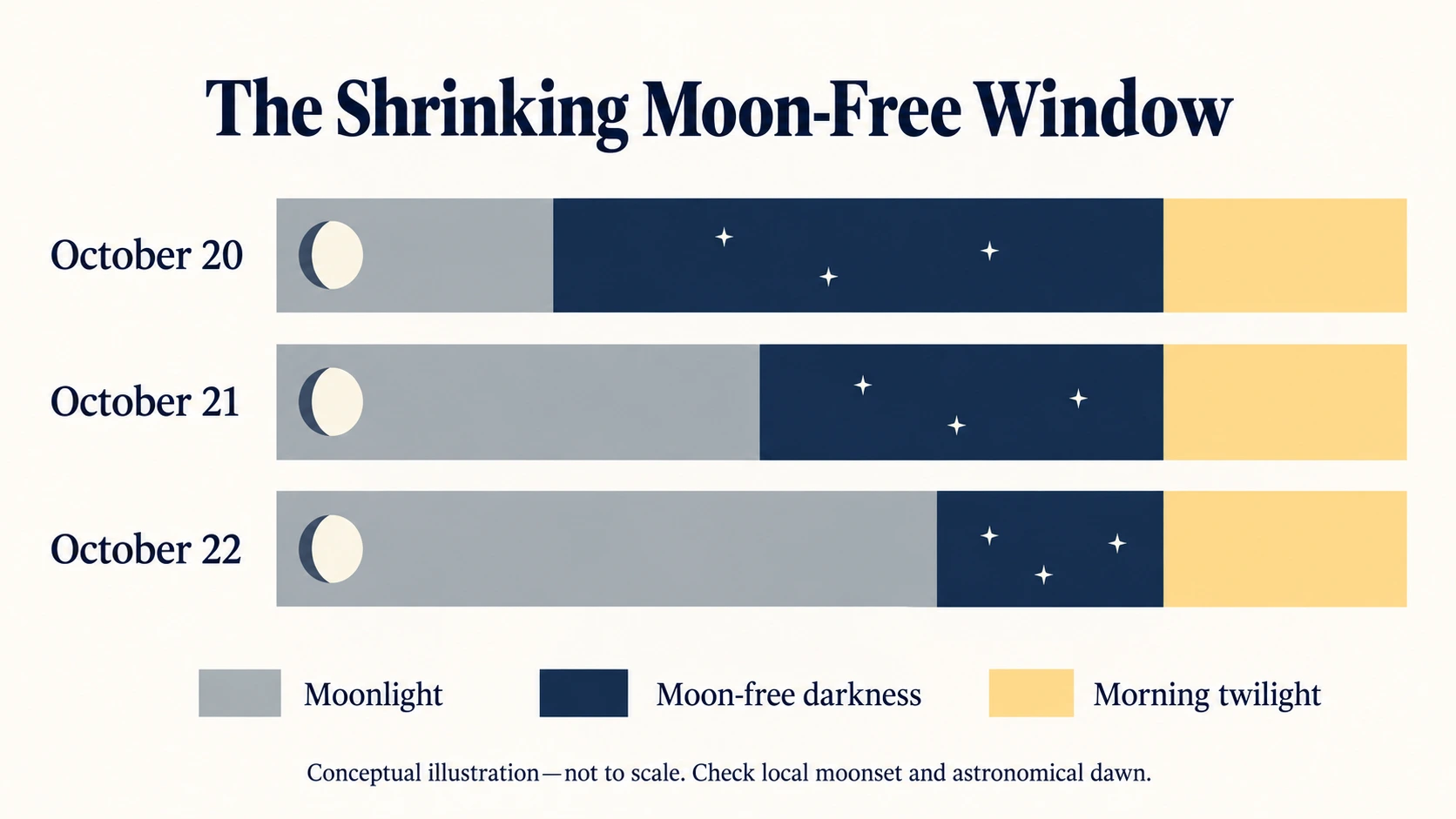
Southern hemisphere observers get a thinner deal. The radiant does not climb as high and the nights are shorter in late October, so from a latitude like Sydney’s the same three conditions leave only about an hour to an hour and a half on the mornings of October 21 and 22.
Notice what the moon does not cost you. On the mornings of October 19 and 20 the moon sets early enough that it takes nothing at all, and the window is limited by the radiant’s altitude instead. The moon only starts charging you on the morning of October 21.
Why the morning of October 21 is the best single bet
The nominal maximum lands at roughly 09:20 UT on October 21. That happens to fall inside the pre-dawn hours for North America, which is about as well as the timing could have worked out for readers there.
From New York, the observing window on the morning of October 21 runs from about 06:05 to 09:45 UT, so it closes right around the predicted peak. From Los Angeles the window runs from about 09:20 to 12:40 UT and opens essentially at the peak. From London it falls between about 00:30 and 04:45 UT, some five to nine hours before. Every one of those is closer to the maximum than the following morning, which sits roughly a full day past it.
So the morning of October 21 offers the closest approach to the peak and about an extra hour of darkness compared with the morning of October 22. That is a rare case where the two things a meteor watcher wants point at the same night.
Two honest caveats. First, the Orionids do not have a sharp peak. The IMO notes that the shower “may also provide several lesser maxima and sometimes the activity may be similar for several consecutive nights centred on the main peak,” which means a few hours either side of the predicted time is not the difference between success and failure. Second, predicted maxima for this shower have been wrong before in both directions, and the American Meteor Society lists the 2026 peak as the night of October 21 to 22 rather than a specific hour. Treat the timing as a tiebreaker, not a guarantee.
💡 Bottom Line: If you get one clear morning, take October 21. If you want more sky time and will accept slightly lower rates, the morning of October 20 gives you an extra hour of dark with the shower already close to full strength.
Where to look, and why not straight at the radiant
The radiant sits at right ascension 95 degrees, declination plus 16 degrees, which puts it just north of Betelgeuse in Orion’s raised arm. It clears the horizon in mid to late evening, and it keeps climbing until dawn. During the October 21 window it moves from about 42 degrees up at moonset to about 65 degrees by the time the sky starts to brighten.
Do not stare at it. NASA advises watching 45 to 90 degrees away from the radiant, because meteors that appear close to it are traveling almost straight toward you and leave very short trails. The long, bright ones show up well off to the side. Lie back, take in as much sky as your field of view allows, and let Orion sit at the edge of your attention rather than the center.
| Parameter | Value |
|---|---|
| Active period | October 2 to November 7 |
| Maximum | October 21, solar longitude 208 degrees |
| Zenithal hourly rate | 20 or more |
| Radiant | RA 95 degrees, Dec plus 16 degrees |
| Entry velocity | 66 km/s |
| Population index (r) | 2.5 |
| Parent body | Comet 1P/Halley |
One number in that table needs translating. The zenithal hourly rate of 20 is a normalized figure, not a forecast of what you will count. It describes what a single observer would see with the radiant directly overhead under a sky dark enough to show sixth-magnitude stars. Your radiant will be at 40 to 70 degrees, not 90, and few readers have a magnitude 6.5 sky. NASA puts the realistic figure at 10 to 20 meteors per hour under genuinely dark conditions at the peak. From a suburban site, or with any moon still up, expect fewer.
Halley’s other shower
Orionid meteors are grains shed by Comet 1P/Halley, which last passed through the inner solar system in 1986 and returns in 2061. Earth crosses the comet’s debris stream twice a year: once in May, producing the Eta Aquariids, and again in October for the Orionids.
They hit the atmosphere at 66 km/s, which is near the fast end of the range for meteor showers. Speed is what gives the Orionids their character. The meteors tend to be brief and thin rather than slow and dramatic, they frequently leave persistent trains that hang in the sky for a second or more after the meteor itself is gone, and the brightest occasionally reach fireball brightness.
Rates vary noticeably from year to year. The IMO records returns from 2006 to 2009 that produced unexpected rates of around 40 to 70, well above the usual level, while the average maximum across 2012 to 2020 sat in the range of 20 to 30. Radar data since 2002 hints at a roughly 12 year cycle in that variation, but the IMO is explicit that the available data does not settle the question. Nobody can tell you in advance whether 2026 will be an ordinary year or a good one.
Getting value out of two or three hours
A short window changes the arithmetic of preparation. Full dark adaptation takes about 30 minutes, and a single glance at a phone screen or a white flashlight resets much of it. When you have five hours, losing 20 minutes is an annoyance. When you have two and a half, it is a tenth of the whole night.
Practical consequences:
- Be outside and settled before the moon sets, not after. Use the last half hour of moonlight to get your eyes started, so the window opens with your vision already adapted.
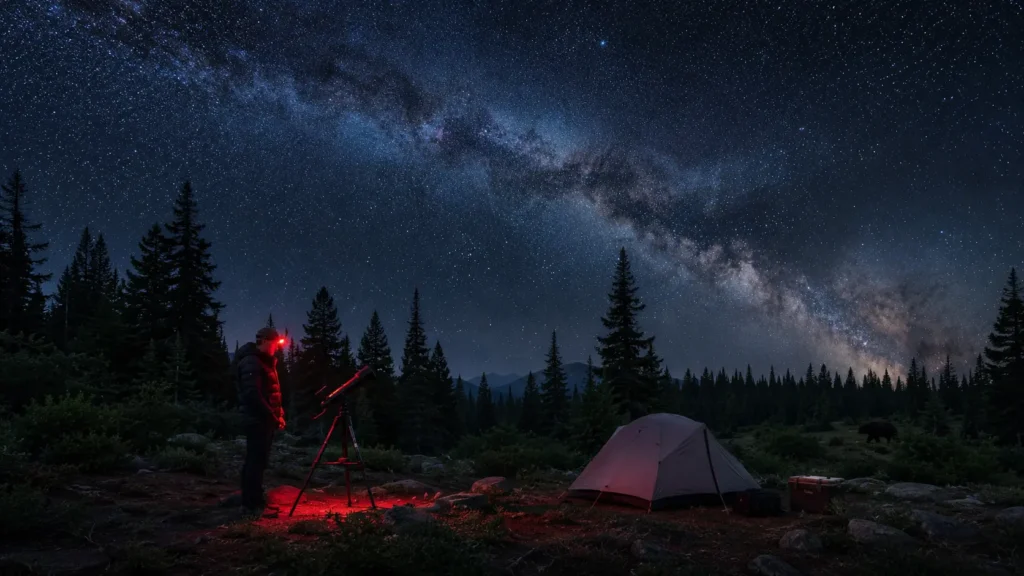
- Use red light only. This matters more this year than in a dark-moon year, for the reason above. Our guide to why a red headlamp preserves night vision covers what actually happens to your eyes and how dim the light needs to be.
- Commit to at least an hour of watching. Meteor rates are averages over time, and they arrive in clumps. Fifteen minutes tells you nothing.
- Site quality matters more when time is short. You cannot make up for a bright horizon by waiting longer, because there is no longer to wait.
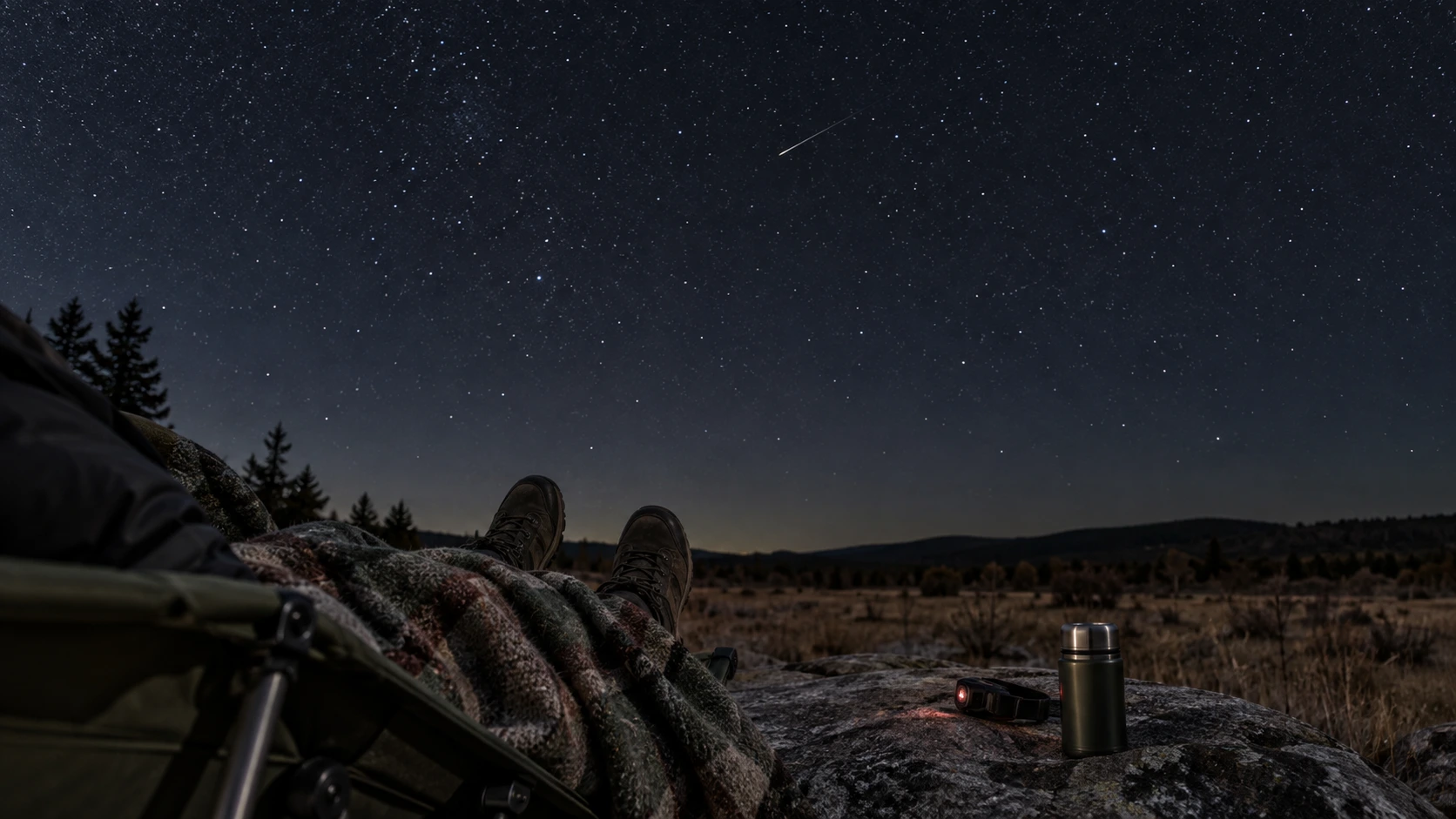
Get comfortable and stay warm. Late October pre-dawn temperatures do more to end meteor sessions early than clouds do.
If the sky is clouded over
The Orionids stay active until November 7, but the later nights are a poor consolation. Rates fall away steadily after the maximum, and the moon is full on October 26 and remains above the horizon through the pre-dawn hours well into the first days of November. By the time a thin waning crescent leaves the early morning genuinely dark, in the first week of November, there is very little shower left to see.
That makes the practical Orionid season for 2026 narrower than the official activity dates suggest: roughly the mornings of October 19 through October 23, with the middle of that range doing most of the work. If all five are clouded out where you are, the honest answer is that this year did not cooperate, and the Leonids follow in mid-November.
Sky positions, moonset times and twilight times in this article were calculated for the listed locations. Shower parameters are from the International Meteor Organization’s 2026 Meteor Shower Calendar and NASA. Verified October 2026 dates as of September 3, 2026.